
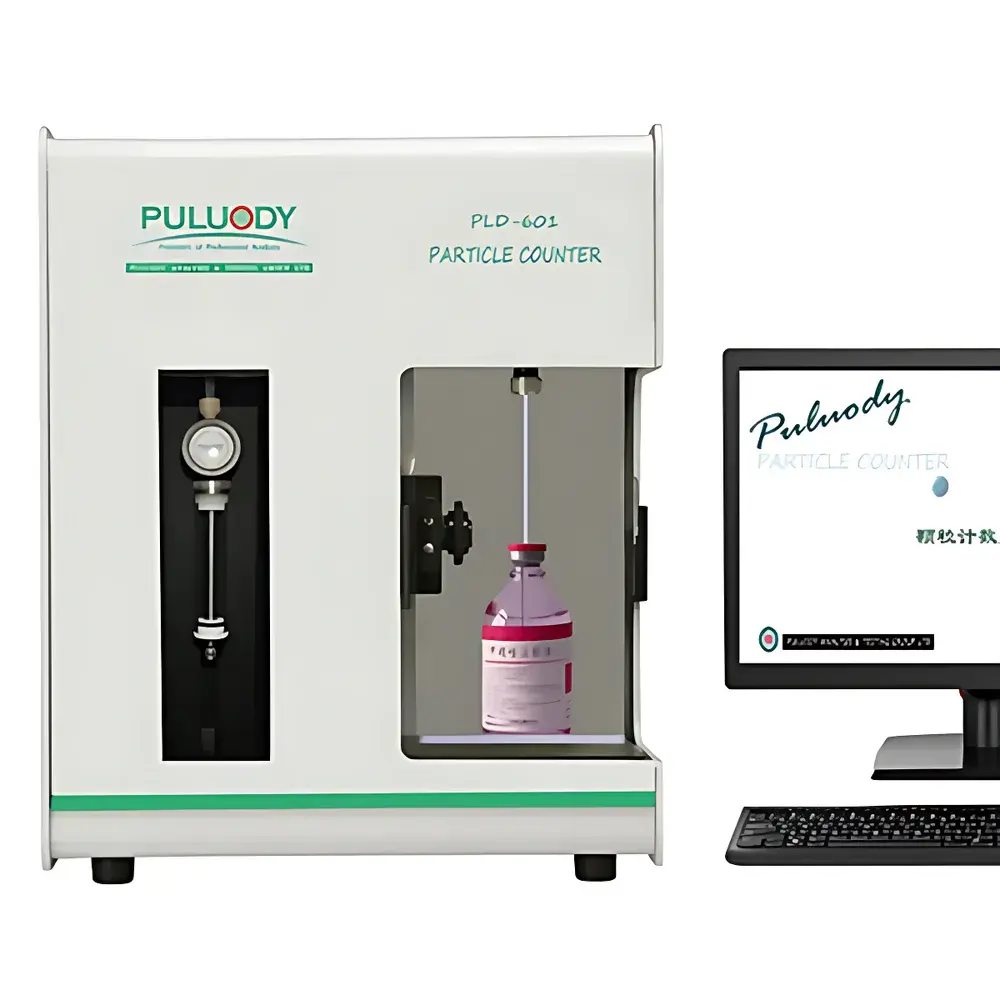
PULUODY PLD-601J Pharmaceutical Stopper Insoluble Particle Analyzer
| Brand | PULUODY |
|---|---|
| Origin | Shaanxi, China |
| Model | PLD-601J |
| Instrument Type | Optical Light-Blockage Particle Counter |
| Detection Principle | Light Obscuration (LO) / Single-Particle Optical Sizing (SPOS) |
| Sensor Generation | 8th-Generation Dual-Laser Narrow-Beam Particle Sensor |
| Flow Control | Precision Metering Plunger Pump + Ultra-Precise Electromagnetic Flow Control System |
| Software Compliance | FDA 21 CFR Part 11, Audit Trail, Electronic Signature, Role-Based 5-Tier User Access |
| Calibration Standards | ISO 21501-4, JJG 1061, NIST-Traceable Latex Spheres |
| Channel Resolution | 1000 Adjustable Channels (Down to 0.01 µm), Configurable Size Ranges (e.g., 1–100 µm, 4–70 µm(c), 0.1 µm(c)) |
| Measurement Range | 1–450 µm (Extended Options: 0.03–3000 µm) |
| Sample Flow Rate | 5–150 mL/min |
| Rinse Flow Rate | 5–500 mL/min |
| Temperature Range (Fluid) | 0–80 °C |
| Ambient Operating Range | −15–50 °C |
| Accuracy | ±5% typical (per ChP 2020 & USP <788>) |
| Repeatability | <2.5% coincidence error at 1000 particles/mL |
| Resolution | >95% (ChP-calibrated), >90% (ISO 21501-4 calibrated) |
| Regulatory Alignment | ChP 0903 (2015/2020), USP <788>, <789>, <797>, EP 10.0, BP 2019, JP 17, WHO IntPh IV, YBB00272004-2015, GB 8368, ISO 21510, ISO 11171, NAS 1638, ISO 4406 |
Overview
The PULUODY PLD-601J Pharmaceutical Stopper Insoluble Particle Analyzer is a regulatory-grade optical light-obscuration (LO) particle counter engineered for quantitative analysis of insoluble particulate matter in parenteral drug products and pharmaceutical packaging components. Designed in strict alignment with global pharmacopoeial requirements—including Chinese Pharmacopoeia (ChP) Volume IV, General Chapter 0903 (2015 & 2020 editions), United States Pharmacopeia (USP) <788>, <789>, and <797>, European Pharmacopoeia (EP) 10.0, and Japanese Pharmacopoeia (JP) 17—the instrument implements the light-blockage principle to detect and size individual particles suspended in liquid media. Its core sensor is an 8th-generation dual-laser narrow-beam detection module, delivering high signal-to-noise ratio and minimal optical diffraction interference across sub-micron to coarse particle ranges. The system is validated for use in GMP-compliant environments, supporting critical quality attribute (CQA) assessment of rubber stoppers, infusion sets, IV bags, vials, syringes, and other primary packaging materials where extractable/leachable particulates pose sterility or safety risks.
Key Features
- 8th-generation dual-laser narrow-beam sensor architecture enabling stable, low-noise detection from 0.01 µm (configurable) to 450 µm—with extended-range options up to 3000 µm available upon specification.
- Dual-mode flow control: precision metering plunger pump (±1% volumetric accuracy) combined with ultra-fast electromagnetic flow regulation ensures consistent sample delivery and minimizes pulsation-induced counting artifacts.
- 1000-channel high-resolution sizing capability—fully programmable channel boundaries allow granular compliance mapping against multiple pharmacopoeial thresholds (e.g., ≥10 µm, ≥25 µm per ChP/USP; ≥4 µm(c), ≥70 µm(c) per EP).
- FDA 21 CFR Part 11-compliant software suite (V8.9) featuring role-based 5-tier user permissions, full audit trail logging, electronic signatures, automated data backup/recovery, and power-failure recovery protocols.
- Integrated validation support: preconfigured calibration routines aligned with ISO 21501-4, JJG 1061, and NIST-traceable latex sphere standards; certified calibration services available via National Northwest Metrology Testing Center (CNAS-accredited) and DIFC Grade I Particle Metrology Station No. 116.
- Wide operational flexibility: fluid temperature range 0–80 °C enables testing of heat-stable formulations; ambient operating range −15–50 °C supports deployment in QC labs, cleanrooms, and warehouse environments.
Sample Compatibility & Compliance
The PLD-601J is validated for direct analysis of diverse pharmaceutical liquids and extracts without filtration or dilution—provided viscosity remains within instrument hydrodynamic limits (<20 cP). Compatible matrices include: sterile aqueous injection solutions, lyophilized powder reconstitutes, concentrated injectables, ophthalmic solutions, vaccines, Water for Injection (WFI), Purified Water (PW), and pharmaceutical-grade elastomeric stopper extracts (per YBB00272004-2015). It also supports terminal filter challenge studies (e.g., 0.22 µm PVDF or PES filters) to quantify particle removal efficiency and assess filter integrity. All test methods are traceable to ISO/IEC 17025-accredited reference procedures. The system meets GLP/GMP documentation requirements for regulated submissions, including raw data archiving, metadata capture (operator, timestamp, instrument ID, method version), and change-controlled software updates.
Software & Data Management
The V8.9 analytical software provides a bilingual (English/Chinese) GUI with intuitive touchscreen navigation and optional wireless keyboard/mouse operation. It supports fully customizable reporting templates compliant with ALCOA+ principles: Attributable, Legible, Contemporaneous, Original, Accurate, Complete, Consistent, Enduring, and Available. Each measurement session generates a structured XML-based audit record containing full parameter history, calibration logs, raw pulse data, and statistical summaries (mean, SD, CV%, cumulative counts). Data export formats include CSV, PDF, and secure encrypted .pda archives. Backup restoration preserves all method configurations, user profiles, and historical datasets—enabling seamless instrument migration or disaster recovery. Remote diagnostics and firmware updates are supported via secure TLS-encrypted connection.
Applications
- Pharmaceutical Quality Control: Quantification of insoluble particles in rubber stoppers, flip-off caps, IV tubing, and prefilled syringe plungers per YBB00272004-2015 and GB 8368.
- Parenteral Product Release Testing: Routine batch verification of injectables against ChP 0903, USP <788>, and EP 2.9.19 acceptance criteria.
- Water System Monitoring: Continuous or grab-sample assessment of WFI, PW, and ultrapure water in biomanufacturing facilities per ASTM D5127 and ISO 14644-1 cleanliness classifications.
- Electronics & Semiconductor: Slurry contamination monitoring in CMP processes, wafer rinse water analysis, and photoresist purity verification.
- Chemical & Materials R&D: Nanoparticle dispersion stability studies, inkjet ink qualification, lubricant cleanliness grading (NAS 1638, ISO 4406), and catalyst slurry homogeneity evaluation.
- Medical Device Validation: Extractables testing of silicone tubing, dialysis membranes, and blood-contacting components under simulated use conditions.
FAQ
Does the PLD-601J comply with FDA 21 CFR Part 11 for electronic records and signatures?
Yes. The V8.9 software implements full Part 11 functionality—including user authentication, audit trail generation, electronic signature workflows, and data integrity safeguards such as write-protection and immutable archival.
Can the instrument be calibrated to ISO 21501-4 for international regulatory submissions?
Absolutely. Calibration is performed using NIST-traceable polystyrene latex spheres per ISO 21501-4 Annex B, with full calibration certificates issued by CNAS-accredited laboratories.
Is method transfer supported between different PLD-601J units in multi-site manufacturing networks?
Yes. Method files—including channel definitions, threshold settings, and report templates—are portable across instruments. Cross-unit reproducibility is maintained through standardized sensor characterization and flow calibration protocols.
What maintenance intervals are recommended for GMP environments?
Daily system flush, weekly optical path inspection, and quarterly full metrological verification are advised. Preventive maintenance kits and service contracts are available through PULUODY’s authorized service centers.
Can the PLD-601J analyze viscous or non-aqueous solvents?
It supports low-viscosity organic solvents (e.g., ethanol, isopropanol, propylene glycol blends) up to ~20 cP. For higher viscosities, optional heated flow cells and solvent-compatible wetted materials (e.g., sapphire capillaries, PEEK manifolds) can be specified.



