
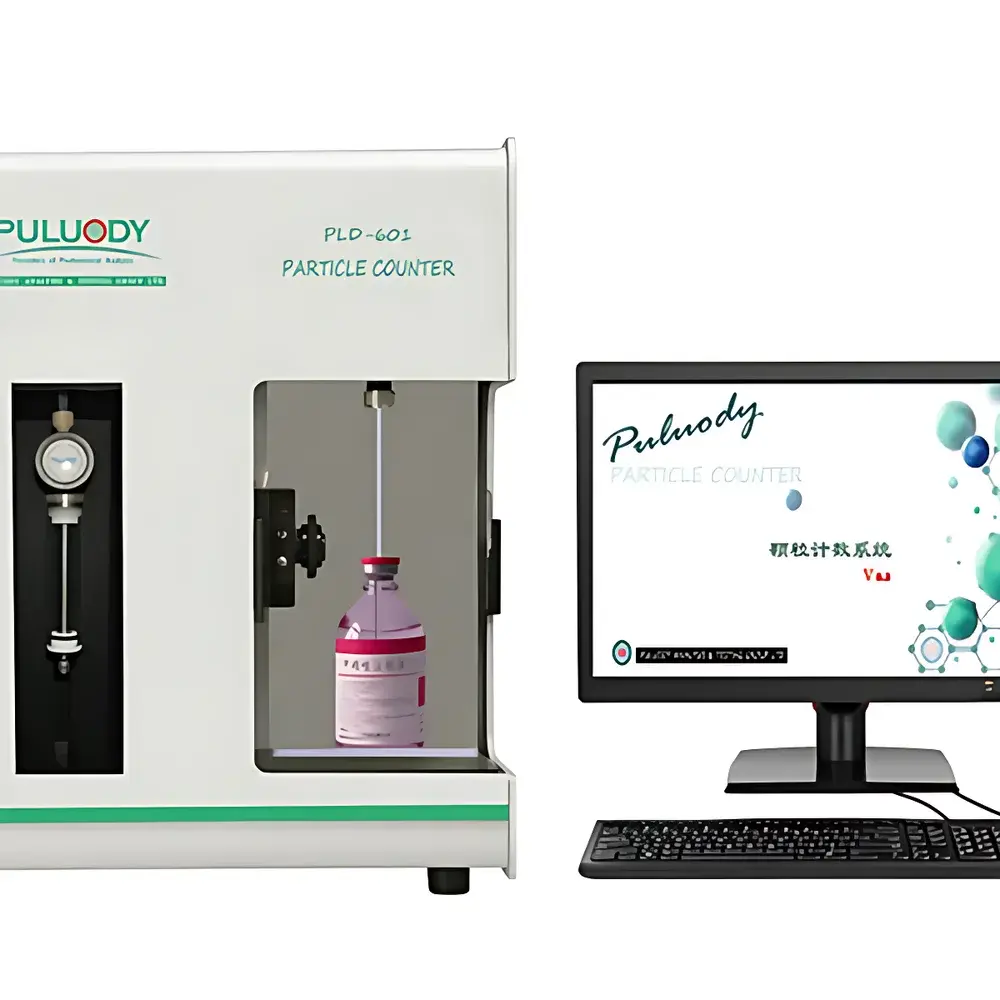
PULUODY PLD-601Q Optical Particle Counter for Insoluble Particulate Matter in Single-Use Infusion Sets
| Brand | PULUODY |
|---|---|
| Model | PLD-601Q |
| Instrument Type | Optical Particle Counter |
| Detection Principle | Light Obscuration (LO) / Dual-Laser Narrow-Beam Sensor |
| Measurement Range | 1–450 µm (optional extension to 0.03–3000 µm) |
| Channel Resolution | 1000 adjustable channels (down to 0.01 µm bin width) |
| Sampling Flow Rate | 5–150 mL/min |
| Rinse Flow Rate | 5–500 mL/min |
| Accuracy | ±5% typical (per USP <788>, ISO 21501-4, ChP 2020) |
| Coincidence Limit | ≤5% at 1000 particles/mL |
| Temperature Range (Fluid) | 0–80 °C |
| Compliance | FDA 21 CFR Part 11, GMP/GLP audit trail, USP <788>/<789>, EP 10.0, ChP 0903, GB/T 11446.9–2013, GB 8368, ISO 21501-4, ISO 11171, NAS 1638 |
Overview
The PULUODY PLD-601Q Optical Particle Counter is a regulatory-grade, light obscuration (LO)-based instrument engineered for the quantitative detection and size-resolved enumeration of insoluble particulate matter in parenteral pharmaceuticals and medical devices. It operates on the principle of dual-laser narrow-beam particle sensing—where suspended particles passing through a precisely collimated optical detection zone interrupt incident laser light, generating pulse signals proportional to cross-sectional area. These pulses are converted into calibrated particle counts per predefined size thresholds across 1000 programmable channels, enabling full compliance with pharmacopoeial requirements for injectables, infusion sets, ophthalmic solutions, vaccines, sterile APIs, and medical packaging materials. Designed specifically for quality control laboratories operating under cGMP, ISO 13485, and FDA-regulated environments, the PLD-601Q meets the stringent physical measurement demands of USP <788>, USP <789>, ChP 0903 (2015 & 2020 editions), EP 10.0, and ISO 21501-4 for optical particle counting.
Key Features
- Dual-laser narrow-beam sensor (8th-generation proprietary design) delivering high signal-to-noise ratio and improved discrimination of sub-2 µm particles in viscous or low-conductivity matrices.
- Dual-precision fluidic control system integrating a precision metering piston pump and ultra-stable electromagnetic flow regulation, ensuring volumetric accuracy better than ±1% and repeatability <±5% per USP/ChP validation protocols.
- 1000-channel resolution architecture supporting user-defined binning from 0.01 µm upward—enabling full alignment with >510 international standards including NAS 1638, ISO 4406, SAE AS4059, and pharmacopoeial reporting formats.
- FDA 21 CFR Part 11-compliant software suite (V8.9) with five-tier role-based access control, electronic signatures, immutable audit trails, automatic data backup/recovery, and power-fail recovery logic.
- Integrated calibration traceability via NIM-certified reference standards (JJG 1061), ISO 21501-4–compliant polystyrene latex (PSL) spheres, or certified reference materials from accredited third-party metrology institutes including the National Northwest Metrology Center and DFCCM Grade I Particle Calibration Station No. 116.
- Touchscreen-driven operation with bilingual (English/Chinese) GUI, configurable report templates, and direct export to CSV, PDF, and LIMS-compatible XML formats.
Sample Compatibility & Compliance
The PLD-601Q is validated for use with a broad spectrum of liquid samples requiring particulate contamination assessment: sterile aqueous solutions (e.g., WFI, purified water, dialysis fluids), lyophilized reconstituted powders, ophthalmic suspensions, vaccine formulations, silicone oil–lubricated syringes, IV tubing assemblies, terminal filter challenge studies, and polymer-based medical packaging extracts. It supports both standard pharmacopoeial test modes (e.g., membrane filtration followed by extract analysis per GB 8368) and direct-sampling protocols compliant with USP <788> Method 1 (light obscuration). All hardware and firmware configurations adhere to ISO/IEC 17025–aligned verification practices and support full 21 CFR Part 11 implementation—including electronic record retention, change control logs, and periodic review of audit trails during regulatory inspections.
Software & Data Management
The embedded V8.9 analytical software provides full lifecycle data governance: automated calibration verification, real-time pass/fail flagging against configurable limits (e.g., ChP 0903 Class A/B/C thresholds), dynamic channel mapping for custom particle size reporting, and statistical process monitoring (SPC) charts. Raw pulse data, event logs, operator actions, and environmental metadata (fluid temperature, ambient conditions) are permanently archived with cryptographic hashing. The system generates electronic audit reports compliant with ALCOA+ principles (Attributable, Legible, Contemporaneous, Original, Accurate) and supports integration with enterprise LIMS, MES, and QMS platforms via secure RESTful API or ODBC drivers. All software updates undergo formal change control and are documented per ICH Q9/Q10 guidelines.
Applications
- Pharmaceutical QC: Quantitative particulate testing of injectables, biologics, and sterile raw materials per USP <788>, EP 2.9.19, and ChP 0903.
- Medical device evaluation: Filter efficiency validation for IV sets, spike filters, and infusion pumps; extractables/leachables particulate screening per ISO 10993-12.
- Water purity monitoring: Solid particle contamination profiling in ultrapure water (UPW), semiconductor process water, and pharmaceutical water systems per ASTM D5127 and ISO 14644-1.
- Electronics manufacturing: Slurry cleanliness verification for CMP processes, wafer rinse water, and photoresist carriers.
- Industrial hygiene: Nanomaterial dispersion stability, lubricant degradation tracking, and cleaning agent residue quantification in critical component wash cycles.
FAQ
Does the PLD-601Q comply with FDA 21 CFR Part 11 requirements for electronic records and signatures?
Yes—the system implements full Part 11 functionality including role-based authentication, audit trail generation, electronic signature capture, and data integrity safeguards aligned with Annex 11 and PIC/S guidance.
Can the instrument be calibrated and verified by an accredited third-party metrology institute?
Yes—it is routinely validated by China’s National Northwest Metrology Testing Center and DFCCM Grade I Particle Calibration Station No. 116, with full traceability to SI units per ISO/IEC 17025.
What pharmacopoeial standards does the PLD-601Q natively support without customization?
USP <788>, USP <789>, ChP 0903 (2015 & 2020), EP 10.0, JP XVII, BP 2019, and ISO 21501-4 are preconfigured in the software with auto-generated compliance reports.
Is it possible to adjust the lower detection limit below 1 µm?
Yes—through optional optical configuration and PSL calibration, the system supports validated detection down to 0.03 µm using extended-range sensor modules (subject to application-specific qualification).
How is sample carryover minimized between runs?
The system employs programmable high-flow rinse cycles (5–500 mL/min), integrated ultrasonic degassing, and inert fluid path materials (316L SS + PFA) to achieve <0.01% residual carryover per ISO 21501-4 verification protocol.



