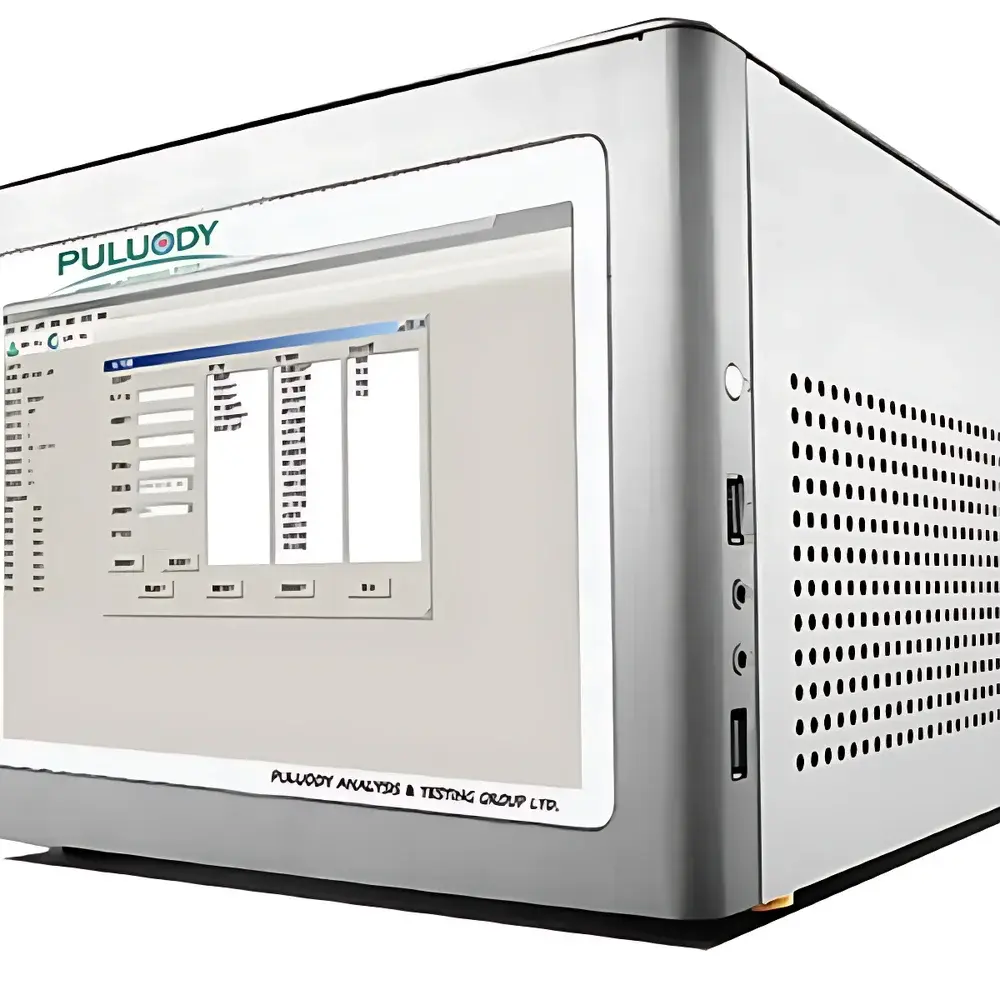
PULUODY PMT-2PB PCB Liquid Particle Counter
| Brand | PULUODY |
|---|---|
| Model | PMT-2PB |
| Detection Principle | Dual-Laser Narrow-Beam Light Scattering |
| Sensor Generation | 8th-Generation Dual-Laser Optical Sensor |
| Measurement Range | 0.1–0.5 µm & 0.5–20.0 µm (customizable to 1–100 µm or 4–70 µm(c) |
| Sampling Method | Precision Metering Piston Pump |
| Flow Control | Dual-Stage Electromagnetic Flow Regulation |
| Accuracy | ±3% typical |
| Sampling Precision | <±1% |
| Coincidence Limit | ≤2.5% error at 1000 particles/mL |
| Output | 4–20 mA analog signal with configurable particle-exceedance alarm |
| Data Interface | iPad-compatible wireless data acquisition system |
| Software | V8.3 Integrated Analysis & Calibration Software (PC + embedded touchscreen version) |
| Calibration Standards | JJG 1061, ISO 21501-4, NIST-traceable latex sphere reference |
| Compliance | Supports GLP/GMP audit trails, FDA 21 CFR Part 11–ready software architecture (user authentication, electronic signatures, change control logs) |
| Display & Control | 7-inch color LCD touchscreen + optional wireless keyboard/mouse |
| Power Input | 100–265 VAC, 50–60 Hz |
| Application Scope | Semiconductor cleaning fluids, ultrapure water (UPW), photomasks, silicon wafers, flat-panel display substrates, PCB etchants & rinsates, nano/microfiltration effluents, polymer solutions, and insoluble particulate analysis in organic solvents |
Overview
The PULUODY PMT-2PB PCB Liquid Particle Counter is an advanced optical particle counting instrument engineered for high-sensitivity contamination monitoring in critical microelectronics manufacturing environments. It employs dual-laser narrow-beam light scattering — a proven principle rooted in Mie theory — to detect and size non-volatile suspended particles in low-conductivity, low-viscosity liquids such as semiconductor process chemicals, deionized water (DIW), ultrapure water (UPW), photoresist developers, and post-etch rinse solutions. Unlike single-wavelength systems, the 8th-generation dual-laser sensor mitigates refractive index dependency and improves sizing fidelity across heterogeneous particle populations, especially sub-micron contaminants (0.1 µm(c) detection capability) that directly impact wafer yield and thin-film integrity. Designed for integration into Class 100 cleanroom workflows, the PMT-2PB delivers trace-level particle quantification essential for meeting SEMI F57, ASTM D6978, and IEST-STD-CC1246D cleanliness specifications.
Key Features
- Dual-laser narrow-beam optical detection system optimized for high-resolution discrimination of particles from 0.1 µm(c) to 20.0 µm — with optional extended ranges up to 100 µm
- Precision metering piston pump coupled with electromagnetic flow regulation ensures repeatable volumetric sampling (<±1% precision) and minimizes pulsation-induced counting artifacts
- Embedded V8.3 analysis software with physically separated calibration and measurement modules — eliminating cross-talk between reference standardization and real-time analysis
- Configurable analog output (4–20 mA) with programmable threshold alarms for automated process interlock signaling in inline monitoring applications
- 7-inch industrial-grade capacitive touchscreen interface with optional wireless keyboard/mouse support for glove-compatible operation in cleanroom settings
- FDA 21 CFR Part 11–compliant software architecture including role-based user access, electronic signature capture, and immutable audit trail generation
Sample Compatibility & Compliance
The PMT-2PB is validated for use with a broad spectrum of process-critical fluids including but not limited to: ammonium hydroxide (NH₄OH), hydrogen peroxide (H₂O₂), sulfuric acid (H₂SO₄), hydrofluoric acid (HF)-based etchants, photoresist strippers, UPW (resistivity ≥18.2 MΩ·cm), and polymer solutions used in spin-coating processes. It conforms to ISO 21501-4 for light-scattering particle counter performance verification and supports calibration traceability to NIST-certified latex standards per JJG 1061. The instrument meets mechanical and electrical safety requirements under IEC 61010-1 and is compatible with GLP and GMP documentation frameworks through its integrated electronic recordkeeping system.
Software & Data Management
The V8.3 software suite operates in dual-mode: embedded firmware for standalone operation and PC-hosted application for advanced statistical reporting. It enables real-time histogram generation, cumulative/differential distribution plots, trend analysis over time-series batches, and automatic conversion to ISO 4406 or NAS 1638 contamination codes. All calibration events, user actions, and measurement logs are timestamped and cryptographically signed. Raw scatter pulse data is retained for retrospective reanalysis without loss of resolution. iPad integration allows remote supervision via secure Wi-Fi — supporting decentralized quality control across multiple fab bays without network infrastructure overhaul.
Applications
- In-line monitoring of chemical delivery systems for semiconductor front-end processes (e.g., CMP slurry lines, wet bench recirculation loops)
- Offline verification of UPW loop integrity and filter efficiency in fab utility plants
- Contamination assessment of PCB fabrication chemistries including solder mask inks, electroless copper baths, and desmear solutions
- Validation of nano/microfiltration membrane performance in ultrapure solvent purification skids
- Insoluble particulate testing of polymer solutions per USP <788> and Ph. Eur. 2.9.19 for electronic-grade packaging materials
- Cleanliness qualification of flat-panel display substrates and touch sensor glass prior to coating
FAQ
Can the PMT-2PB be used for organic solvents such as acetone or IPA?
Yes — the fluidic path is constructed from chemically inert materials (e.g., PFA, sapphire, fused silica), enabling compatibility with common semiconductor-grade organics when configured with appropriate wetted material options.
Does the system support automated calibration verification during routine operation?
Yes — the V8.3 software includes scheduled auto-check routines using internal reference beads, with pass/fail status logged to the audit trail.
Is it possible to integrate the 4–20 mA output with a DCS or SCADA system?
Yes — the analog output is isolated and configurable for any particle size channel or total count mode, with user-defined alarm thresholds mapped to discrete digital outputs.
How does the dual-laser design improve accuracy compared to single-laser counters?
Dual-wavelength interrogation reduces Mie resonance artifacts and enhances sizing linearity across diverse refractive indices (e.g., SiO₂ vs. metallic residues), particularly below 0.5 µm where conventional sensors exhibit significant bias.
What documentation is provided for regulatory audits?
A full IQ/OQ protocol package, calibration certificate traceable to NIST, software validation summary (including Part 11 compliance evidence), and raw data export capability in CSV and PDF formats are supplied with each unit.