
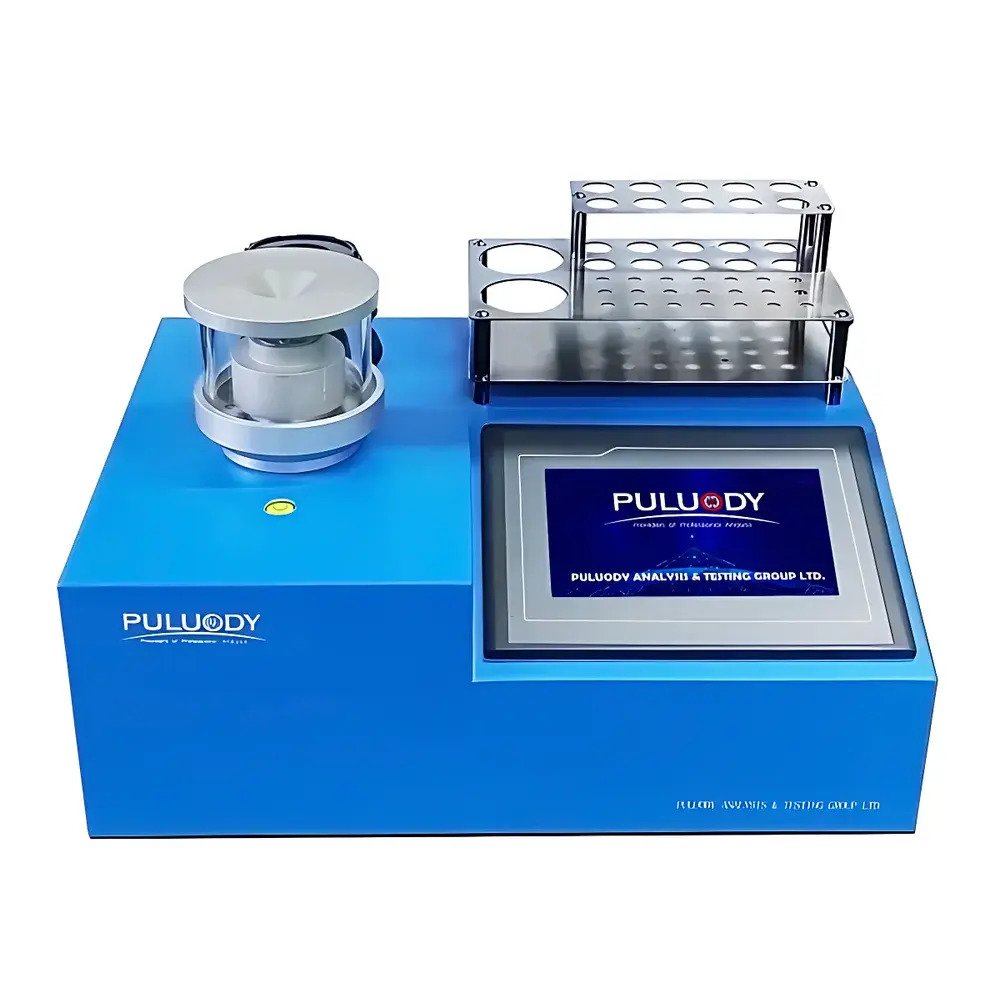
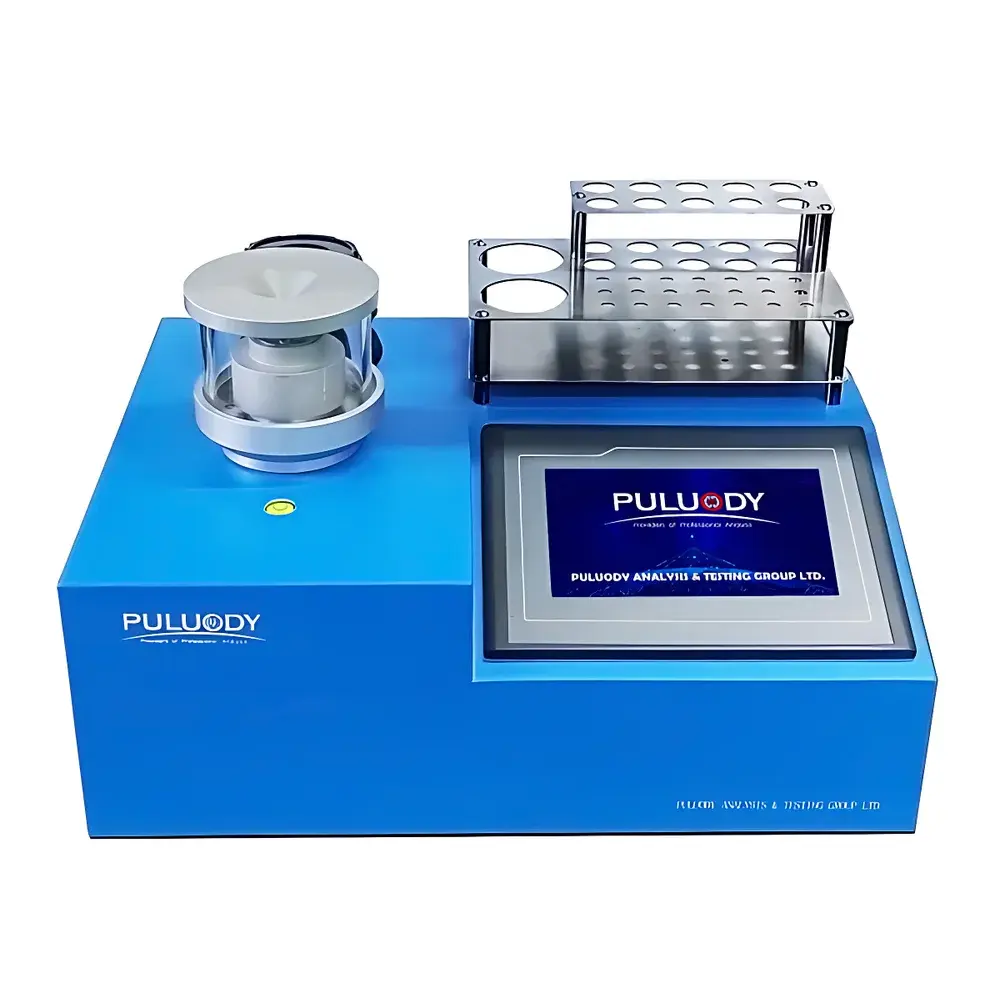
PULUODY PRF-III Rotational Ferrograph System
| Brand | PULUODY |
|---|---|
| Origin | Shaanxi, China |
| Manufacturer Type | Original Equipment Manufacturer (OEM) |
| Country of Manufacture | China |
| Model | PQ-2A |
| Price | USD 64,500 (FOB China) |
Overview
The PULUODY PRF-III Rotational Ferrograph System is a precision-engineered oil debris analysis instrument designed for quantitative and qualitative ferrographic assessment of wear particles in lubricants and hydraulic fluids. It operates on the principle of high-gradient magnetic sedimentation—leveraging a controlled, rotating magnetic field to separate ferromagnetic and paramagnetic wear debris by size and magnetic susceptibility. As the oil sample rotates over a glass substrate positioned within a precisely calibrated magnetic field, particles migrate radially and deposit in concentric annular zones: large particles (>10 µm) settle in the inner ring, medium particles (5–10 µm) in the middle ring, and fine particles (<5 µm) in the outer ring. This spatially resolved deposition enables systematic morphological, dimensional, and concentration-based characterization under optical or electron microscopy—providing actionable insights into wear mechanisms, component degradation modes, and incipient mechanical failure.
Key Features
- Triple-ring deposition architecture enabling simultaneous analysis of coarse, medium, and fine wear debris with minimal particle overlap
- Magnetic head delivering adjustable field strength from 100–1000 Gs, with operational stability ≥600 Gs at the deposition zone
- High-precision rotational control: programmable speeds of 70 rpm (deposition), 150 rpm (washing), and 200 rpm (drying), each independently selectable
- Radial and axial magnetic head runout ≤ ±100 µm—ensuring consistent field geometry and inter-run reproducibility
- 360° isotropic particle distribution across ≥50 mm² effective deposition area; inner ring coverage ≥10 mm²
- Quantitative reproducibility: <8% mean deviation across eight microscope fields (qualitative mode); <12% across four fields (quantitative mode)
- Linear photodensity response (0–55% OD range) correlating directly with ferrous debris mass concentration (0–3000 ppm oil contamination)
- Integrated tactile control panel with LED digital display showing real-time speed and elapsed time for each phase
Sample Compatibility & Compliance
The PRF-III accommodates a broad spectrum of petroleum-based and synthetic lubricants—including mineral oils, turbine oils, gear oils, hydraulic fluids, greases, coolants, and fuels—without requiring solvent dilution or pre-filtration. Its design conforms to ASTM D7690 (Standard Practice for Ferrographic Analysis of Wear Debris), ISO 4406 (fluid cleanliness coding), and supports alignment with ISO 17359 (condition monitoring and diagnostics of machines). While not inherently 21 CFR Part 11 compliant, the system interfaces seamlessly with validated third-party image acquisition and analysis software packages that support audit trails, electronic signatures, and data integrity controls required under GLP/GMP environments.
Software & Data Management
The PRF-III functions as a hardware platform integrated with dedicated digital imaging and ferrographic quantification software. The system captures high-resolution images via a USB 3.0 digital camera coupled to a dual-light (brightfield/darkfield) metallurgical microscope. Software modules enable automated particle recognition, size classification (by equivalent circular diameter), shape factor calculation (e.g., aspect ratio, roundness), and spectral density mapping across all three deposition rings. Export formats include CSV, TIFF, and PDF reports compliant with internal QA documentation workflows. Raw image archives are timestamped and metadata-tagged (oil type, viscosity, sampling date, machine ID), supporting traceability in predictive maintenance databases.
Applications
This ferrograph is widely deployed in asset-intensive industries where early detection of mechanical wear prevents catastrophic failure. In coal mining, it monitors shearer drums, belt conveyors, and hoist gearboxes. In power generation, it supports condition-based maintenance of hydro-turbine governors and steam turbine lube systems. Steel mills use it to assess rolling mill bearing health; cement plants apply it to kiln drive trains and vertical roller mills. Marine applications include main engine crankcase oil surveillance and propulsion gearbox diagnostics. Aerospace MRO facilities employ it for auxiliary power unit (APU) oil analysis during depot-level overhaul. The system is especially effective for low-speed, high-torque equipment where vibration-based monitoring lacks sensitivity to incipient surface fatigue or adhesive wear.
FAQ
What types of wear particles can the PRF-III detect?
It detects ferromagnetic and weakly magnetic particles (e.g., iron, steel, nickel alloys) ranging from submicron to >100 µm. Non-ferrous particles (e.g., copper, aluminum, lead) may be co-deposited but require supplemental EDX or EDS analysis for identification.
Is calibration required before each analysis?
No routine recalibration is needed; however, daily verification using certified reference oil samples (e.g., ISO UFT 12/13/14) is recommended to ensure photometric linearity and deposition fidelity.
Can the PRF-III be integrated into an enterprise CMMS or SAP PM module?
Yes—via standardized CSV/XML output and optional OPC UA or REST API middleware, enabling direct ingestion of ferrographic metrics (e.g., large particle count, severity index) into reliability-centered maintenance platforms.
What is the minimum required oil sample volume?
1.5 mL of undiluted oil is sufficient for full-spectrum deposition; larger volumes (up to 5 mL) improve statistical confidence for low-concentration samples.
Does the system support automated particle counting without manual microscopy?
Yes—the bundled image analysis software includes AI-assisted segmentation and classification algorithms trained on >20,000 labeled wear particle images, reducing operator dependency while maintaining ASTM-aligned reporting thresholds.






