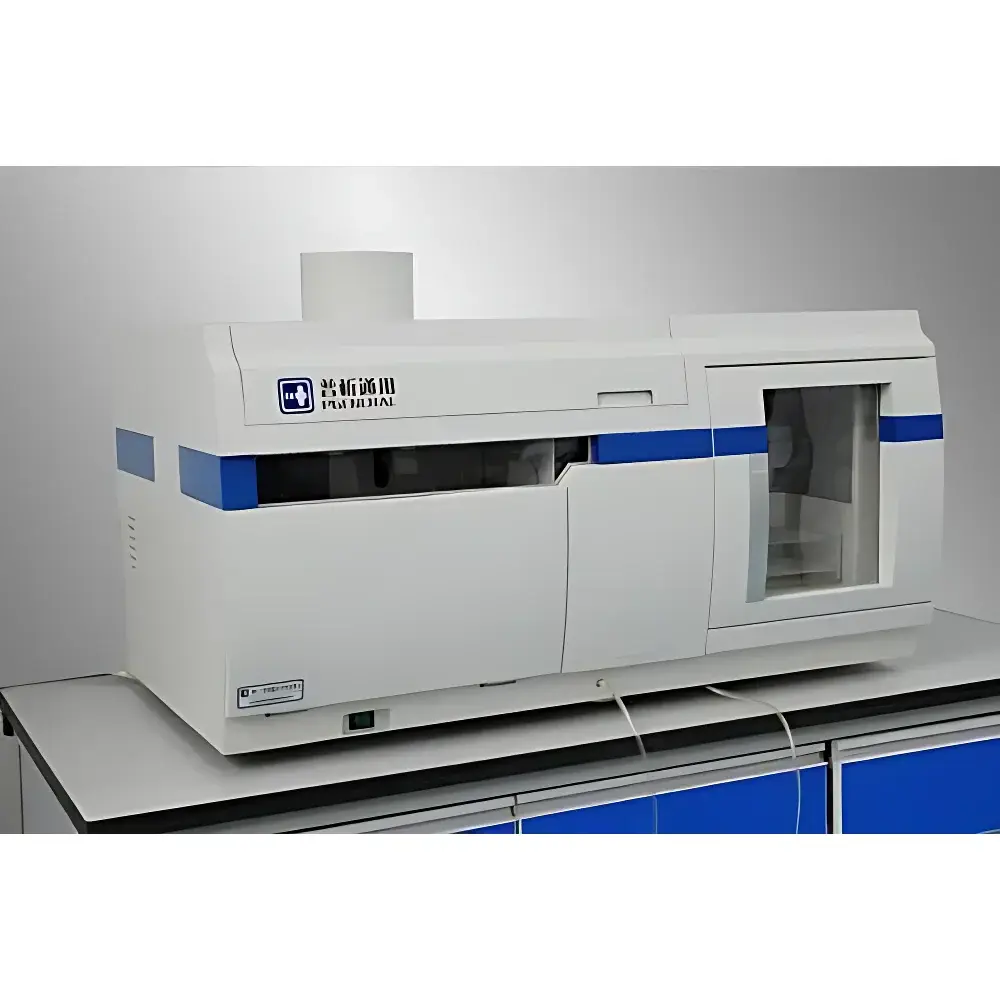
Purkinje PF6-2 Used Non-Dispersive Atomic Fluorescence Spectrometer
| Origin | Beijing, China |
|---|---|
| Manufacturer Type | Authorized Distributor |
| Regional Origin | Domestic (China) |
| Model | PF6-2 |
| Price | USD 4,200 (FOB Beijing) |
| Instrument Category | Spectroscopy |
| Operational Age | Refurbished & Certified |
| Warranty | 6 Months Limited Hardware Warranty |
| Compliance | Meets GB/T 21189–2007 (Chinese National Standard for AFS), ASTM D5673–17 (for As/Se in Water) |
Overview
The Purkinje PF6-2 is a refurbished, factory-certified non-dispersive atomic fluorescence spectrometer (AFS) engineered for trace elemental analysis of hydride-forming elements. Based on the principle of atomic fluorescence spectroscopy—where ground-state atoms in a quartz atomizer are excited by a high-intensity hollow cathode lamp and emit characteristic fluorescence photons at specific wavelengths—the PF6-2 delivers exceptional sensitivity (sub-pg/mL detection limits for As, Hg, Se), low spectral interference, and wide linear dynamic range (>103). Unlike dispersive AFS systems requiring monochromators, this non-dispersive design employs optimized optical filtering and high-quantum-efficiency photomultiplier tube (PMT) detection to maximize signal-to-noise ratio while minimizing complexity and maintenance overhead. The instrument is purpose-built for routine regulatory compliance testing in accredited laboratories operating under GLP, ISO/IEC 17025, and China’s CNAS-CL01 frameworks.
Key Features
- Modular architecture with isolated optical, pneumatic, and fluidic subsystems—enabling rapid fault isolation and field-replaceable unit (FRU) servicing without full system downtime.
- Integrated closed-loop flow-injection hydride generation system combining precision syringe pump and dual-channel peristaltic pumping—ensuring reproducible reagent delivery, reduced carrier solution consumption (<1.2 mL/min), and minimized memory effects.
- Reflux-type gas–liquid separator with patented baffle geometry—achieving >99.2% separation efficiency for H2–Ar–H2O vapor mixtures without secondary separators or cryogenic traps.
- Multi-channel simultaneous detection capability (2–3 elements) using independently controllable high-intensity coded hollow cathode lamps with embedded EEPROM memory—storing lamp type, optimal current/voltage settings, and cumulative operating hours.
- Auto-calibrating quartz atomizer with PID-controlled low-power ignition (1,200 h mean time between failures (MTBF) under continuous use.
- Full environmental containment: sealed reaction chamber and internal exhaust manifold ducted directly to lab fume hood—meeting OSHA 29 CFR 1910.1200 requirements for hazardous vapor handling.
Sample Compatibility & Compliance
The PF6-2 is validated for aqueous matrices including drinking water, wastewater, soil leachates, biological digests (EPA Method 200.9), food extracts (GB 5009.11–2014), and pharmaceutical excipients. It supports direct analysis of As, Se, Pb, Bi, Te, Sn, Sb, Hg, Cd, Zn, and Ge at concentrations from 0.005–100 µg/L without pre-concentration. Instrument performance complies with GB/T 21189–2007 (non-dispersive AFS specifications), EPA 200.9 (trace metals in water), and ISO 17294-2:2016 (water quality—elemental analysis by ICP-MS/AAS/AFS). All refurbished units undergo full functional verification per Purkinje’s Factory Reconditioning Protocol (FRP-2023), including wavelength accuracy check, background correction validation, and carryover assessment per ISO 17025 Clause 5.9.
Software & Data Management
The proprietary WinAFS v4.2 software operates natively on Windows 10/11 (64-bit) with bilingual UI (English/Chinese). It implements full 21 CFR Part 11–compliant audit trail logging—including user login/logout timestamps, parameter change history, raw data integrity hashing (SHA-256), and electronic signature support. Workflow automation includes automatic standard curve generation (linear/log-linear fitting), concentration-dependent auto-dilution (1:2 to 1:100), real-time blank subtraction, and intelligent over-range protection (halts acquisition if signal exceeds 150% of highest calibrant). Data export conforms to ASTM E1382–22 (analytical data interchange format) and supports LIMS integration via ODBC and CSV/Excel templates.
Applications
The PF6-2 serves as a cost-optimized alternative to ICP-MS for regulated hydride-element testing in environmental monitoring labs (e.g., municipal water QA/QC), food safety centers (heavy metal screening per GB 2762–2022), pharmaceutical QC (ICH Q2(R2) method validation support), and geological survey institutes (ore leachate analysis). Its robustness in high-salinity or organic-rich matrices—where ICP techniques suffer from polyatomic interferences—makes it particularly suitable for seafood mercury testing, rice arsenic profiling, and industrial effluent surveillance. Routine daily throughput exceeds 60 samples with <2.5% RSD (n=10) for As at 0.1 µg/L.
FAQ
Is this unit fully refurbished and tested prior to shipment?
Yes—each PF6-2 undergoes complete optical alignment, lamp energy calibration, gas-flow verification, and 8-hour stability burn-in per Purkinje FRP-2023. A Certificate of Reconditioning and Performance Verification is included.
Does the warranty cover software updates and technical support?
The 6-month hardware warranty excludes software licensing but includes remote diagnostics and firmware patches. Extended support contracts (1–3 years) are available upon request.
Can the system be integrated into an existing LIMS environment?
Yes—WinAFS v4.2 provides native ODBC drivers and configurable CSV export templates compatible with Thermo Fisher SampleManager, LabVantage, and STARLIMS.
What consumables require regular replacement?
Recommended replacement intervals: quartz atomizer (1,200 h), PMT (5,000 h), pump tubing (3 months), and hollow cathode lamps (2,000 h). All are stocked globally via authorized Purkinje distributors.
Is method validation documentation provided?
Each unit ships with a pre-loaded set of validated methods for As/Hg/Se per GB 5009.11–2014 and EPA 1631E, including LOD/LOQ reports, linearity studies, and spike recovery data.
Related Products