
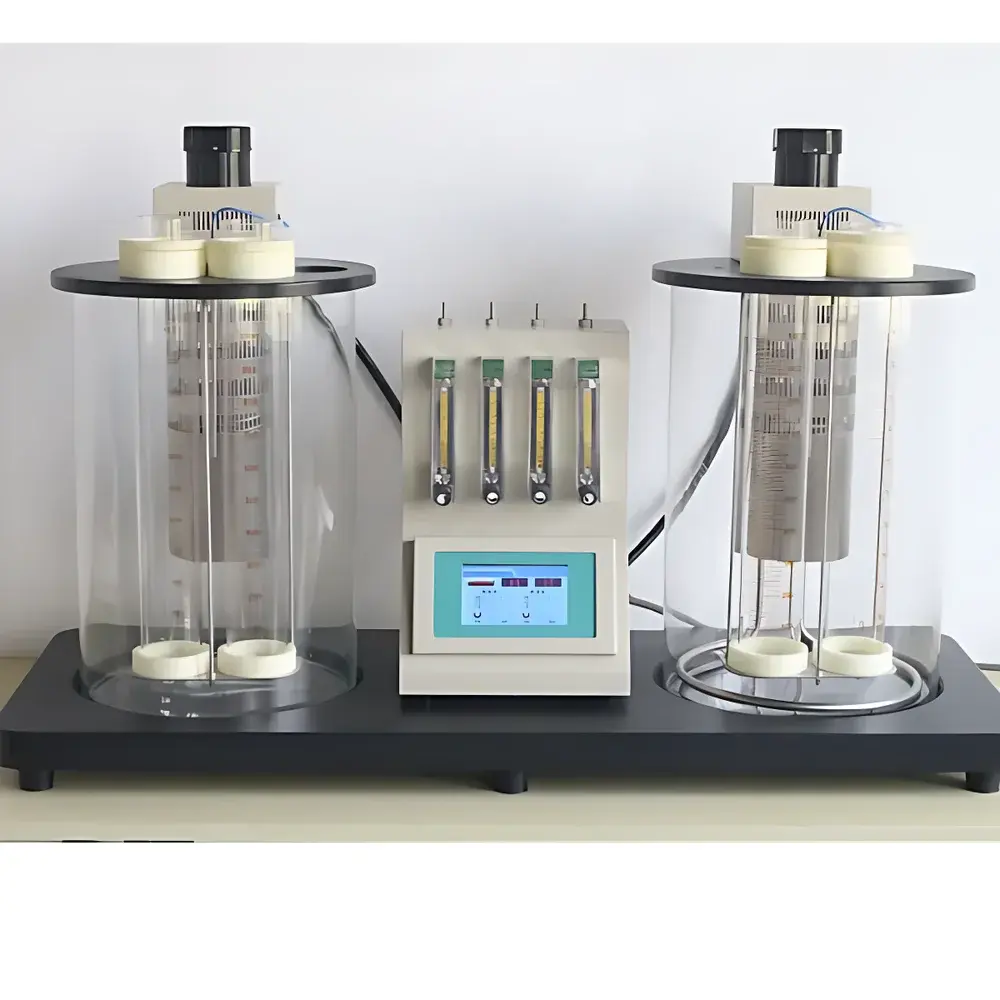
PUSH PS-PM201 Foam Characteristic Tester for Lubricating Oils
| Brand | PUSH |
|---|---|
| Origin | Hebei, China |
| Manufacturer Type | Direct Manufacturer |
| Country of Origin | China |
| Model | PS-PM201 |
| Price Range | USD 3,300 – 4,200 (FOB) |
| Instrument Category | Laboratory Analyzer |
| Test Parameter | Foam Tendency & Foam Stability |
| Compliant Standards | GB/T 12579, ASTM D892 |
| Temperature Control Range | Low Bath 24 °C / High Bath 93.5 °C |
| Temperature Accuracy | ±0.5 °C |
| Display | High-Resolution Color Touchscreen |
| Power Consumption | 3300 W |
| Air Flow Rate | 94 ± 5 mL/min per diffuser |
| Diffuser Diameter | Ø25.4 ± 0.02 mm |
| Maximum Pore Size | ≤80 µm |
| Air Permeability at 2.44 kPa (250 mm H₂O) | 3000–6000 mL/min |
| Electrical Supply | AC 220 V ±5%, 50 Hz ±5% |
| Operating Ambient | 10–35 °C, ≤85% RH |
| Net Weight | 39 kg |
Overview
The PUSH PS-PM201 Foam Characteristic Tester is a dedicated laboratory instrument engineered to quantitatively evaluate the foam tendency (FT) and foam stability (FS) of lubricating oils under rigorously controlled thermal and aerodynamic conditions. It operates in strict accordance with internationally recognized test methodologies—namely GB/T 12579 (Chinese National Standard) and ASTM D892 (Standard Test Method for Foaming Characteristics of Lubricating Oils). These standards define a standardized two-stage procedure: first, air is sparged through a calibrated sintered-glass diffuser into a preheated oil sample at either 24 °C or 93.5 °C; second, foam volume is recorded immediately after cessation of air flow (FT), then again after a defined 10-minute drainage period (FS). The PS-PM201 replicates this protocol with high reproducibility by integrating precision digital PID temperature regulation, gravimetrically validated airflow control, and real-time automated timing—all critical for generating data suitable for specification conformance, formulation development, and quality assurance in OEM and refinery laboratories.
Key Features
- Dual independent temperature baths: one maintained at 24 °C (low-temperature test), the other at 93.5 °C (high-temperature test), each equipped with PID-controlled heating and circulation for ±0.5 °C thermal stability across the entire test duration.
- Calibrated dual-channel mass airflow system: two independent glass rotameters, each delivering 94 ± 5 mL/min of compressed, oil-free air—traceable to NIST-traceable flow standards and verified prior to each test sequence.
- Sintered-glass diffuser assembly: Ø25.4 ± 0.02 mm diameter, manufactured to ASTM D892 dimensional tolerances, with maximum pore size ≤80 µm and air permeability certified at 3000–6000 mL/min under 2.44 kPa (250 mm H₂O) differential pressure.
- Integrated human-machine interface: 7-inch high-resolution color touchscreen with intuitive icon-driven workflow navigation, real-time parameter display, and on-screen test status logging—including start/stop timestamps, bath temperatures, and airflow confirmation.
- Robust mechanical architecture: stainless-steel frame, insulated bath chambers, and vibration-damped mounting for diffuser assemblies to minimize measurement drift during prolonged testing cycles.
Sample Compatibility & Compliance
The PS-PM201 accommodates standard ASTM D892 sample volumes (200 mL) in graduated glass cylinders (100–300 mL range) and supports all conventional mineral-, synthetic-, and semi-synthetic-based lubricants—including engine oils, hydraulic fluids, gear oils, and turbine oils. Its design ensures full compliance with the physical apparatus requirements specified in Clause 6 of ASTM D892 and Section 5 of GB/T 12579, including diffuser geometry, airflow delivery path, cylinder positioning, and ambient draft control. The instrument’s calibration traceability supports GLP-compliant operation, and its stable thermal and pneumatic performance enables consistent generation of data acceptable for regulatory submissions, internal QC release protocols, and supplier qualification audits aligned with ISO/IEC 17025 requirements.
Software & Data Management
While the PS-PM201 operates as a standalone benchtop analyzer without proprietary PC software, its embedded firmware supports non-volatile storage of up to 200 test records—including date/time stamp, bath temperature setpoint and actual reading, airflow verification status, FT/FS volume readings (in mL), and operator ID input. All stored data can be exported via USB interface in CSV format for integration into LIMS environments or statistical process control (SPC) platforms. Audit trail functionality includes immutable timestamping of every test initiation and result entry, satisfying foundational data integrity expectations under FDA 21 CFR Part 11 for non-electronic-signature applications.
Applications
- Formulation screening of anti-foam additives (e.g., silicone polymers, alkyl acrylates) during R&D of new engine oil packages.
- Batch release testing of finished lubricants against OEM specifications (e.g., GM dexos1®, Ford WSS-M2C945-A, API SP).
- Troubleshooting field-reported foaming issues in hydraulic systems or circulating lubrication circuits.
- Stability assessment of used oils undergoing oxidative stress or contamination with water or cleaning agents.
- Interlaboratory method validation studies supporting ASTM D892 round-robin programs.
FAQ
Does the PS-PM201 support automatic data export to Excel-compatible formats?
Yes—test results are saved internally and can be downloaded via USB flash drive in CSV format, directly importable into Microsoft Excel or statistical analysis tools.
Is calibration certification included with shipment?
Each unit ships with a factory calibration report documenting airflow verification at 94 mL/min and temperature accuracy verification at both 24 °C and 93.5 °C using NIST-traceable reference instruments.
Can the instrument be operated in a fume hood?
Yes—the PS-PM201 is designed for ambient lab use but may be installed in a ventilated fume hood when handling volatile or odoriferous samples; ensure adequate clearance around rear ventilation grilles.
What maintenance is required for the sintered-glass diffuser?
Diffusers must be cleaned ultrasonically in petroleum ether after each test series and inspected periodically for pore blockage or cracking; replacement diffusers are supplied with traceable pore-size certification.
Is remote monitoring or Ethernet connectivity available?
No—this is a self-contained, locally operated instrument. Remote data acquisition requires external USB-to-Ethernet gateways configured at the facility level.





