
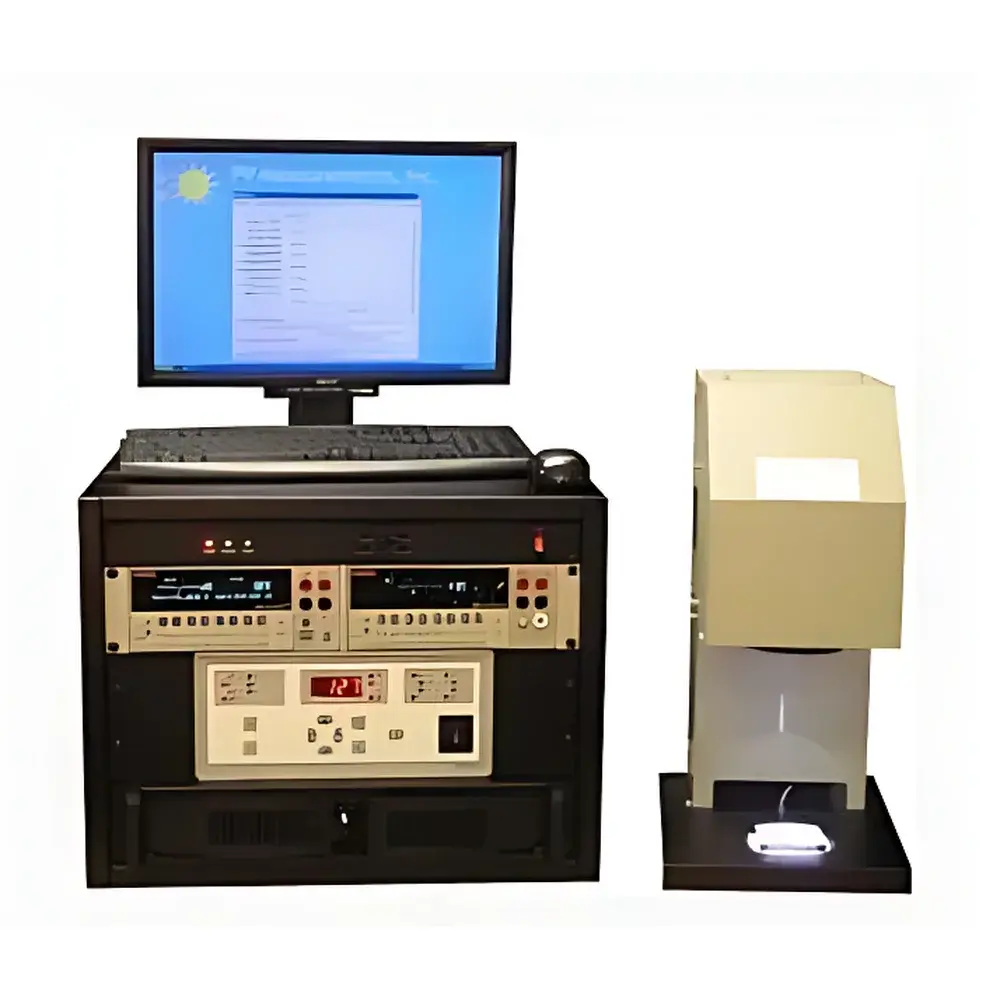
PV Measurements IV5 Photovoltaic I-V Curve Characterization System
| Brand | PV Measurements |
|---|---|
| Origin | USA |
| Manufacturer Type | Authorized Distributor |
| Origin Category | Imported |
| Model | IV5 |
| Automation Level | Fully Automated |
| Light Source | Continuous 5 cm × 5 cm ABA-class (optional AAA-class) solar simulator |
| Voltage Ranges | ±2.0 V, ±10.0 V |
| Current Ranges | 0.1 mA to 1.0 A |
| Measurement Method | Four-wire Kelvin sensing |
| Compliance | IEC 60904-9, JIS C 8912, ASTM E927-19 |
| Standard Reference Cell | NREL-traceable 20 mm × 20 mm monocrystalline Si cell with ISO/IEC 17025 calibration certificate |
| Software | Windows-based PV characterization suite with automated data acquisition, parameter calculation, report generation, and audit-trail-enabled export |
Overview
The PV Measurements IV5 Photovoltaic I-V Curve Characterization System is a fully automated, turnkey solution engineered for high-accuracy current–voltage (I-V) curve measurement of photovoltaic devices under controlled illumination conditions. Based on the principle of dynamic electronic load sweep combined with synchronized radiometric referencing, the IV5 system enables precise determination of fundamental photovoltaic performance parameters—including open-circuit voltage (Voc), short-circuit current (Isc), maximum power point (Pmax, Vmax, Imax), fill factor (FF), power conversion efficiency (η), series resistance (Rs), and shunt resistance (Rsh). The system integrates a Class ABA (optionally AAA) solar simulator compliant with IEC 60904-9, JIS C 8912, and ASTM E927-19 standards; a calibrated reference cell traceable to NREL and certified to ISO/IEC 17025; a high-resolution source-measure unit (SMU) operating in four-terminal sensing mode; a motorized sample stage with adjustable fixtures; and dedicated Windows-based software supporting GLP-aligned data handling.
Key Features
- Fully automated I-V sweep execution with programmable voltage/current step resolution, sweep direction, and dwell time
- Class ABA solar simulator delivering continuous 5 cm × 5 cm uniform irradiance (1 Sun equivalent), with optional upgrade to AAA-class spectral match, spatial uniformity, and temporal stability
- Integrated electronic shutter enabling rapid transition between light and dark I-V measurements without manual intervention
- Four-wire (Kelvin) measurement architecture eliminating lead resistance errors—critical for low-Rs or high-current devices
- Real-time correction for simulator intensity drift using simultaneous reference cell monitoring
- Modular hardware design supporting scalable configurations: 2″, 4″, 6″, or 8″ beam diameters; temperature-controlled stages; and external environmental chamber integration
- High-stability xenon short-arc lamp with integrated hour-meter and safety interlock system for lamp life management and operator protection
Sample Compatibility & Compliance
The IV5 system accommodates a broad spectrum of photovoltaic technologies, including but not limited to monocrystalline and multicrystalline silicon, amorphous silicon, GaAs, GaInP, CdTe, CIGS, perovskite, organic photovoltaics (OPV), dye-sensitized solar cells (DSSC), and multi-junction tandem devices. All measurements adhere to internationally recognized test protocols: IEC 60904-1 (photovoltaic current–voltage characteristics), IEC 60904-3 (reference solar spectral irradiance distributions), and IEC 61215-2 (terrestrial photovoltaic module qualification). The included NREL-traceable reference cell carries full uncertainty budget documentation aligned with SI units and is certified per ISO/IEC 17025 by an accredited calibration laboratory. System-level validation reports support FDA 21 CFR Part 11 compliance when configured with audit-trail-enabled software logging.
Software & Data Management
The proprietary PV Analysis Suite provides intuitive graphical interface for experiment setup, real-time curve visualization, batch processing, and standardized reporting. Each measurement session automatically records timestamp, ambient temperature, reference cell output, lamp hours, shutter state, and instrument configuration metadata. Raw I-V datasets are stored in vendor-neutral ASCII format (.csv) with embedded header information for traceability. Advanced features include automatic PCE normalization to standard test conditions (STC: 25°C, AM1.5G, 1000 W/m²), temperature coefficient extraction (via optional thermal control), and comparative analysis across multiple samples or batches. Export modules generate PDF reports conforming to journal submission templates (e.g., IEEE PVSC, Progress in Photovoltaics) and support LIMS integration via OPC UA or RESTful API.
Applications
The IV5 system serves as a primary metrology platform across R&D laboratories, quality assurance departments, and production line process control environments. Typical use cases include: performance benchmarking of novel absorber materials under varied spectral conditions (AM0 to AM2); degradation studies under accelerated aging protocols (damp heat, thermal cycling); evaluation of anti-reflective coating efficacy; contact optimization via Rs/Rsh mapping; validation of encapsulation integrity through dark I-V leakage analysis; and certification testing prior to IEC 61215 or UL 1703 submission. Its portability and battery-powered operation option also enable field-deployable outdoor characterization under natural sunlight with GPS-synchronized irradiance logging.
FAQ
What standards does the solar simulator meet?
The standard ABA-class simulator complies with IEC 60904-9 (Class ABA), JIS C 8912, and ASTM E927-19. An optional AAA-class configuration meets the stricter spectral match (±12.5%), uniformity (±2%), and temporal stability (±0.5%) requirements defined in IEC 60904-9 Ed. 3.
Can the system measure temperature-dependent I-V characteristics?
Yes—when paired with an optional temperature-controlled stage or environmental chamber, the software supports automated I-V sweeps across user-defined temperature ranges (e.g., −40°C to +85°C), with simultaneous thermocouple feedback and PCE temperature coefficient derivation.
Is the reference cell calibration NIST-traceable?
The included monocrystalline silicon reference cell is calibrated at a NREL-accredited laboratory and certified to ISO/IEC 17025. Its calibration certificate explicitly states traceability to SI units via NREL’s primary standard reference cells.
Does the software support 21 CFR Part 11 compliance?
When deployed with password-protected user roles, electronic signatures, and immutable audit trails enabled, the PV Analysis Suite satisfies key technical controls required for regulated environments under 21 CFR Part 11 and EU Annex 11.
What sample sizes can be tested?
The base platform accommodates substrates up to 150 mm × 150 mm. Custom fixtures and larger beam options (up to 8″) support wafer-scale and mini-module characterization, including edge-defined film-fed growth (EFG) and ribbon silicon formats.





