
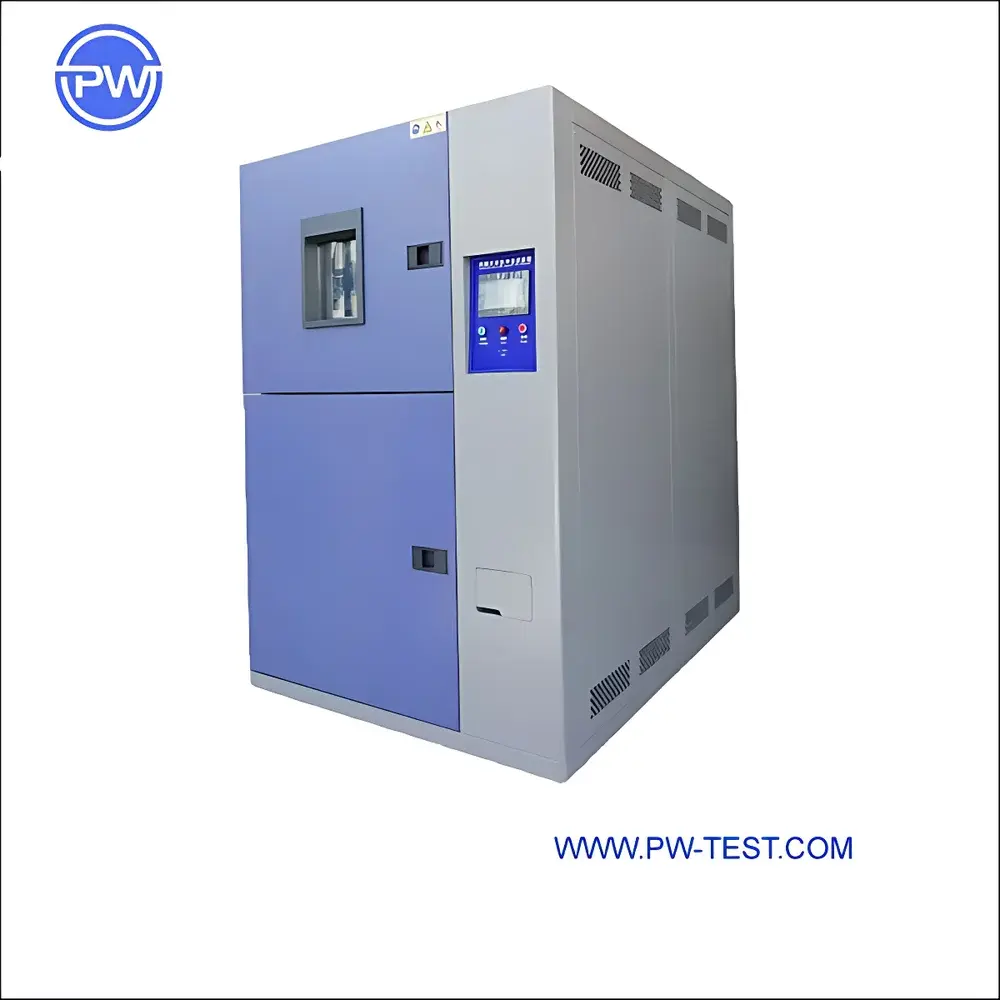
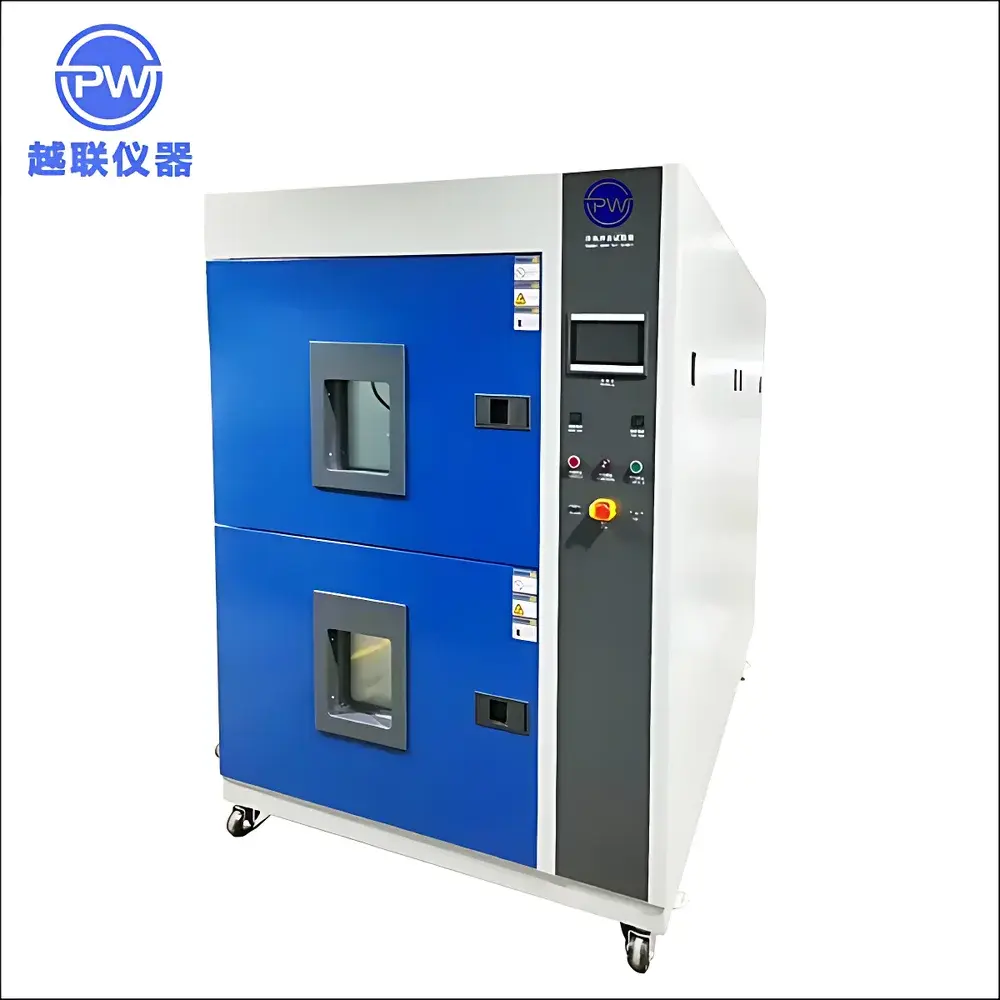
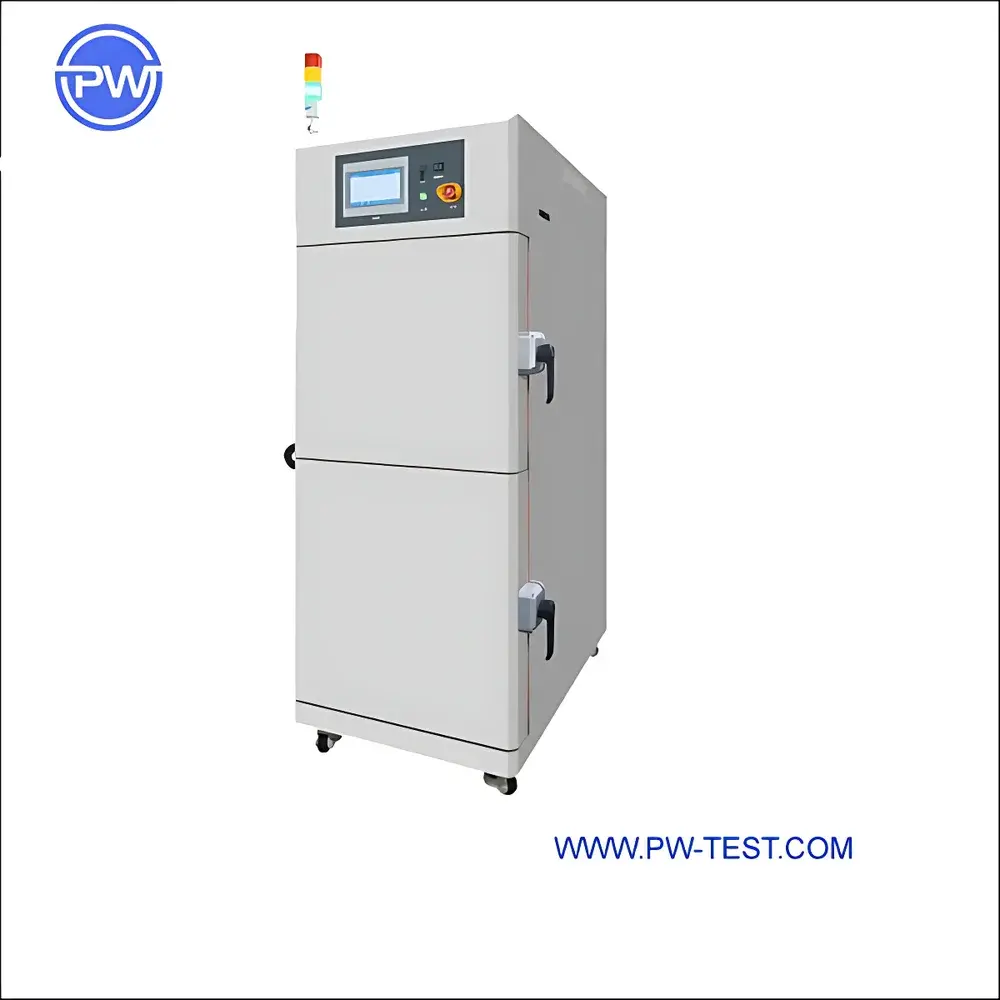
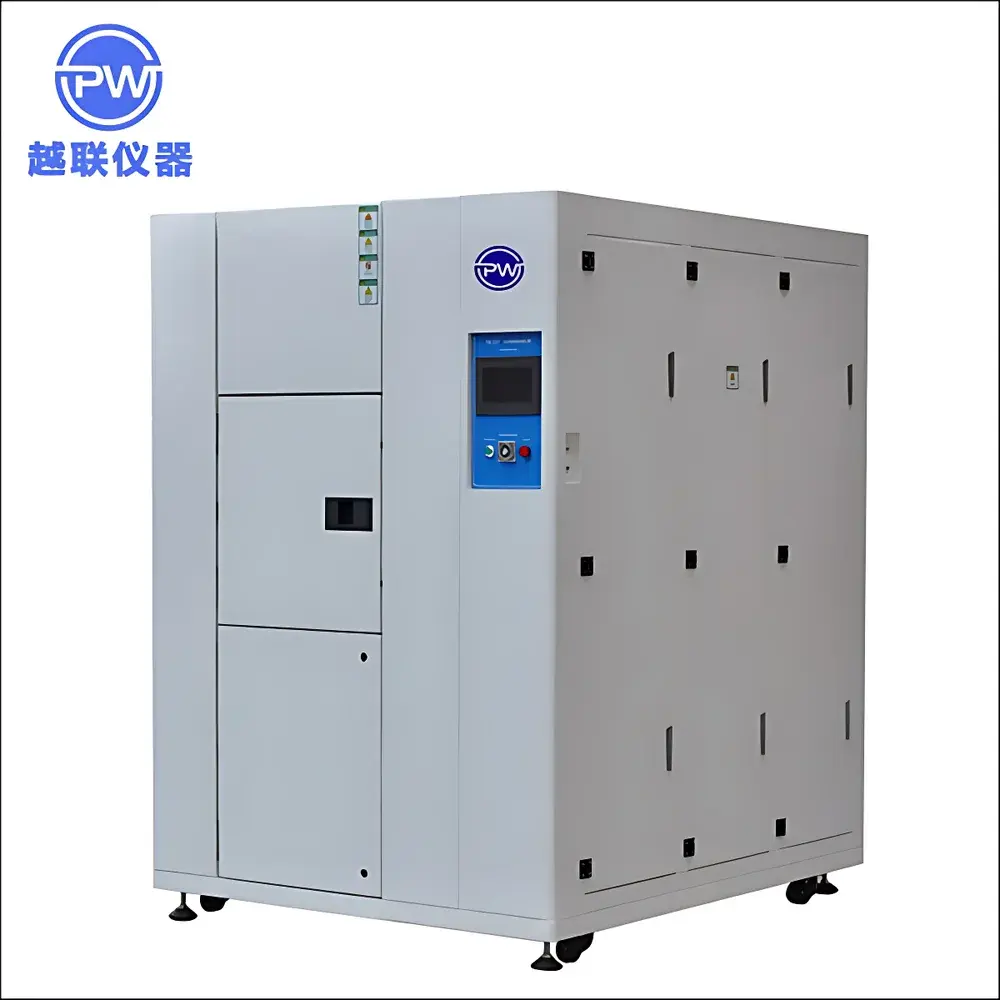
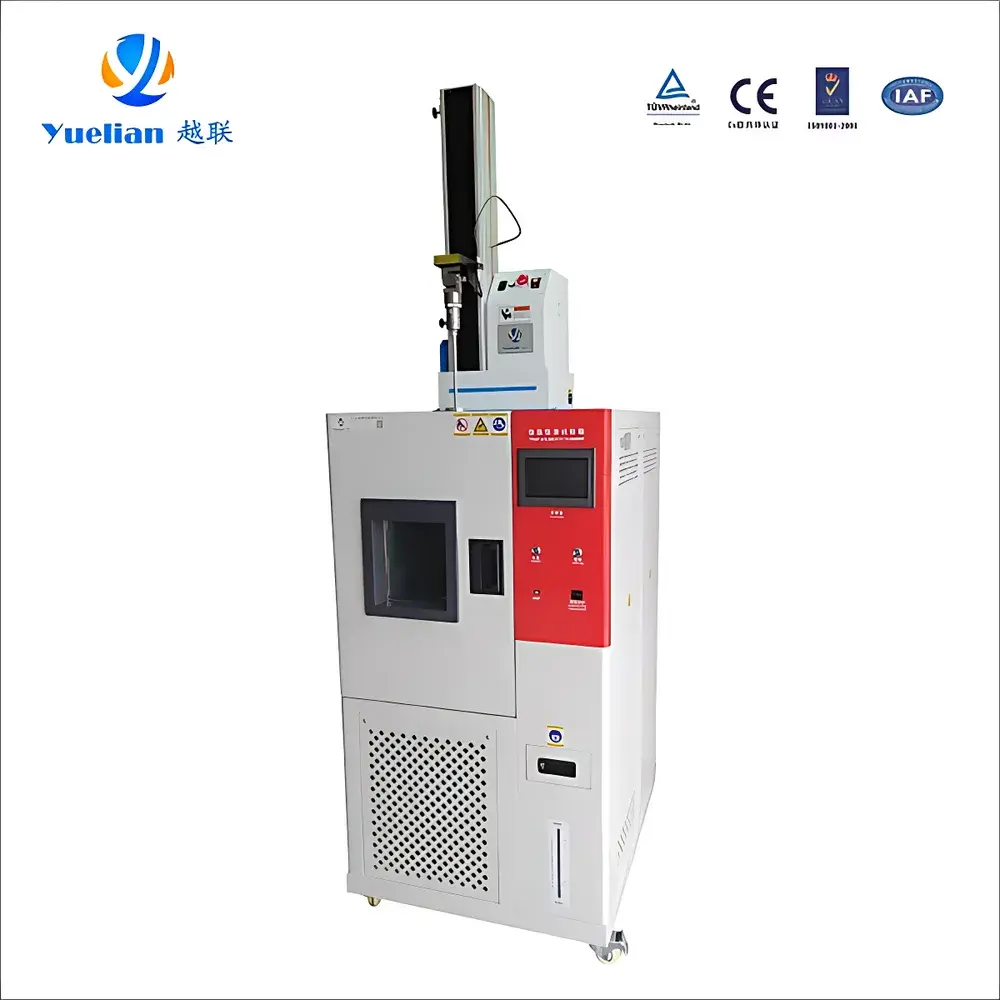
PW-CTS2-50-40W Two-Zone Thermal Shock Test Chamber (Water-Cooled) by YueLian / PW
| Brand | YueLian / PW |
|---|---|
| Origin | Guangdong, China |
| Manufacturer Type | Authorized Distributor |
| Product Origin | Domestic (China) |
| Model | PW-CTS2-50-40W |
| High-Temperature Range | +150 °C |
| Low-Temperature Range | −40 °C |
| Thermal Shock Range | −40 °C to +150 °C |
| Temperature Stability | ±0.5 °C |
| Heating Rate | 3 °C/min |
| Cooling Rate | 2 °C/min |
| Transfer Time (Basket) | ≤5 s |
| Thermal Transition Time | ≤15 s |
| Temperature Uniformity | ±2 °C |
| Dwell Time per Zone | 5 min |
| Internal Chamber Dimensions (W×H×D) | 400×400×320 mm |
| External Dimensions (W×H×D) | ≈1200×1840×1875 mm |
| Power Requirement | 8 kW, 380 V, 50/60 Hz |
| Refrigerant | R404A / R23 (non-ozone-depleting, low-GWP blend) |
| Cooling Method | Water-cooled |
| Control Resolution | 0.1 °C (temperature), 1 min (time) |
| Compliance | IEC 60068-3 |
Overview
The PW-CTS2-50-40W is a two-zone, water-cooled thermal shock test chamber engineered for high-reliability evaluation of electronic components, PCB assemblies, automotive sensors, and aerospace materials under rapid, repetitive temperature transitions. Unlike single-chamber or forced-air thermal cycling systems, this chamber implements a true dual-bath architecture—comprising physically isolated high-temperature (+150 °C) and low-temperature (−40 °C) reservoirs—with a pneumatically actuated stainless-steel test basket that transfers specimens between zones in ≤5 seconds. Thermal shock is induced via abrupt exposure to extreme ambient conditions, enabling accelerated failure mode analysis per IEC 60068-2-14 (Test N: Change of Temperature) and MIL-STD-810H Method 503.5. The system employs on-demand refrigerant flow modulation—rather than continuous compressor operation—to maintain setpoint stability (±0.5 °C) while minimizing energy consumption and thermal stress on mechanical components.
Key Features
- True two-zone design with independent high- and low-temperature chambers, eliminating thermal cross-contamination and ensuring repeatable shock profiles.
- Patented on-off refrigerant energy regulation: PLC-controlled solenoid valves modulate cooling capacity in real time based on zone-specific demand—reducing compressor cycling and extending service life.
- Water-cooled condensing system using R404A/R23 blended refrigerant—compliant with EU F-Gas Regulation (EU) No 517/2014 and EPA SNAP program requirements for non-ozone-depleting, low-global-warming-potential alternatives.
- Stainless-steel (SUS 304) inner chamber and insulated structural panels: 24k glass wool for hot zone; PU foam + glass wool composite for cold zone—achieving thermal resistance >0.8 m²·K/W.
- High-efficiency air circulation: SIROCCO-type impeller driven by TECO motor with extended stainless-steel shaft—ensuring uniform airflow and minimal turbulence-induced specimen vibration.
- 7-inch full-color LCD touchscreen controller with embedded PLC architecture, supporting multi-segment programmable profiles (up to 127 programs, 32,000 cycles per program) and real-time graphical curve display.
- Comprehensive data integrity features: battery-backed RAM storage, USB 2.0 hot-pluggable logging (1–32 GB), RS-232/RS-485 interface for SCADA integration, and configurable sampling intervals (30–300 sec).
Sample Compatibility & Compliance
The PW-CTS2-50-40W accommodates standard test specimens up to 400 × 400 × 320 mm (W×H×D) and supports weight loads ≤15 kg per cycle. Its internal SUS 304 stainless-steel shelves and removable silicone gasketed door seals ensure compatibility with cleanroom-grade electronics, medical device housings, and coated optical substrates. Temperature validation follows IEC 60068-3-5 (methods for determining temperature change rates) and ASTM E1545 (standard practice for calibration of thermal shock chambers). All sensor placements conform to IEC 60068-3-11 for measurement uncertainty control—thermocouples mounted at air outlet positions with traceable NIST-calibrated reference probes. The unit meets CE marking requirements (EMC Directive 2014/30/EU, LVD Directive 2014/35/EU) and includes built-in safeguards aligned with ISO 13850 (emergency stop) and IEC 61000-4-2 (ESD immunity).
Software & Data Management
The embedded controller firmware supports GLP/GMP-compliant data handling: all parameter changes, alarm events, and program executions are timestamped and logged with user ID tagging. Audit trails are retained for ≥90 days (at 1-minute sampling) in non-volatile memory, with optional export to CSV or XML for LIMS integration. Remote monitoring is enabled via RS-485 daisy-chaining (up to 32 units) or optional Ethernet gateway module. PC-based companion software (Windows 2000/XP or later) provides offline curve analysis, statistical process control (SPC) charting, and deviation reporting per ISO 9001:2015 clause 8.2.4. Firmware updates are performed via USB without requiring factory service intervention. Data encryption (AES-128) and role-based access control (administrator/operator modes) satisfy FDA 21 CFR Part 11 requirements for electronic records and signatures when deployed in regulated QC environments.
Applications
This thermal shock chamber is routinely deployed in reliability laboratories for solder joint fatigue assessment (IPC-J-STD-020D), plastic housing embrittlement testing (ISO 294-4), MEMS package delamination screening, and qualification of EV battery modules per UN ECE R100 Annex 8. It supports accelerated life testing of conformal-coated PCBs subjected to automotive under-hood thermal transients (SAE J2223), as well as validation of adhesive bond strength in optoelectronic assemblies exposed to diurnal cycling. In R&D settings, the precise dwell-time control and rapid transfer capability enable systematic study of intermetallic growth kinetics at Cu/Sn interfaces, while the water-cooled design ensures stable operation during extended 1,000-cycle qualification runs required by AEC-Q200 stress testing protocols.
FAQ
What standards does the PW-CTS2-50-40W comply with for thermal shock testing?
It conforms to IEC 60068-2-14 (Test N), MIL-STD-810H Method 503.5, and ASTM D5229/D5229M for composite material evaluation.
Is the chamber suitable for testing moisture-sensitive devices (MSL-rated components)?
Yes—its rapid transfer time (<5 s) and sealed cold/hot zones minimize condensation risk; however, pre-conditioning per J-STD-033 is recommended prior to shock exposure.
Can the system be integrated into an automated test cell with PLC coordination?
Yes—RS-232/RS-485 ports support Modbus RTU protocol; digital I/O terminals allow external start/stop, alarm acknowledgment, and status feedback.
What maintenance intervals are recommended for the refrigeration system?
Compressor oil and filter dryer replacement every 24 months; annual verification of refrigerant charge and nitrogen-purged weld integrity per ASME B31.5 guidelines.
Does the controller support password-protected parameter locking for production line use?
Yes—three-tier user authentication (operator, engineer, administrator) with configurable lockout of critical settings including temperature limits, ramp rates, and program editing.



