
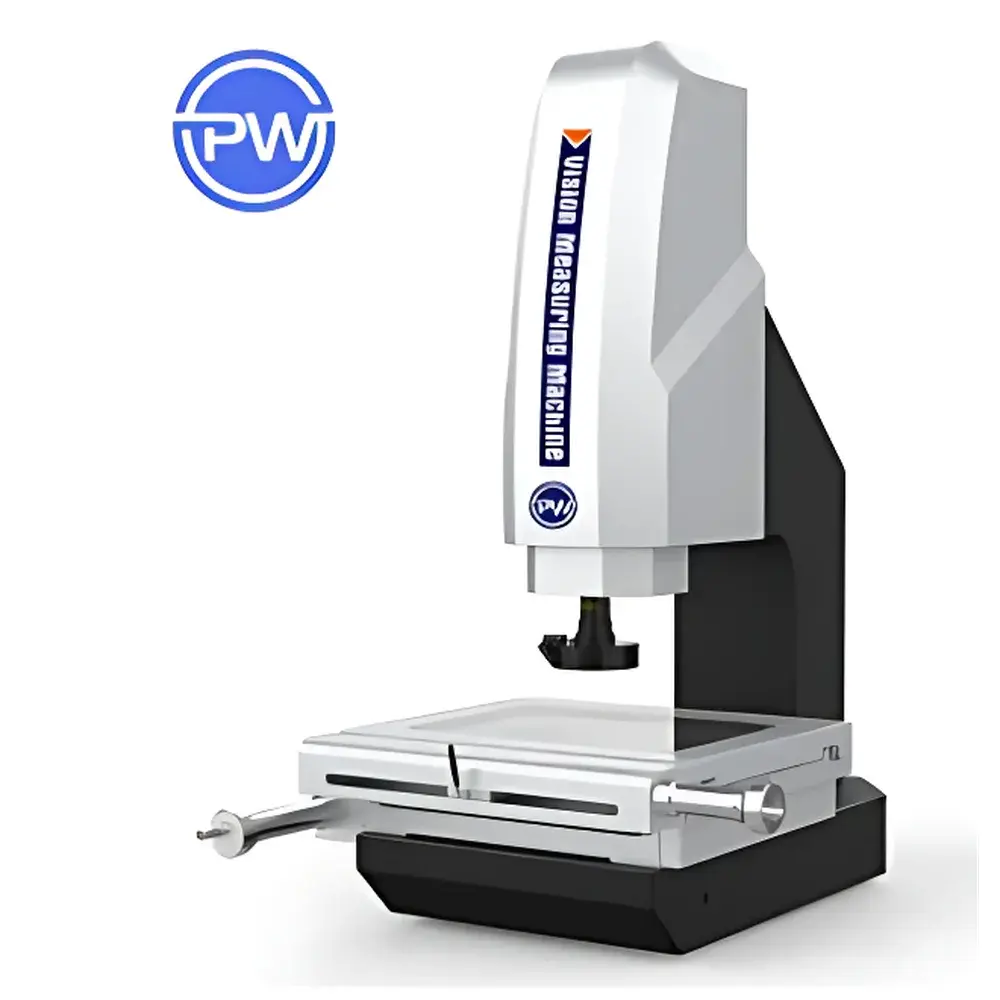
PW Optical Measuring System PW-OMS322 High-Precision 2.5D Manual Vision Measuring Machine
| Brand | PW |
|---|---|
| Origin | Guangdong, China |
| Manufacturer Type | Authorized Distributor |
| Country of Origin | China |
| Model | PW-OMS322 |
| Price Range | USD 2,800 – 28,000 |
Overview
The PW Optical Measuring System PW-OMS322 is a high-precision 2.5D manual vision measuring machine engineered for dimensional metrology in quality control laboratories, precision machining workshops, and R&D environments. It operates on the principle of optical magnification and digital image analysis—capturing high-resolution images of part features via a telecentric zoom lens and industrial-grade CMOS sensor, then computing geometric dimensions (length, width, angle, radius, position, form error) using pixel-to-unit calibration and edge-detection algorithms. Unlike fully automated CNC-based systems, the PW-OMS322 prioritizes operator-guided measurement flexibility with mechanical stability as its foundational design criterion—making it especially suitable for low-to-medium volume inspection, first-article verification, and GD&T validation where repeatability, ease of setup, and tactile control are critical.
Key Features
- Granite base and column structure providing exceptional thermal stability, vibration damping, and long-term geometric integrity—compliant with ISO 10360-2 requirements for coordinate measuring machine (CMM) structural performance.
- Non-threaded precision ground optical shafts with rapid-locking linear motion mechanism, achieving bidirectional repeatability ≤2 µm across full travel range.
- A-grade linear optical encoders integrated with precision-machined granite stage, delivering positional accuracy rated at (2.5 + L/200) µm per ISO 10360-2 (where L is measured length in mm).
- Motorized zoom lens (0.7x–4.5x continuous magnification) with telecentric optical path design to minimize perspective distortion and parallax error—essential for accurate 2D profile measurement of stepped or inclined surfaces.
- High-sensitivity 5 MP color CMOS camera with global shutter, optimized for low-noise imaging under variable illumination conditions and compatible with sub-pixel edge detection (≤0.1 pixel resolution).
- Dual-mode illumination system: programmable 4-ring, 8-sector surface LED array (cool white, 5700K CCT) plus collimated transmitted backlight—both independently controllable via onboard lighting management module for optimal contrast enhancement on reflective, translucent, or opaque features.
Sample Compatibility & Compliance
The PW-OMS322 accommodates parts up to 300 mm × 200 mm × 150 mm (X×Y×Z), supporting flat, prismatic, and rotationally symmetric components commonly found in automotive stampings, precision molds, PCB assemblies, medical device housings, and micro-machined metal/plastic parts. Its non-contact measurement modality eliminates probe-induced deformation risks associated with soft or thin-walled samples. The system meets essential metrological traceability requirements when calibrated against NIST-traceable step gauges or ball bars. While not certified to ISO/IEC 17025 as a standalone calibration laboratory, it supports GLP-compliant documentation workflows when paired with iMeasuring2.1 software’s audit trail and user permission modules—fully compatible with FDA 21 CFR Part 11 electronic record and signature compliance configurations.
Software & Data Management
iMeasuring2.1 is a Windows-based metrology platform offering real-time image acquisition, multi-point alignment (RPS and best-fit), auto-edge detection with adjustable sensitivity thresholds, and GD&T evaluation per ASME Y14.5–2018 and ISO 1101 standards—including position, concentricity, parallelism, and profile tolerances. Measurement reports are exportable in PDF, Excel, and XML formats—with embedded image snapshots, tolerance status flags, and statistical summaries (CPK, PPK, X-bar R charts). Optional integration with enterprise MES or QMS platforms is supported via OPC UA and RESTful API interfaces. When equipped with an optional tactile probe module (e.g., Renishaw TP20-compatible interface), the system transitions into a hybrid 2.5D/3D platform capable of measuring height, depth, and surface roughness profiles—extending its utility beyond planar geometry into volumetric verification.
Applications
- Verification of machined part dimensions against engineering drawings (e.g., hole centers, slot widths, chamfer angles)
- First-article inspection for aerospace fasteners, connector pins, and miniature gears
- PCB solder paste inspection and component placement accuracy assessment
- Medical device component metrology—including catheter hub features, syringe barrel wall thickness, and orthodontic bracket slot geometry
- Tooling and mold cavity verification prior to production ramp-up
- Reverse engineering support through point-cloud generation (when used with optional probe add-on)
FAQ
What does “2.5D” mean in this context?
It indicates that while the system primarily measures X- and Y-axis planar geometry using optical imaging, it can also determine Z-axis height values—either via focus-stacking (depth-from-focus), motorized Z-axis encoder feedback, or optional tactile probing—without full 3D surface reconstruction capability.
Is the PW-OMS322 compliant with ISO 10360 or VDI/VDE 2617 standards?
Its stated accuracy specification (2.5 + L/200 µm) aligns with the maximum permissible error (MPE) definition in ISO 10360-2 for Class M2 CMMs; however, formal certification requires third-party verification under controlled environmental conditions (20 ± 1°C, humidity ≤60%).
Can the system be integrated into an automated production line?
As a manual operation platform, it lacks built-in automation interfaces; however, optional footswitch triggers, external I/O ports, and scriptable macros in iMeasuring2.1 enable semi-automated batch inspection sequences when deployed at dedicated QC stations.
Does the software support multi-language UI and report generation?
Yes—iMeasuring2.1 offers English, German, Japanese, and Simplified Chinese language packs, with customizable report templates supporting company branding, logo insertion, and multilingual annotations.
What maintenance is required to sustain measurement accuracy?
Annual recalibration of optical axis alignment and encoder scaling is recommended; routine cleaning of lens elements and illumination diffusers using lint-free optics-grade wipes ensures consistent image fidelity and edge detection reliability.




