
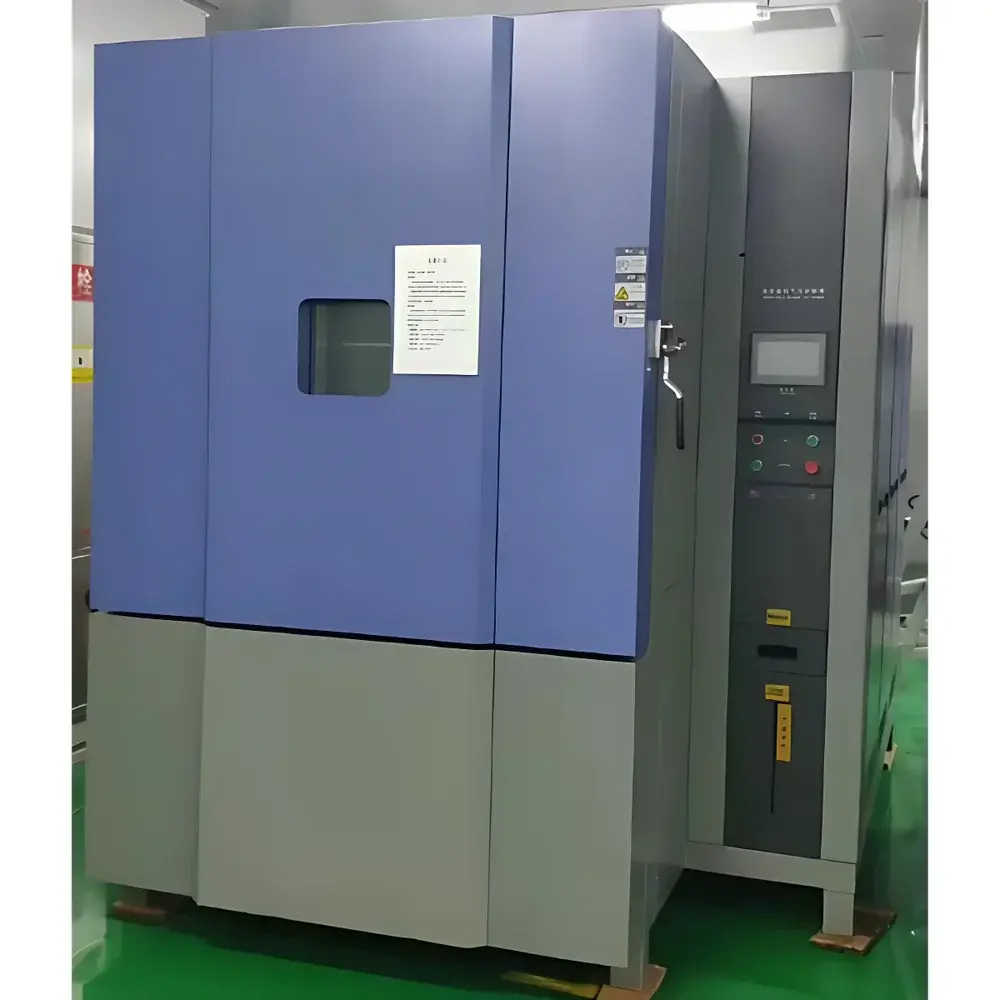
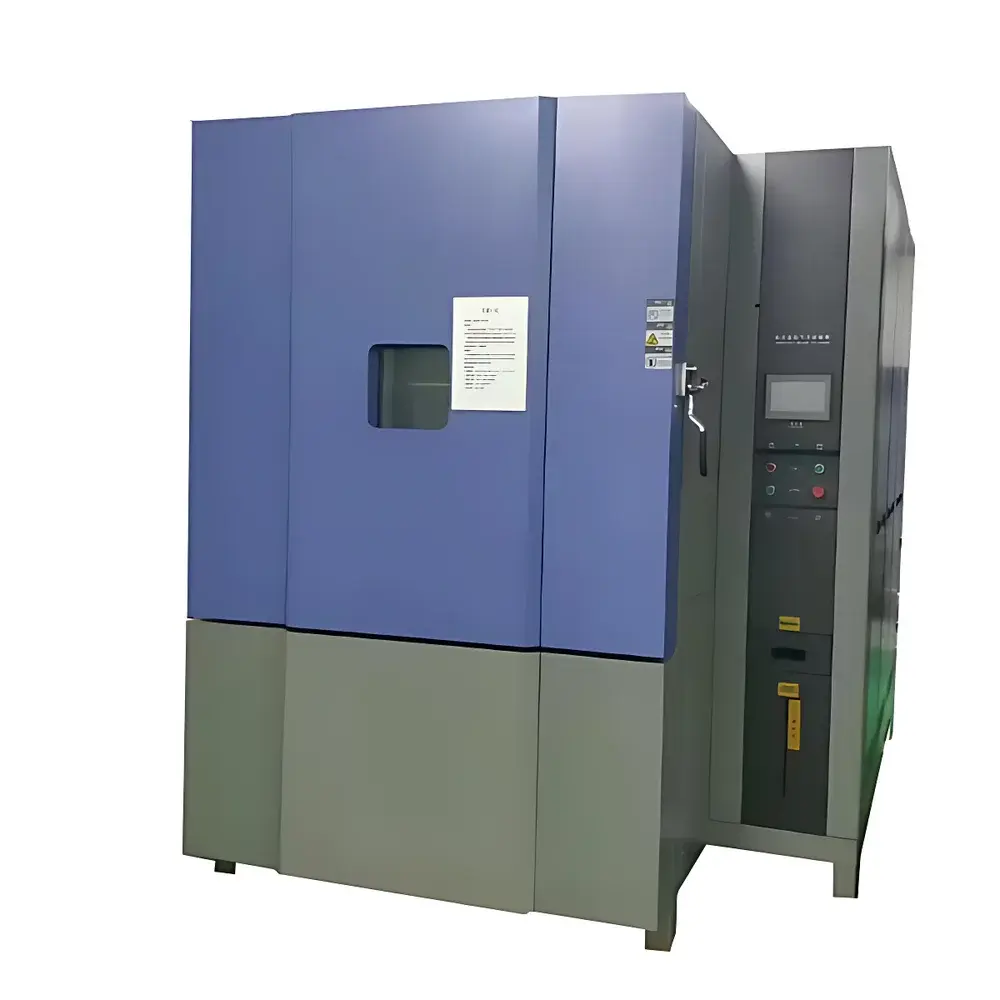
PW-SD150LS High-Low Temperature and Low-Pressure Environmental Test Chamber (Yuelian / PW)
| Brand | Yuelian / PW |
|---|---|
| Origin | Guangdong, China |
| Manufacturer Type | Authorized Distributor |
| Product Origin | Domestic (China) |
| Model | PW-SD150LS |
| Refrigeration Method | Mechanical Compression Refrigeration |
| Temperature Range | −40 °C to +150 °C |
| Temperature Fluctuation | ±0.5 °C (ambient pressure, empty chamber) |
| Temperature Uniformity | ≤2 °C (ambient pressure to 40 kPa, empty chamber) |
| Temperature Deviation | ±0.5 °C (ambient pressure, empty chamber) |
| Ramp Rate (Heating) | ≥1 °C/min (−40 °C to +150 °C, ambient pressure, empty, average) |
| Ramp Rate (Cooling) | ≤40 min (ambient pressure to 1.0 kPa) |
| Internal Chamber Dimensions | 600 D × 500 W × 830 H mm |
| Pressure Range | Ambient (101.3 kPa) to 50 kPa |
| Pressure Control Accuracy | ±2 kPa (≥40 kPa) |
| Compressor | Bitzer or Bock semi-hermetic twin-stage cascade system |
| Vacuum Pump | Leybold oil-sealed rotary vane pump |
| Control System | Japanese Unique industrial-grade 7″ color touchscreen with PID+VRF control logic |
| Compliance | GB/T 2423.1, GB/T 2423.2, GB/T 2423.21, GB/T 2423.25, GB/T 2423.26, GJB 150.1A–150.6, GB/T 10590, GB/T 5170.10, JJF 1101 |
Overview
The PW-SD150LS High-Low Temperature and Low-Pressure Environmental Test Chamber is an integrated aerospace-grade environmental simulation system engineered for rigorous thermal and altitude-related reliability testing. It combines precise temperature control (−40 °C to +150 °C) with programmable low-pressure operation (down to 1 kPa, equivalent to ~30,000 m altitude), enabling simultaneous or sequential high/low-temperature and low-pressure exposure per MIL-STD-810, DO-160, and GJB 150 series standards. The chamber employs a dual-stage cascade refrigeration architecture with VRF (Variable Refrigerant Flow) control—eliminating the need for active heating during sub-ambient stabilization and reducing energy consumption by >40% versus conventional BTHC (Balance Temperature and Humidity Control) systems. Its structural design features an outer-pressure, inner-insulated stainless steel chamber (SUS304, 4.0 mm thickness), PU + glass wool composite insulation (150 mm), and magnetically sealed variable-frequency air circulation—ensuring thermal uniformity ≤2 °C across the full pressure range (101.3 kPa to 40 kPa) under no-load conditions.
Key Features
- VRF-Based Energy-Efficient Thermal Control: Electronic expansion valves modulate refrigerant mass flow in real time via PID feedback from Pt100 sensors—enabling stable low-temperature hold without resistive heater activation and minimizing compressor cycling.
- High-Fidelity Vacuum Regulation: Leybold oil-sealed rotary vane vacuum pump coupled with HUBA precision pressure transducer (±0.1 kPa accuracy below 4 kPa) and motorized proportional control valve enables dynamic pressure maintenance without gas backfilling—critical for low-outgassing test environments.
- Aerospace-Grade Structural Integrity: Double-walled SUS304 inner chamber with TIG-welded seams, reinforced external frame, and vacuum-rated door seal (Wilson-type silicone gasket with anti-frost heating) certified for repeated 100 kPa differential pressure cycles.
- Multi-Layer Thermal Management: Sinusoidal finned evaporator with anti-frost geometry; auxiliary wall-mounted heaters and radiation-enhancing internal shrouds; optimized air ducting with guided airflow vanes to maintain uniformity even at <10 kPa.
- Robust Safety & Diagnostics: Independent dual-limit overtemperature protection, compressor suction/discharge pressure monitoring, vacuum pump motor overload sensing, and automated fault logging with actionable resolution guidance displayed on the controller interface.
- Comprehensive I/O & Remote Integration: USB, RS232, and RJ45 interfaces support data export, U-disk-based parameter backup, HP-compatible printing, and LAN-based multi-chamber supervision using optional SCADA software (up to 16 units).
Sample Compatibility & Compliance
The PW-SD150LS accommodates electronic components, avionics modules, sensor assemblies, and small mechanical subsystems up to 25 kg per shelf (two adjustable stainless steel shelves included). Standard Φ50 mm test port (with blind flange) supports feedthrough cabling, pneumatic lines, or connector mounting per MIL-DTL-38999 requirements. All materials—including internal gaskets, insulation, and wiring—comply with outgassing limits specified in ECSS-Q-ST-70-02C. The system meets full verification requirements of GB/T 5170.10–2008 (Environmental Testing Equipment Verification Methods), JJF 1101–2003 (Calibration Specifications), and GJB 150.2A–2009 (Low-Pressure/Altitude Testing). It is routinely deployed for qualification per RTCA DO-160G Section 4 (Temperature), Section 5 (Altitude), and Section 16 (Temperature/Altitude Combined), as well as MIL-STD-810H Method 500.6 and 505.6.
Software & Data Management
The embedded Japanese Unique touchscreen controller provides ISO/IEC 17025-aligned data integrity: 430,000-point internal memory (timestamped at 1-min intervals), automatic alarm event logging with start/end timestamps, and encrypted USB export of CSV-formatted temperature/pressure/time datasets. Calibration traceability is maintained via built-in PT100 sensor validation routines aligned with JJF 1101. Optional PC-based supervisory software enables centralized audit trail generation compliant with FDA 21 CFR Part 11 (electronic signatures, user access controls, change history). All program edits, parameter changes, and emergency stops are permanently recorded with operator ID and timestamp—supporting GLP/GMP laboratory audit readiness. Historical curve overlays (setpoint vs. actual) can be exported for comparative analysis across test campaigns.
Applications
- Aerospace component qualification under combined thermal-vacuum stress (e.g., satellite power converters, MEMS inertial sensors)
- Automotive ECU validation per ISO 16750-4 (climatic load cycling with altitude simulation)
- Military electronics screening per MIL-STD-883 Method 1009 (altitude-induced arcing and corona assessment)
- Avionics cooling system performance mapping across operational envelope (−40 °C/30,000 ft to +70 °C/sea level)
- Material outgassing rate measurement per ASTM E595 (using optional residual gas analyzer integration)
- Reliability growth testing of UAV propulsion controllers under rapid decompression profiles (e.g., 75.2 kPa → 18.8 kPa in ≤15 s, optional)
FAQ
What standards does the PW-SD150LS comply with for low-pressure testing?
It conforms to GJB 150.2A–2009, GB/T 2423.21–2008, and MIL-STD-810H Method 500.6 for altitude simulation, with full verification per GB/T 5170.10–2008.
Can the chamber operate at both extreme temperature and ultra-low pressure simultaneously?
Yes—it supports concurrent operation at −40 °C and 1 kPa (≈30,000 m), though temperature uniformity specification is relaxed to ≤10 °C per GJB 150.2A Annex A under such conditions.
Is remote monitoring and control supported out of the box?
RJ45 Ethernet connectivity is standard; optional PC software enables real-time multi-chamber supervision, alarm forwarding via email/SMS, and secure HTTPS-based web interface access.
How is condensation managed during low-temperature, low-pressure cycles?
An electrically heated observation window (conductive-coated laminated glass), internal anti-frost door gasket heating, and automated electromagnetic drain valve prevent ice accumulation at all operational pressures.
What maintenance intervals are recommended for the vacuum pump and refrigeration system?
Leybold pump oil replacement every 2,000 operating hours; Y-type condenser filter cleaning every 3 months; full refrigerant circuit inspection and oil analysis annually—documented in the provided maintenance logbook.



