
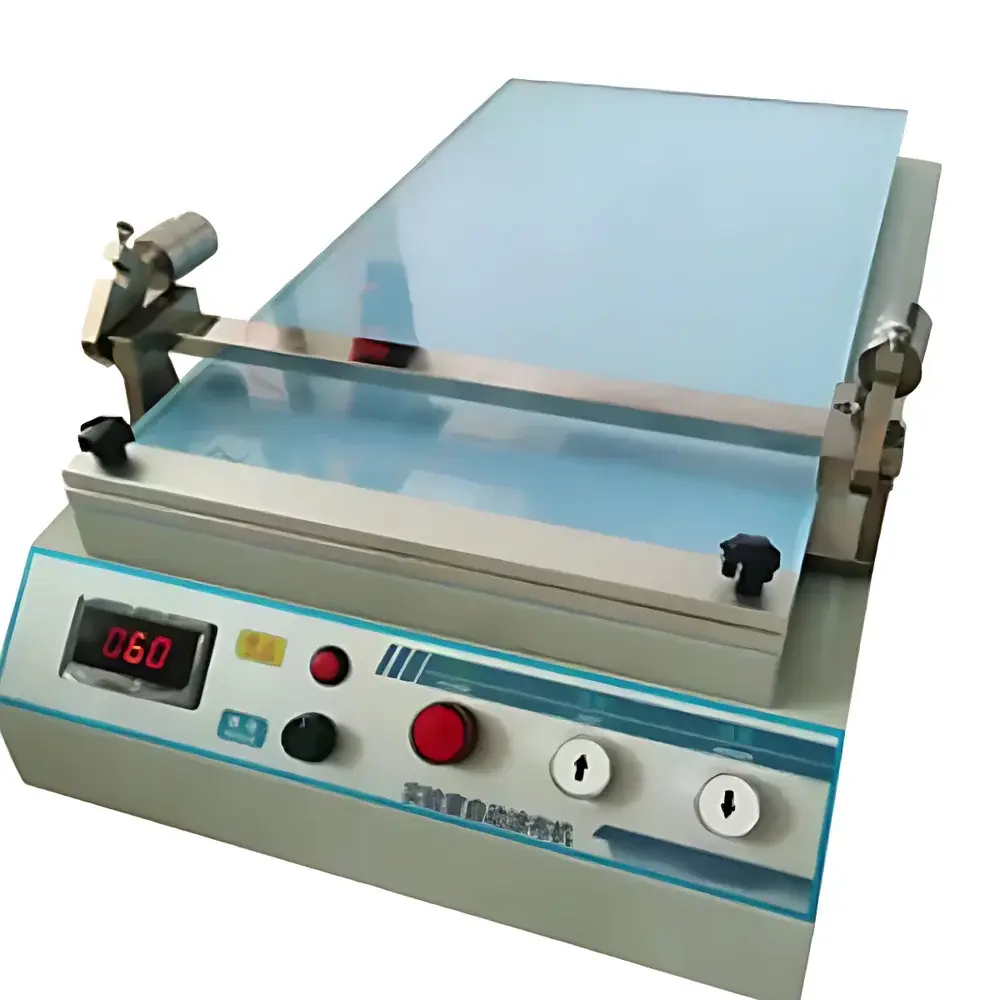
PW-TB320 AFA-IV Wire-Bar Coating Machine
| Brand | PW (Yuelian) |
|---|---|
| Origin | Guangdong, China |
| Model | PW-TB320 |
| Coating Method | Wire-Bar (Standard ISO/GB Compliant, Optional Selection) |
| Coating Width | 300 × 420 mm |
| Travel Range (X-axis) | 300 × 420 mm |
| Coating Speed | Adjustable 1–5 m/min |
| Drive System | Infinitely Variable AC Motor |
| Control Interface | Dedicated Panel with Coating/Return/Stop/Speed Adjustment |
| Weighting System | Dual-Side Adjustable Counterweights |
| Wire-Bar Length | 400 mm |
| Power Supply | 110–220 V AC, 50/60 Hz |
| Rated Power | 120 W |
| Net Weight | 20 kg |
| Overall Dimensions | 710 × 420 × 285 mm (L×W×H) |
| Accuracy | Dependent on Wire-Bar Tolerance per ISO 2137 and GB/T 9278 |
Overview
The PW-TB320 AFA-IV Wire-Bar Coating Machine is a precision-engineered laboratory-scale coating system designed for reproducible, uniform wet-film deposition across flat substrates. It operates on the principle of controlled wire-bar (also known as Mayer rod) application—where a precisely wound stainless-steel wire wrapped around a rigid mandrel is drawn across the substrate surface at a defined speed and pressure, metering a consistent volume of liquid coating material. This method relies on capillary geometry and gravitational drainage to establish film thickness governed by wire diameter, viscosity, and withdrawal speed—enabling direct correlation between rod specification (e.g., 10 µm, 25 µm, 100 µm wire spacing) and theoretical dry-film thickness per ISO 2137 and GB/T 9278. The machine is engineered for use in R&D laboratories engaged in formulation development, quality control, and process validation for adhesives, inks, functional coatings, polymer dispersions, and thin-film electronics.
Key Features
- Infinitely variable AC motor drive enabling precise speed regulation from 1 to 5 meters per minute—critical for optimizing shear history and minimizing edge defects in viscous or shear-thinning systems.
- Dual-side adjustable counterweight system ensures consistent normal force distribution across the full 400 mm wire-bar length, minimizing bowing and improving lateral uniformity.
- Fixed travel path (300 × 420 mm) with repeatable end-point positioning, supporting high inter-run reproducibility under GLP-aligned experimental protocols.
- Modular wire-bar mounting interface compatible with standard ISO/GB-compliant rods (diameters 0.1–2.0 mm; wire spacings 10–200 µm), facilitating rapid method transfer and comparative studies.
- Compact benchtop footprint (710 × 420 × 285 mm) with 20 kg net weight—designed for integration into fume hoods, glove boxes, or climate-controlled coating chambers.
- Panel-mounted controls provide tactile, non-software-dependent operation—ideal for environments requiring minimal IT infrastructure or audit-trail simplicity.
Sample Compatibility & Compliance
The PW-TB320 accommodates rigid and semi-flexible substrates up to 420 mm wide and 300 mm long—including glass slides, silicon wafers, PET/PVC films, filter papers, aluminum foils, and coated cardboards. Substrate flatness and surface energy significantly influence leveling behavior; optimal results are achieved with substrates exhibiting 32 mN/m. The system complies with mechanical and electrical safety requirements outlined in IEC 61010-1 for laboratory equipment. Wire-bar selection follows ISO 2137 (paints and varnishes) and GB/T 9278 (coating general test conditions), ensuring traceability to internationally recognized film-thickness calibration frameworks. While the unit itself does not generate electronic records, its manual operation supports compliance with GLP Annex 11 and FDA 21 CFR Part 11 when paired with paper-based SOPs and handwritten logbooks.
Software & Data Management
The PW-TB320 operates via dedicated hardware controls without embedded software or network connectivity—eliminating cybersecurity concerns and simplifying validation in regulated environments. All operational parameters (speed setting, counterweight mass, rod type, substrate ID, ambient temperature/humidity) must be documented externally using laboratory notebooks or LIMS-integrated forms. For users requiring digital traceability, optional external USB data loggers can record motor current draw (correlated to load torque) and cycle timing, providing secondary evidence of consistent mechanical performance over time. No firmware updates or cloud services are involved—ensuring long-term operational stability and vendor-independent maintenance.
Applications
- Formulation screening of water-based acrylics, solvent-borne polyurethanes, UV-curable oligomers, and nanocomposite dispersions.
- Correlation of rheological properties (viscosity, yield stress, thixotropy) with final film morphology and defect formation (e.g., orange peel, ribbing, cratering).
- Accelerated drying/curing studies under controlled temperature and humidity (when used inside environmental chambers).
- Preparation of standardized test panels for ASTM D1006 (adhesion), ASTM D4145 (flexibility), and ISO 2409 (cross-cut adhesion).
- Thin-film electrode fabrication for printed electronics, perovskite solar cells, and battery slurries—where thickness uniformity directly impacts device efficiency and repeatability.
FAQ
What wire-bar standards are supported?
The PW-TB320 accepts all ISO 2137–compliant wire-bars with 400 mm active length and standard 6 mm OD mandrels—including common specifications such as 10, 25, 50, 100, and 200 µm wire spacing.
Can the machine be integrated into an automated workflow?
No native automation interface is provided; however, the motor’s analog speed input (0–10 V DC) allows third-party PLC integration for synchronized start/stop and speed modulation in pilot-line configurations.
Is calibration documentation available?
Wire-bar dimensional certification (certified wire spacing and roundness) must be obtained from the rod supplier; PW provides mechanical alignment verification reports upon request.
What maintenance is required?
Monthly inspection of belt tension, counterweight screw integrity, and wire-bar groove cleanliness; annual lubrication of linear guide rails using ISO VG 32 mineral oil.
Does the unit meet CE or UL certification?
It conforms to IEC 61010-1 safety principles but is supplied without CE/UL marking—users are responsible for local regulatory conformity assessment prior to installation.



