
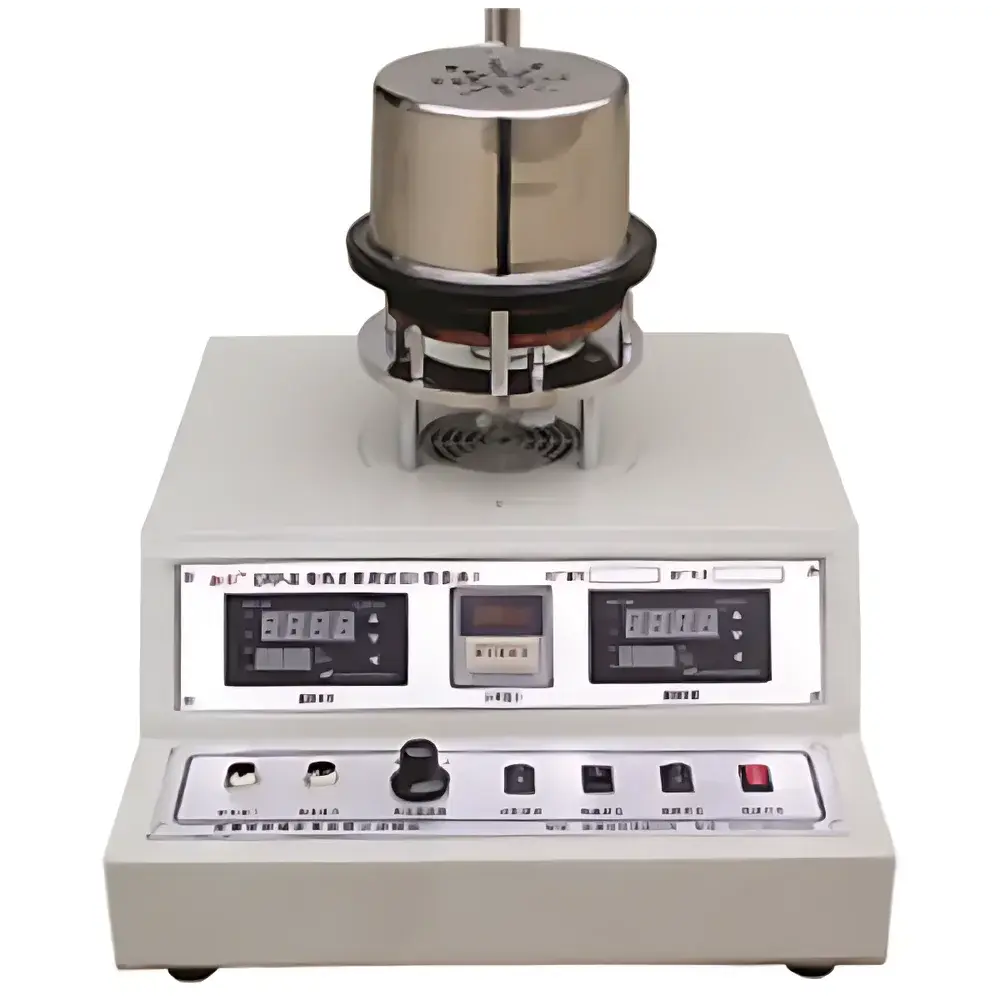
PWDRP-II Thermal Conductivity Analyzer (Steady-State Heat Flow Method)
| Brand | PW |
|---|---|
| Origin | Guangdong, China |
| Model | PWDRP-II |
| Measurement Principle | Steady-State Heat Flow (Guarded Hot Plate / Parallel Plate Method) |
| Thermal Conductivity Range | 0.1–100 W/(m·K) |
| Accuracy | ±3% |
| Repeatability | ±2% |
| Temperature Range | Ambient to 110 °C |
| Sample Forms | Solid discs, powders, pastes, liquids, adhesives, foils, and granular materials |
| Sample Diameter | Φ130 mm |
| Thickness Range | 1–100 mm |
| Heating Source | Low-voltage (36 V) copper block heater |
| Power Supply | AC 220 V, 50 Hz |
| Timer Resolution | 0.1 s (0–999.9 s) |
| Included Accessories | Two calibrated thermocouples, one aluminum reference sample, insulated test chamber, powder/paste containment frame, thermal interface compound |
Overview
The PWDRP-II Thermal Conductivity Analyzer is a precision-engineered steady-state heat flow instrument designed for reliable determination of thermal conductivity (λ) in heterogeneous solid, semi-solid, and fluid materials under controlled temperature conditions. Based on the guarded hot plate principle—compliant with ASTM C177 and ISO 8302—the system establishes a unidirectional, steady-state temperature gradient across a planar sample sandwiched between two parallel plates: a heated upper plate and a cooled lower plate. Heat flux is measured via calibrated thermocouples embedded in the plates and sample interfaces, while temperature differentials are monitored with high-stability sensors. The resulting λ value is calculated using Fourier’s law: λ = q·δ/ΔT, where q is the measured heat flux (W/m²), δ is sample thickness (m), and ΔT is the steady-state temperature difference (K) across the sample. Engineered for laboratory-based quality control and R&D validation, the PWDRP-II operates within ambient to 110 °C, supporting method development for thermal interface materials (TIMs), insulation composites, battery thermal management layers, and functional coatings.
Key Features
- Steady-state parallel-plate architecture with integrated 36 V low-voltage copper block heater—ensuring electrical safety and thermal uniformity.
- Dual high-accuracy thermocouples (Type K) for simultaneous measurement of surface temperatures at both sample interfaces.
- Digitally controlled temperature regulation with ±1 °C stability over the full operating range (ambient to 110 °C).
- High-resolution digital timer (0.1 s resolution, up to 999.9 s) synchronized with thermal equilibrium detection for precise dwell-time validation.
- Modular sample fixture system: includes standardized Φ130 mm disc holder, removable powder/paste containment frame with thermal boundary compensation, and optional foil clamping accessories.
- Compact, benchtop-integrated design with built-in temperature display, timer interface, and power management—no external controllers or PC required for basic operation.
Sample Compatibility & Compliance
The PWDRP-II accommodates diverse material states without requiring phase-specific instrumentation reconfiguration: rigid solids (e.g., aluminum, phenolic board), compliant elastomers (e.g., silicone rubber), low-density insulators (e.g., expanded perlite), viscous pastes and adhesives, and even low-conductivity gases when sealed in calibrated chambers. Sample thickness flexibility (1–100 mm) enables characterization of thin films and bulk monoliths alike. All measurements adhere to fundamental steady-state assumptions—uniform cross-section, negligible lateral heat loss, and thermal equilibrium confirmed via <5 mK/min drift thresholds over ≥5-minute stabilization intervals. The system supports traceable calibration per ISO/IEC 17025 requirements when used with NIST-traceable reference materials (e.g., certified aluminum, SRM 1470). It is suitable for internal QC workflows aligned with ASTM D5470 (thermal transmission properties of thermally conductive electrical insulation materials) and meets baseline criteria for GLP-compliant thermal property reporting.
Software & Data Management
While the PWDRP-II operates autonomously via front-panel controls, optional RS-232 or USB data logging enables time-synchronized acquisition of temperature, elapsed time, and calculated λ values into third-party spreadsheet or LIMS environments. Raw sensor outputs (mV from thermocouples) are accessible for advanced uncertainty analysis per GUM (JCGM 100:2008). Audit trails—including operator ID, test date/time, sample ID, and environmental ambient logs—can be appended manually or integrated via CSV export. No proprietary software is bundled; all exported data conform to ASTM E1459 and ISO/IEC 17025 documentation standards for reproducibility and regulatory review.
Applications
- Thermal interface material (TIM) qualification for electronics cooling assemblies.
- Insulation performance verification of building materials (e.g., aerogels, cork composites, mineral wool).
- R&D screening of polymer nanocomposites and phase-change materials (PCMs).
- Quality assurance of battery module thermal pads and graphite heat spreaders.
- Academic research on anisotropic conduction in layered or filled composites.
- Regulatory submission support for medical device thermal management dossiers (per ISO 10993-5 biocompatibility testing context).
FAQ
What standards does the PWDRP-II comply with?
It follows the physical principles and procedural logic of ASTM C177, ISO 8302, and ASTM D5470, with hardware design enabling compliance when operated per documented SOPs.
Can it measure anisotropic materials?
Yes—by orienting samples to align preferred conduction axes perpendicular to the heat flow direction; directional λ must be reported with explicit orientation metadata.
Is calibration traceable to national standards?
Calibration requires user-supplied NIST-traceable reference materials; the system provides stable, repeatable platform conditions necessary for accredited lab implementation.
How is edge loss minimized during testing?
The integrated guard ring design and low-thermal-conductivity insulation chamber suppress lateral heat leakage to <2% of total flux under standard configurations.
Does it support automated multi-sample sequencing?
No—each test is manually initiated and monitored; however, consistent operator protocols yield ≤±2% repeatability across sequential runs.



