
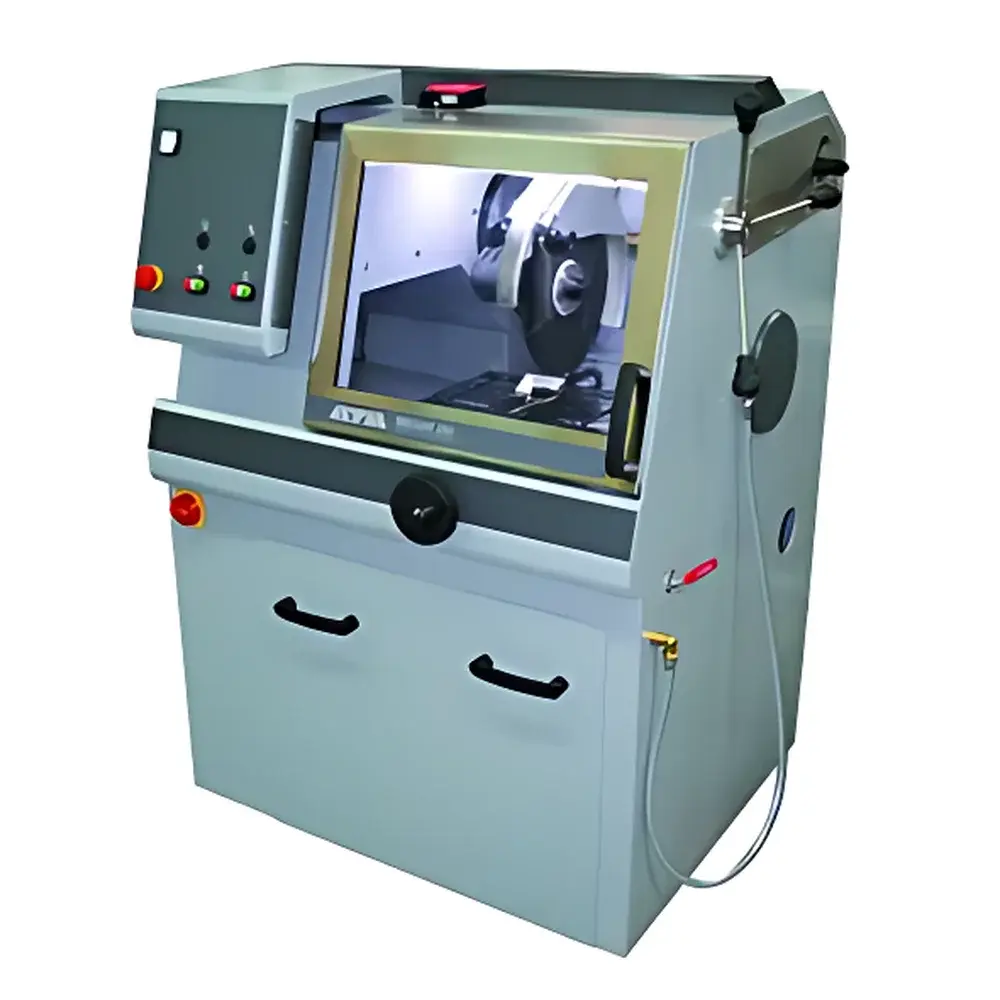
QATM Brillant 255 Manual Vertical Abrasive Cut-Off Machine
| Brand | QATM |
|---|---|
| Origin | Germany |
| Model | Brillant 255 |
| Cutting Method | Wet abrasive cutting |
| Drive Type | Manual feed (Y/X axes) with optional manual Z-axis for parallel sectioning |
| Frame Material | Powder-coated aluminum alloy |
| Cutting Chamber | Side-access, large-volume |
| Clamping System | T-slot table with modular fixture compatibility |
| Force Control | Gear-disk regulated longitudinal feed |
| Height Adjustment | Stepless gear-disk locking for wheel vertical positioning |
| Illumination | Integrated LED lighting |
| Alignment Aid | Built-in laser positioning system |
| Safety Interlock | Motorized door interlocked with wheel rotation status |
| Compliance | Designed per EN ISO 12100, EN 60204-1, and EN 62061 for mechanical and electrical safety in laboratory environments |
Overview
The QATM Brillant 255 is a precision-engineered, manually operated vertical abrasive cut-off machine designed for reproducible, low-distortion specimen preparation in metallurgical, materials science, and quality control laboratories. It employs wet abrasive cutting—using water-cooled silicon carbide or diamond-impregnated wheels—to minimize thermal damage and microstructural alteration during sectioning. Its rigid aluminum frame, powder-coated for chemical resistance and durability, supports stable kinematics across the Y (longitudinal), X (transverse), and optionally Z (vertical stacking) axes. Unlike automated systems, the Brillant 255 prioritizes operator control and tactile feedback: feed force is precisely modulated via a calibrated gear-disk mechanism, enabling consistent material removal rates even on heterogeneous or brittle samples. The side-access chamber accommodates elongated components up to 255 mm in height and permits uninterrupted cutting of serial specimens without repositioning. This architecture aligns with standardized metallographic specimen preparation workflows defined in ASTM E3, ISO 14487, and EN 10365.
Key Features
- Rigid powder-coated aluminum housing with vibration-damped cutting arm—reduces operational noise below 72 dB(A) at 1 m distance.
- Two-axis manual feed system (Y/X) with micrometer-scale repeatability; fine-tuned via dual gear-disk controls for both longitudinal feed force and vertical wheel height locking.
- Optional manual Z-axis cross-feed integrated into the T-slot table—enables parallel sectioning of multiple specimens with fixed spacing accuracy of ±0.1 mm.
- Integrated Class II laser alignment system projects a visible reference line directly onto the sample surface, supporting pre-cut positioning within ±0.2 mm tolerance.
- LED illumination module mounted inside the cutting chamber provides uniform, shadow-free lighting (5000 K CCT, >80 CRI) without heat emission or bulb degradation over time.
- Electromechanical safety interlock ensures the transparent polycarbonate access door remains locked until the abrasive wheel decelerates to <10 rpm—compliant with EN 62061 SIL 2 requirements.
Sample Compatibility & Compliance
The Brillant 255 accepts specimens ranging from small weld coupons (≥5 mm × 5 mm) to long rods or extrusions (up to Ø100 mm × 300 mm L). Its T-slot table (180 mm × 220 mm) supports QATM’s full range of mechanical clamps—including vise-type, rotary, and multi-angle fixtures—for irregular geometries such as turbine blades, castings, or additively manufactured parts. All wet-cutting operations comply with OSHA 1910.215(a)(3) and EU Directive 2006/42/EC for abrasive wheel machinery. The machine’s water recirculation path includes a sediment trap and optional filtration unit to maintain coolant clarity per ASTM D4294 specifications. Documentation includes CE Declaration of Conformity, RoHS compliance statement, and traceable calibration certificate for the laser alignment subsystem.
Software & Data Management
As a fully manual platform, the Brillant 255 does not incorporate embedded software or digital data logging. However, its mechanical repeatability and deterministic feed parameters support GLP-compliant recordkeeping: operators log feed settings (gear-disk position index), wheel type/diameter, coolant flow rate (measured separately), and cut duration in paper-based or LIMS-integrated worksheets. Optional accessories include a digital tachometer for rotational speed verification and a calibrated torque wrench for clamp tightening validation—both traceable to NIST standards. For laboratories under FDA 21 CFR Part 11 or ISO/IEC 17025 accreditation, procedural SOPs for Brillant 255 operation are available upon request and include audit-trail documentation templates.
Applications
- Preparation of transverse and longitudinal sections for optical microscopy (OM), scanning electron microscopy (SEM), and energy-dispersive X-ray spectroscopy (EDS).
- Cutting of hard metals (e.g., tool steels, Inconel, Ti-6Al-4V) and ceramic composites where wire sawing induces cracking.
- Serial sectioning of fatigue-tested specimens for crack propagation analysis per ASTM E647.
- Dimensional reduction of additively manufactured parts prior to HIP or heat treatment qualification.
- Sectioning of coated substrates (e.g., thermal barrier coatings) with minimal delamination risk due to low-force, water-cooled cutting.
FAQ
What abrasive wheel sizes are compatible with the Brillant 255?
Standard mounting accepts 250 mm diameter wheels with 32 mm bore and maximum thickness of 3.2 mm. Optional adapters support 200 mm and 300 mm wheels.
Is coolant flow rate adjustable, and how is it monitored?
Yes—the integrated ball valve allows continuous adjustment from 0.5 to 3.0 L/min; flow is verified using an inline rotameter calibrated to ±2% FS.
Can the laser alignment be recalibrated in-house?
Yes—QATM supplies a calibration kit including alignment target plate and procedure manual; recalibration requires no special tools and takes <10 minutes.
Does the machine meet requirements for ISO/IEC 17025 accredited labs?
Yes—when operated per documented SOPs and maintained per QATM’s scheduled service protocol (including annual gear-disk backlash verification), it satisfies clause 6.4.3 on equipment suitability.
What is the maximum recommended cutting depth per pass for hardened steel?
For HRC 60–65 tool steels using a resin-bonded SiC wheel (250 × 3.2 × 32 mm), the recommended single-pass depth is ≤0.3 mm at 2800 rpm and 2.0 L/min coolant flow.



