
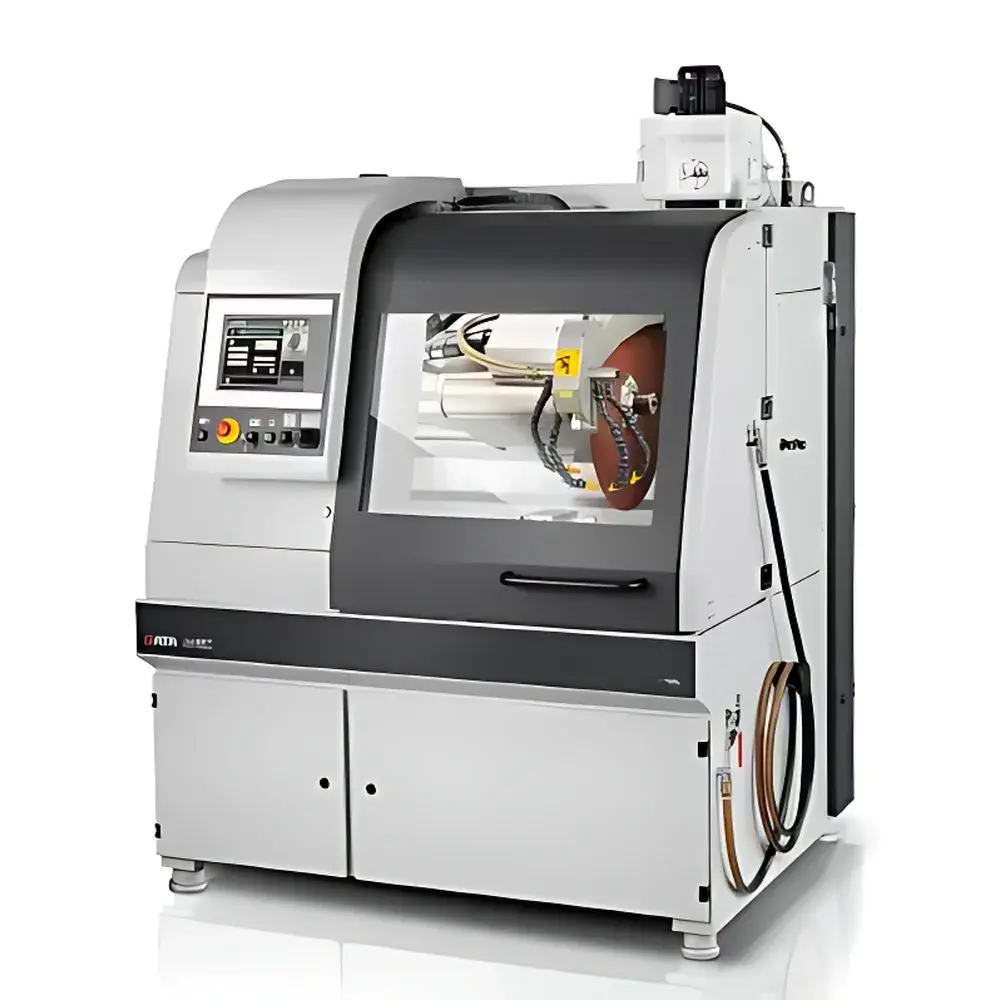
QATM Qcut 600 BOT Vertical Automated Precision Cutting Machine
| Brand | QATM |
|---|---|
| Origin | Germany |
| Model | Qcut 600 BOT |
| Instrument Type | Wet Abrasive Wheel Cutting Machine |
| Maximum Wheel Diameter | 610 mm (24") |
| Max Cutting Depth | 244 mm |
| X-Axis Travel | 550 mm |
| Y-Axis Travel | 360 mm |
| Z-Axis Travel | 550 mm |
| Z-Axis Positioning Accuracy | 0.1 mm |
| B-Axis Rotation Range | ±200° (5-axis), 360° (4-axis) |
| C-Axis Rotation Range | 360° |
| Table Diameter | Ø600 mm, Stainless Steel |
| T-Slot Width | 12 mm |
| Spindle Speed | 1000–2400 rpm (variable) |
| Main Motor Power | 15 kW (S1 duty) |
| Electrical Supply | 30 kVA |
| Dimensions (W×H×D) | 1640 × 2200 × 1480 mm |
| Approx. Weight | 1600 kg |
Overview
The QATM Qcut 600 BOT is a high-precision, vertically oriented, fully automated abrasive cutting system engineered for demanding metallurgical and materials science laboratories. Built on a rigid, vibration-damped steel frame and designed in Germany, it employs wet abrasive wheel cutting—based on controlled mechanical abrasion with water-cooled silicon carbide or diamond-impregnated wheels—to produce distortion-free, thermally stable cross-sections of metallic, ceramic, composite, and polymer specimens. Its five-axis kinematic architecture (X, Y, Z, B, and C) enables complex multi-angle, multi-plane cuts—including bevels, stepped sections, and off-axis slices—without manual repositioning. This eliminates cumulative alignment errors and significantly improves repeatability across serial sample preparation workflows, particularly for failure analysis, metallography, and quality control applications governed by ASTM E3, ISO 14487, and EN 10365 standards.
Key Features
- Five-axis CNC-controlled motion system (X/Y/Z linear + B/C rotational axes) supporting simultaneous coordinated movement for contour cutting and angular sectioning.
- Large-diameter stainless-steel rotary table (Ø600 mm) with integrated 12 mm T-slots, enabling secure, customizable fixturing of irregular or oversized samples up to 600 mm in diameter.
- Precision Z-axis positioning with ±0.1 mm repeatability, critical for maintaining consistent cut depth and minimizing material removal variability.
- Variable-speed spindle (1000–2400 rpm) optimized for torque delivery across wheel diameters up to 610 mm (24″), ensuring optimal wheel life and surface integrity.
- Integrated coolant circulation system with optional belt-type filter unit, maintaining stable temperature and particulate control during extended operation.
- Full-enclosure safety design featuring interlocked sliding front door and side access panels, compliant with EN ISO 13857 and EN 60204-1 requirements.
- Dynamic wheel wear compensation algorithm that automatically adjusts feed rate and plunge depth based on real-time wheel diameter monitoring.
Sample Compatibility & Compliance
The Qcut 600 BOT accommodates a broad spectrum of specimen geometries and materials—including cast iron, hardened steels, aluminum alloys, titanium, refractory metals, WC-Co composites, and fiber-reinforced polymers—without requiring secondary mounting or embedding for most routine cuts. Its modular clamping interface supports custom fixtures, vacuum chucks, and hydraulic vices for high-volume or high-tolerance preparation. The system meets CE marking requirements and adheres to key international standards for laboratory sample preparation equipment: ASTM E3-22 (Standard Guide for Preparation of Metallographic Specimens), ISO 14487:2021 (Metallographic sampling and sectioning), and EN 10365 (Dimensional tolerances for hot-rolled steel sections). All operational logs—including cycle start/stop timestamps, axis positions, coolant flow status, and emergency stops—are timestamped and stored for GLP/GMP audit readiness.
Software & Data Management
Operation is managed via QATM’s proprietary Qcut Control Suite—a Windows-based HMI with intuitive graphical programming interface. Users define cutting sequences using drag-and-drop path planning, parameter presets (feed rate, rpm, coolant flow), and conditional logic (e.g., “if wheel diameter < 590 mm, reduce feed by 15%”). The software supports import of DXF geometry files for direct contour translation and exports ASCII-formatted process logs compatible with LIMS integration. Audit trail functionality complies with FDA 21 CFR Part 11 requirements through electronic signatures, user-level access control (admin/operator/maintainer roles), and immutable event logging. Firmware updates are delivered via encrypted USB media; no cloud connectivity is required, preserving data sovereignty in regulated environments.
Applications
- Preparation of transverse, longitudinal, and oblique sections for optical/electron microscopy in failure analysis labs.
- High-accuracy sectioning of weld joints, heat-affected zones (HAZ), and clad materials per AWS D1.1 and ISO 15614-1 protocols.
- Routine QC cutting of incoming raw materials (billets, bars, tubes) prior to hardness or tensile testing.
- Sectioning of additively manufactured components where layer orientation and support structure removal require precise angular control.
- Research-grade specimen fabrication for synchrotron X-ray tomography, where minimal kerf loss and subsurface deformation are mandatory.
FAQ
What types of cutting wheels are compatible with the Qcut 600 BOT?
Standard flange sizes are Ø32 mm and Ø40 mm; wheels up to 610 mm diameter with arbor hole tolerances per DIN 69871 are supported. Diamond, cubic boron nitride (CBN), and resin-bonded silicon carbide wheels are routinely used.
Does the system support remote diagnostics or predictive maintenance?
Yes—via optional Ethernet-enabled service port, authorized technicians can perform firmware verification, drive health assessment, and lubrication cycle validation without physical access.
Can the Qcut 600 BOT be integrated into an automated lab workflow with robotic sample handling?
It features standard I/O signals (24 V DC, opto-isolated) and Modbus TCP support for synchronization with third-party gantry robots or conveyor systems.
Is operator training included with purchase?
QATM provides on-site commissioning and two-day certified operator training covering safety protocols, program creation, maintenance routines, and compliance documentation generation.
What is the recommended maintenance interval for the central lubrication system?
Automatic grease dosing occurs every 200 operating hours; full system inspection—including spindle bearing preload check and coolant filter replacement—is scheduled every 1,500 hours or annually, whichever occurs first.



