
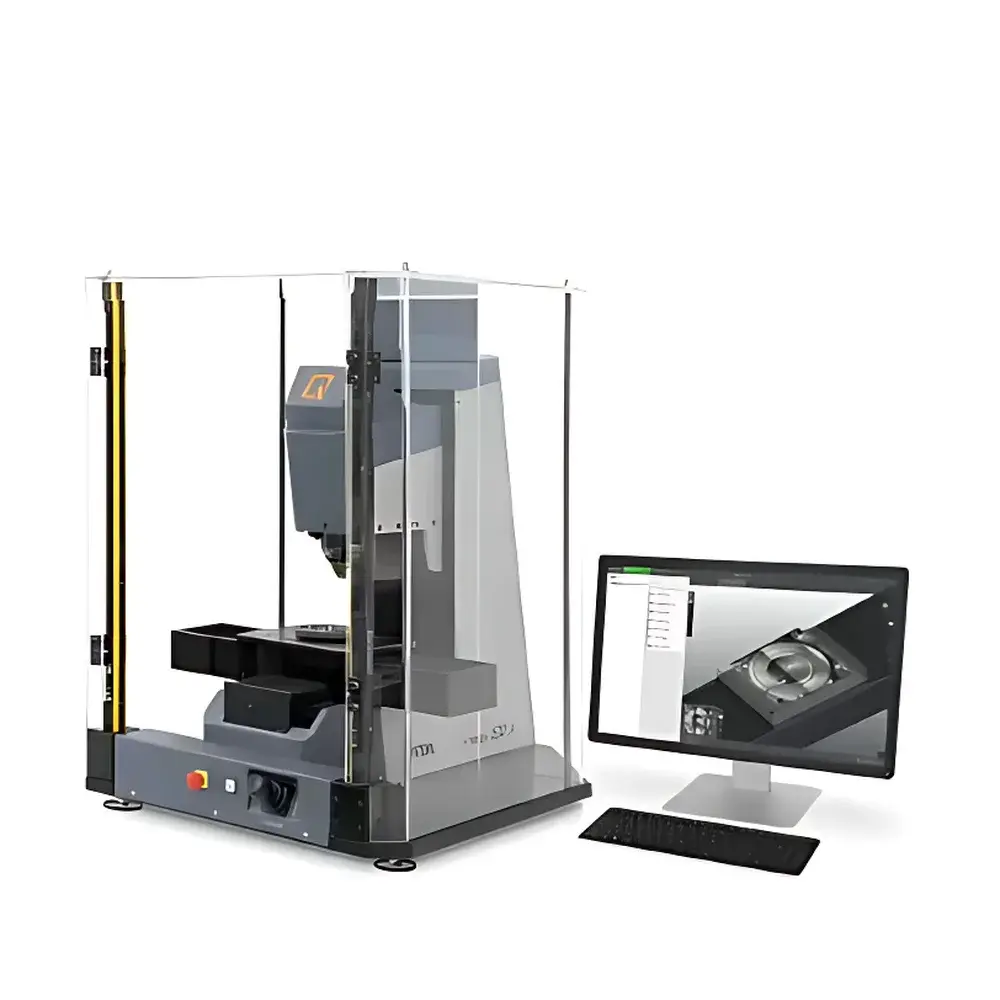
QATM QNESS 150 A/A+ Rockwell Hardness Tester
| Brand | QATM |
|---|---|
| Origin | Austria |
| Model | QNESS 150 A/A+ |
| Instrument Type | Rockwell Hardness Tester |
| Test Force Range | 1–250 kg (9.81–2450 N) |
| Test Height / Throat Depth | 187 mm / 180 mm (extendable to 377 mm) |
| Maximum Specimen Weight | 50 kg |
| Motorized Cross-Table Dimensions | 170 × 250 mm |
| Height Adjustment Speed | up to 6 mm/s |
| Power Supply | 230 V~1/N/PE or 110 V~1/N/PE |
| Max. Power Consumption | ~240 W |
| Host Weight | 120 kg (137 kg with height extension) |
| Interface | 3× USB |
| Software | Qpix Control2 |
| Optional Features | Dual high-resolution camera system (up to 2×), panoramic camera (A+ only), motorized anvil/cross-table, Jominy fixture, multi-specimen holders, interchangeable indenters and objectives |
Overview
The QATM QNESS 150 A/A+ is a fully automated, microprocessor-controlled Rockwell hardness testing system engineered for precision, repeatability, and compliance in industrial quality control and R&D laboratories. Based on the standardized Rockwell principle—measuring permanent depth deformation under major and minor loads—the instrument applies calibrated forces ranging from 1 kgf to 250 kgf (9.81 N to 2450 N) using hardened steel or diamond indenters, enabling evaluation across all standard Rockwell scales (e.g., HRA, HRB, HRC, HRD, HRF, HRG, HRH, HRR, HR15N–HR45T). Designed and manufactured in Austria, the QNESS 150 platform integrates mechanical robustness with digital metrology, featuring a rigid C-frame architecture, temperature-compensated load cell feedback, and closed-loop force control to ensure ASTM E18 and ISO 6508-1 conformity across its full test range.
Key Features
- Fully motorized operation: programmable height adjustment (up to 6 mm/s), motor-driven cross-table (170 × 250 mm travel), and automatic indenter/objective changer (optional)
- Dual configuration flexibility: QNESS 150 A offers core Rockwell functionality with optional high-resolution imaging; QNESS 150 A+ adds integrated panoramic camera for full-field specimen overview and alignment verification
- Expandable test envelope: standard throat depth of 180 mm and test height of 187 mm—extendable to 377 mm for tall or irregularly shaped components
- Load accuracy certified to ±0.5% of reading per ASTM E18 Annex A1, with real-time force monitoring and dynamic compensation for mechanical hysteresis
- Robust construction: cast-iron base and column, vibration-damped design, and 120 kg operational mass ensuring stability during high-force indentation cycles
- Comprehensive safety: interlocked enclosure, emergency stop, overload protection, and automatic indenter retraction post-test
Sample Compatibility & Compliance
The QNESS 150 accommodates specimens up to 50 kg and supports diverse geometries via motorized cross-table positioning and customizable fixturing—including single/multi-specimen holders, Jominy end-quench sample clamps, and specialized anvil configurations for curved or thin-section parts. All hardware and software comply with ISO/IEC 17025 requirements for testing laboratories, and the system is configurable for GLP/GMP environments with audit-trail-enabled Qpix Control2 software. It meets essential regulatory expectations for hardness validation in aerospace (AMS 2242), automotive (VDA 5), and medical device manufacturing (ISO 13485), and supports traceable calibration per ISO 6508-2 and national metrology institute standards.
Software & Data Management
Qpix Control2 serves as the central interface for method definition, test execution, statistical analysis, and report generation. The software enables full parameter scripting (load sequence, dwell times, scale selection, repeat counts), real-time force/depth curve visualization, and automatic pass/fail evaluation against user-defined tolerance bands. Data export conforms to ASTM E140 and ISO 6508-3 reporting formats, with CSV, PDF, and XML outputs. For regulated environments, optional 21 CFR Part 11 compliance modules provide electronic signatures, role-based access control, and immutable audit trails. Integration with LIMS and MES systems is supported via OPC UA and TCP/IP protocols.
Applications
- Heat treatment verification: case depth assessment, carburizing/nitriding process validation, and tempering uniformity checks
- Metallurgical QA/QC: incoming material inspection, lot release testing, and supplier qualification per ASTM A370 or EN 10002
- Failure analysis labs: correlation of hardness gradients with microstructural features observed via metallography
- R&D of advanced alloys: high-temperature hardness mapping, coating-substrate interface evaluation, and tribological performance screening
- Automotive powertrain testing: camshaft, gear, and bearing component hardness profiling under production-representative conditions
FAQ
What Rockwell scales are supported by the QNESS 150 A/A+?
The system supports all standard Rockwell and superficial Rockwell scales (e.g., HRA–HR45T) through interchangeable diamond cone and ball indenters, programmable minor/major loads, and automatic scale recognition.
Is the system compatible with existing calibration workflows?
Yes—certified reference blocks (e.g., NIST-traceable SRMs) are fully supported, and the instrument accepts third-party calibration certificates aligned with ISO 6508-2 and DKD-R 3-7 guidelines.
Can test data be exported to enterprise quality systems?
Absolutely—Qpix Control2 provides structured data export (CSV, XML), direct database connectivity, and optional OPC UA server for seamless integration into SAP QM, Siemens Opcenter, or custom MES platforms.
What maintenance intervals are recommended?
Annual verification of force application and depth measurement subsystems is advised; daily cleaning of the indenter and anvil, plus quarterly lubrication of the Z-axis drive mechanism, ensures long-term metrological integrity.
Does the A+ model offer enhanced measurement uncertainty?
No—measurement uncertainty is identical between A and A+ models; the A+ variant adds panoramic imaging capability for improved setup reproducibility and operator-independent alignment, not improved intrinsic hardness uncertainty.



