
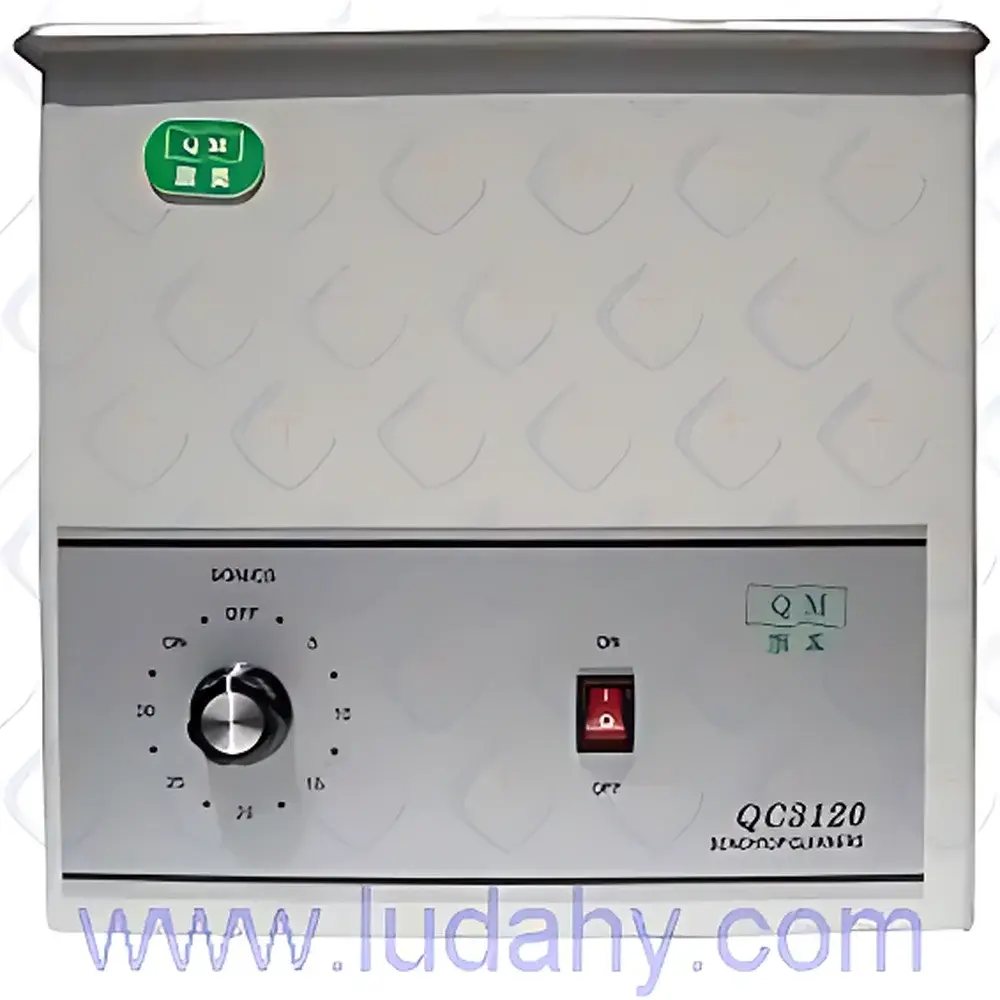
QC Series Ultrasonic Cleaner
| Origin | Tianjin, China |
|---|---|
| Manufacturer Type | Authorized Distributor |
| Product Origin | Domestic (China) |
| Model | QC3120 (Extended Range Available) |
| Pricing | Upon Request |
| Tank Dimensions | 235 × 135 × 100 mm |
| Capacity | 3 L |
| Ultrasonic Power Output | 120 W |
| Heating Function | Not Integrated |
| Temperature Control | Not Available |
| Timer | Mechanical, Adjustable up to 30 min |
Overview
The QC Series Ultrasonic Cleaner is an engineered solution for precision cleaning of laboratory glassware, precision components, surgical instruments, and analytical sample preparation tools. It operates on the principle of high-frequency ultrasonic cavitation—generating controlled micro-bubbles in liquid media that collapse with localized energy release, effectively dislodging particulate contaminants, organic residues, and biofilms from surfaces without mechanical abrasion. Unlike conventional fixed-frequency ultrasonic cleaners, the QC Series employs pulse-modulated ultrasonic drive technology: the transducer output is delivered in precisely timed bursts, with each pulse amplitude maintained above the cavitation threshold. This ensures consistent energy delivery into the cleaning medium while minimizing standing-wave formation and thermal drift—resulting in improved cleaning uniformity, reduced sample degradation risk, and enhanced reproducibility across repeated cycles.
Key Features
- Pulse-modulated ultrasonic generation—optimized for sustained cavitation efficiency and minimized acoustic shadowing
- Mechanical timer with robust rotary dial interface (0–30 minute range), offering fail-safe operation without reliance on electronic firmware or battery backup
- Stainless steel tank construction (SUS304 grade) with rounded internal corners to prevent residue accumulation and facilitate cleaning validation
- Integrated degas mode (manual activation) to accelerate removal of dissolved air prior to critical cleaning cycles
- Over-current and over-temperature protection circuits compliant with IEC 61010-1 safety standards for laboratory equipment
- Compact footprint design suitable for benchtop integration in ISO Class 5–7 cleanrooms and regulated QC laboratories
Sample Compatibility & Compliance
The QC3120 model accommodates standard laboratory vessels including volumetric flasks (up to 1 L), chromatography vials, pipette tips, filter housings, and small-diameter tubing assemblies. Its 3 L tank volume supports batch cleaning of multiple items while maintaining adequate liquid depth (≥75 mm) for effective acoustic coupling. The unit meets general requirements for non-sterile pre-cleaning steps defined in ISO 15883-1 (washer-disinfectors) and ASTM D2601 (standard practice for ultrasonic cleaning of metal parts). Though not certified as a medical device sterilizer, it is routinely deployed in GLP-compliant environments for instrument decontamination prior to HPLC column rinsing, ICP-MS sample introduction system maintenance, and SEM sample mounting preparation. No heating or temperature regulation functionality is included—ensuring compliance with protocols requiring ambient-temperature cleaning to avoid thermal denaturation or volatile loss.
Software & Data Management
The QC3120 operates as a standalone analog-controlled instrument with no embedded software, network interface, or data logging capability. This architecture eliminates cybersecurity concerns, firmware update dependencies, and audit trail complexity—making it suitable for environments where regulatory simplicity is prioritized (e.g., ISO/IEC 17025-accredited testing labs performing routine equipment maintenance). All operational parameters are set manually via front-panel controls; no computer interface, USB port, or cloud connectivity is provided. For laboratories requiring electronic recordkeeping, external time-stamped video documentation or manual logbook entries (per SOP-CLN-004) are recommended for traceability during cleaning validation studies.
Applications
- Cleaning of HPLC injection valves, autosampler needles, and flow cell components
- Removal of residual solvents and matrix deposits from GC inlet liners and septa
- Preparation of TEM grid supports and AFM calibration samples
- Decontamination of reusable pipette tips and electrophoresis combs prior to nucleic acid analysis
- Routine maintenance of optical cuvettes, spectrophotometer cells, and refractometer prisms
- Supporting ASTM E2912 (standard guide for ultrasonic cleaning verification) through repeatable cycle timing and power consistency
FAQ
Does the QC3120 include a heater or temperature control function?
No. The QC3120 is designed exclusively for ambient-temperature ultrasonic cleaning. Heating elements and thermostatic regulation are omitted to ensure stability in temperature-sensitive applications and simplify qualification documentation.
Is this unit suitable for cleaning delicate optical components such as lenses or coated mirrors?
Yes—when used with low-surface-tension, non-ionic detergent solutions and appropriate dwell times (typically 2–5 minutes), the pulse-modulated output minimizes micro-pitting risk compared to continuous-wave systems. Always verify compatibility with substrate material specifications before deployment.
Can the QC3120 be validated for use in GMP-regulated environments?
It can be incorporated into GMP workflows as a non-critical cleaning aid, provided operational parameters (timer setting, solution composition, and bath replacement frequency) are defined in written procedures and verified per Annex 15 of the EU GMP Guidelines.
What is the expected service life of the piezoelectric transducers under normal laboratory usage?
Based on accelerated aging tests per IEC 60068-2-64, transducers maintain ≥92% nominal output after 10,000 operating hours when operated within specified duty cycles (≤30 min ON / 15 min OFF).
Are replacement tanks or custom tank inserts available for the QC3120?
Standard SUS304 tank replacements are available through authorized distributors. Custom geometries require minimum order quantities and extended lead times; engineering consultation is required prior to quotation.



