
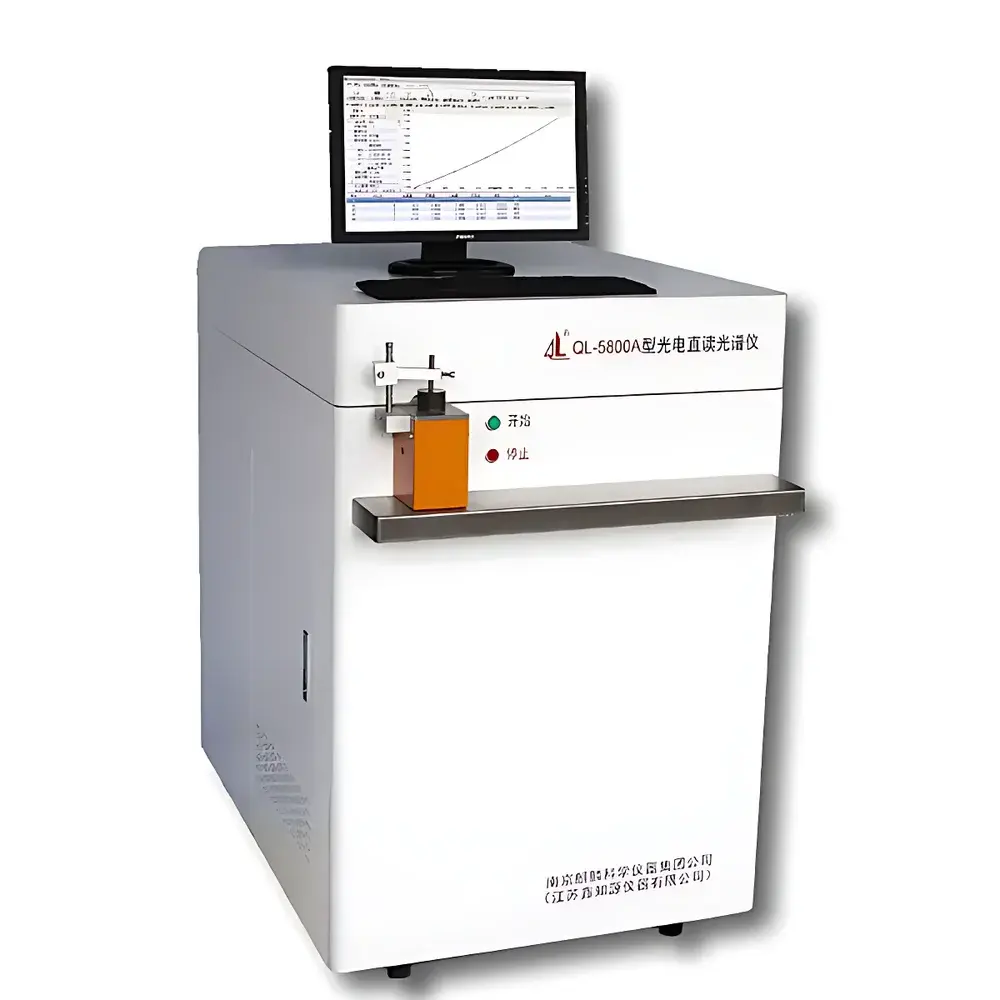
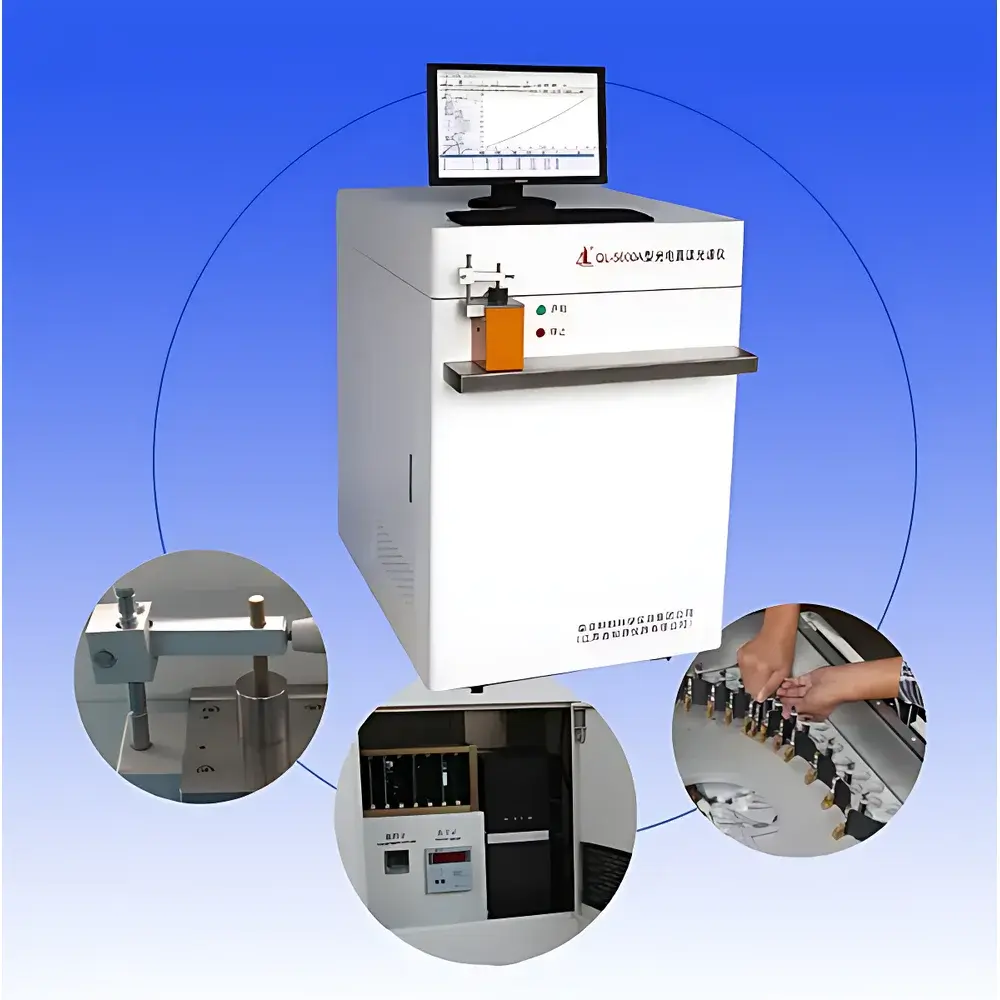
Qilin QL-5800A Spark Emission Direct-Reading Optical Emission Spectrometer (OES)
| Brand | Qilin |
|---|---|
| Model | QL-5800A |
| Instrument Type | Floor-standing |
| Excitation Method | Spark discharge |
| Detector Type | Photomultiplier Tube (PMT) |
| Focal Length | 750 mm |
| Grating Groove Density | 2400 lines/mm |
| Wavelength Range | 130–600 nm |
| Number of Channels | 32 |
| Operating Environment | Argon-purged optical chamber |
| Optical Stability | Thermostatically controlled at 38 °C ±0.2 °C |
| Dimensions (L×W×H) | 1120 × 750 × 920 mm |
| Net Weight | 266 kg |
Overview
The Qilin QL-5800A Spark Emission Direct-Reading Optical Emission Spectrometer is a floor-standing, argon-purged OES system engineered for high-precision elemental analysis of solid metallic samples in industrial and quality control laboratories. Based on the fundamental principle of spark-induced atomic emission spectroscopy, the instrument vaporizes and excites surface material from conductive metal samples using a controlled high-energy spark discharge. The resulting polychromatic light is dispersed by a high-resolution 750 mm focal length Czerny-Turner spectrometer with a 2400 lines/mm holographically ruled concave grating, enabling accurate wavelength separation across the ultraviolet-to-visible range (130–600 nm). Detection is performed via an array of imported photomultiplier tubes (PMTs), each optimized for specific spectral lines, delivering high signal-to-noise ratio, long-term stability, and low dark current — critical attributes for reproducible quantitative analysis in compliance-critical environments.
Key Features
- 750 mm focal length Paschen-Runge mount spectrometer with vacuum-sealed optical path, ensuring minimal air absorption below 190 nm and optimal resolution for trace element detection (e.g., C, P, S, N).
- Digitally controlled spark source with adjustable frequency (100–1000 Hz), peak current (up to 120 A pre-ignition, 30 A exposure), and dynamically regulated DC voltage (300 V), allowing tailored excitation for diverse matrices including Fe, Al, Cu, Ni, Mg, Zn, Pb, Sn, and Co.
- Thermostatically stabilized optical bench maintained at 38 °C ±0.2 °C, minimizing thermal drift and guaranteeing long-term calibration stability without external air conditioning.
- High-integration PMT detection system with 32 configurable channels; each PMT operates with independently adjustable negative high voltage (–550 V to –1000 V) across eight discrete steps, optimizing linearity and dynamic range per analytical line.
- Argon-flushed spark stand with fixed 4 mm inter-electrode gap; no water cooling required, enabling uninterrupted sequential analysis of >50 samples per hour with consistent precision (RSD ≤ 0.2% for major elements).
- Linear motor-driven entrance slit scanning mechanism and fixed exit slits (50 µm / 75 µm), supporting rapid multi-element acquisition and future channel expansion up to 48.
- Dedicated single-board measurement and control unit interfacing with host PC via high-speed serial protocol, reducing latency and improving data throughput during integration time segmentation.
Sample Compatibility & Compliance
The QL-5800A is validated for direct analysis of flat, polished, conductive solid metal samples ≥20 mm in diameter and ≥5 mm in thickness. It supports standardized sample preparation per ISO 11577, ASTM E415, and GB/T 4336. Its argon-purged optical chamber meets requirements for UV-sensitive element quantification (C, P, S, B, As) in low-alloy steels and aluminum alloys. The instrument architecture supports audit-ready operation under GLP and GMP frameworks: full measurement traceability (including integration times, HV settings, spark parameters), user-accessible calibration logs, and exportable raw intensity data compliant with LIMS integration protocols. While not natively 21 CFR Part 11 certified, its software architecture permits configuration of electronic signatures, role-based access control, and immutable audit trails when deployed with validated third-party laboratory informatics systems.
Software & Data Management
The QL-5800A operates under a Windows-based native application with bilingual interface support (English/Chinese). Core functions include automated calibration curve generation using certified reference materials (CRMs), matrix-matched standardization, interference correction algorithms (e.g., inter-element and background corrections), and real-time intensity ratio calculation relative to internal reference lines. All spectral data — including raw intensities, net intensities, corrected concentrations, and QC flags — are stored in a relational database compliant with SQL standards. Export formats include CSV, XML, and ASTM E1382-compliant ASCII reports. Remote data transmission is supported via TCP/IP, enabling centralized monitoring across multi-instrument networks. Software updates and method backups are managed through version-controlled archives with timestamped metadata.
Applications
The QL-5800A serves as a primary analytical tool in foundry process control, steelmaking ladle analysis, incoming raw material verification, and final product certification. Typical use cases include rapid grade identification of carbon steels (AISI/SAE, EN 10027), aluminum alloy composition verification (AA series, EN AW), copper-base alloy sorting (brass, bronze), and trace impurity screening in high-purity nickel and cobalt superalloys. Its robust spark source and stable PMT response make it especially suitable for high-volume production QA/QC labs requiring <60-second turnaround per sample with sub-ppm detection limits for key residuals (e.g., As, Sn, Pb in electrical steels). The system is routinely deployed in ISO/IEC 17025-accredited laboratories for conformity assessment against EN 10204 3.1 certificates.
FAQ
What types of metals can be analyzed with the QL-5800A?
It supports ferrous (Fe-based), non-ferrous (Al, Cu, Ni, Mg, Zn, Pb, Sn, Co), and refractory (Ti, Mo) alloys — provided samples are electrically conductive, flat, and properly prepared.
Is vacuum pumping required for UV-range analysis?
No. The optical chamber is continuously purged with high-purity argon (≥99.998%), eliminating the need for mechanical vacuum pumps while maintaining transmission down to 130 nm.
Can the instrument be upgraded to add more analytical channels?
Yes. The hardware design supports expansion from 32 to up to 48 PMT channels via optional detector modules and corresponding exit slits.
What maintenance is required for long-term stability?
Routine tasks include daily argon flow verification, monthly spark stand cleaning, biannual PMT gain calibration using reference lamps, and annual grating alignment check per manufacturer service protocol.
Does the software support LIMS integration?
Yes. The system provides configurable ODBC/JDBC connectivity and ASTM E1382-compliant data export templates for seamless ingestion into enterprise LIMS platforms.





