
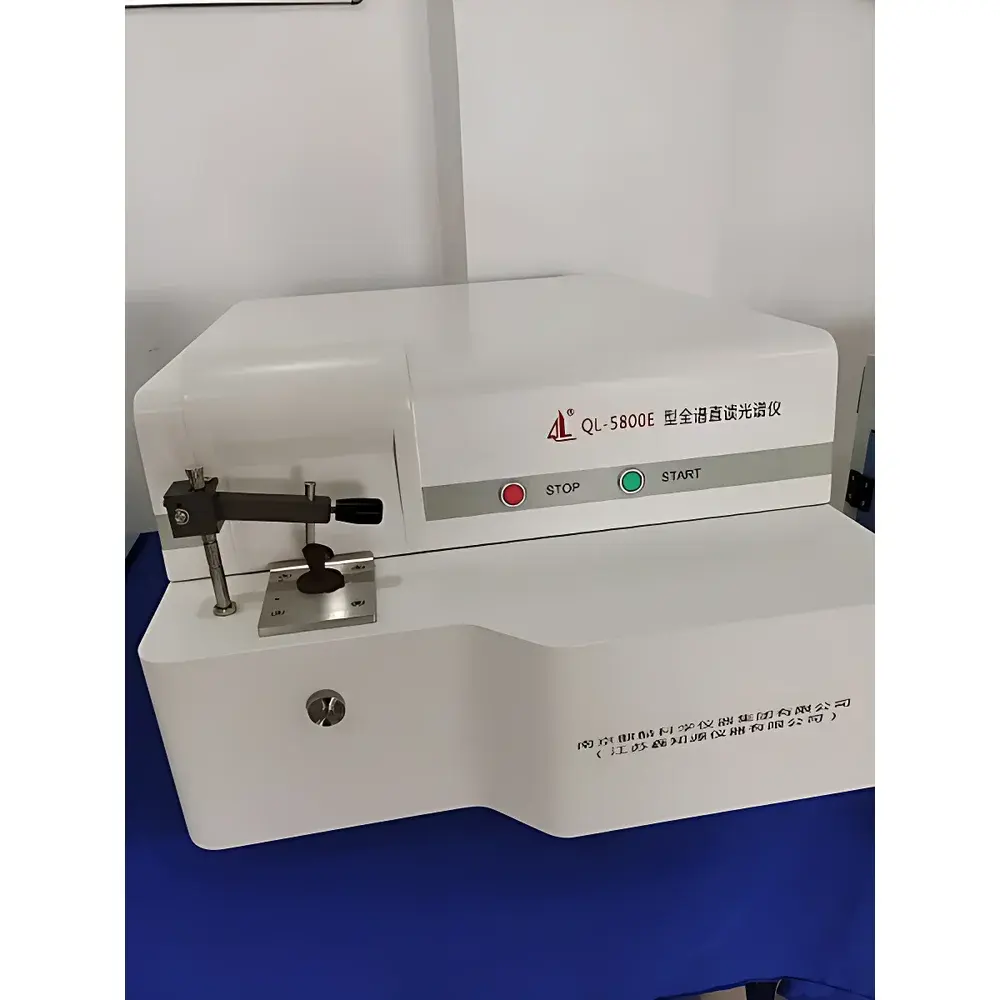
Qilin QL-5800E Full-Spectrum Direct-Reading Optical Emission Spectrometer
| Brand | Qilin / QL |
|---|---|
| Origin | Jiangsu, China |
| Manufacturer Type | Authorized Distributor |
| Regional Classification | Domestic (PRC) |
| Model | QL-5800E |
| Instrument Type | Benchtop |
| Excitation Method | Spark |
| Detector Type | CCD Array |
| Focal Length | 401 mm |
| Grating Groove Density | 2400 lines/mm |
| Wavelength Range | 140–680 nm |
| Number of Detection Channels | 60 |
Overview
The Qilin QL-5800E is a benchtop full-spectrum direct-reading optical emission spectrometer (OES) engineered for high-precision elemental analysis of solid metallic samples. It operates on the principle of spark-induced plasma emission spectroscopy: a high-energy argon-spark discharge excites atoms in the sample surface, causing them to emit characteristic ultraviolet–visible (UV–Vis) radiation. This emitted light is dispersed by a high-resolution Paschen–Runge mounting spectrometer with a Rowland circle geometry and captured across the entire spectral range (140–680 nm) using a thermoelectrically stabilized CCD array detector. Unlike traditional photomultiplier tube (PMT)-based OES systems limited to fixed analytical channels, the QL-5800E’s full-spectrum acquisition enables post-acquisition reprocessing, flexible multi-element calibration, and rapid method adaptation—without hardware modification. Its vacuum optical chamber ensures stable transmission below 190 nm, critical for accurate quantification of non-metals including C, P, S, N, B, and As in ferrous and non-ferrous matrices.
Key Features
- Paschen–Runge Optical System: Precision-machined 401 mm focal length vacuum spectrometer with 2400 lines/mm holographic grating, optimized for resolution and signal-to-noise ratio across the full UV–Vis range.
- CCD-Based Full-Spectrum Detection: High quantum efficiency CCD array with pixel-level data acquisition; supports simultaneous measurement of all elements within the wavelength window, enabling dynamic channel assignment and retrospective spectral review.
- Digital Spark Source with HEPS Technology: Fully programmable digital generator delivering 100–1000 Hz discharge frequency and adjustable energy parameters (pulse width, current, pre-spark duration) to optimize excitation for diverse matrices—from low-alloy steels to high-conductivity aluminum or copper alloys.
- Vacuum Integrity Architecture: Multi-stage oil-backstreaming prevention system featuring differential vacuum valves and inline oil traps; maintains <1 Pa vacuum in the optical chamber during operation and standby, protecting CMOS/CCD sensors from hydrocarbon contamination.
- Modular Argon Gas Management: Integrated gas control module replaces discrete solenoids and rotameters; includes electrode self-purging, real-time pressure monitoring, and optimized argon flow profiles that reduce consumption by up to 40% versus conventional designs.
- Open-Geometry Spark Stand: Tool-free sample stage with adjustable clamping force and modular fixtures accommodating irregular geometries—including rods ≥3 mm diameter, thin sheets, and castings—with consistent 4 mm inter-electrode gap maintained via tungsten jet electrode.
Sample Compatibility & Compliance
The QL-5800E supports quantitative analysis across major metallic base materials: Fe, Al, Cu, Ni, Co, Mg, Ti, Zn, Pb, Sn, and Ag. Its extended spectral coverage (140–680 nm) and vacuum optics meet ASTM E415, ISO 11577, and GB/T 4336 requirements for carbon steel analysis—including low-carbon determination down to 0.001 wt% C. The instrument architecture complies with IEC 61000-6-3 (EMC) and IEC 61010-1 (safety). Software features audit-trail logging, user access levels, and electronic signature support aligned with GLP and GMP documentation expectations. While not FDA 21 CFR Part 11–certified out-of-the-box, its TCP/IP-based communication layer and deterministic data export protocols facilitate integration into validated laboratory informatics environments.
Software & Data Management
Control and analysis are executed via Qilin SpectroSoft™—a Windows 10–compatible application offering bilingual (English/Chinese) UI, intuitive workflow navigation, and hierarchical user permissions. Core functions include automatic wavelength calibration via internal reference lines (e.g., Fe I 358.12 nm), real-time plasma monitoring (intensity, stability index), and temperature/vacuum/argon pressure telemetry. Calibration models are stored as portable .cal files; factory-preloaded curves cover >30 standard material groups (e.g., ASTM A36, EN AW-6061, UNS C11000). All raw spectra and processed results are saved in vendor-neutral ASCII formats (.csv, .txt) alongside metadata (date/time, operator ID, sample ID, instrument state). Remote diagnostics and firmware updates are supported over Ethernet using standard TCP/IP sockets—no proprietary drivers required.
Applications
The QL-5800E serves quality control laboratories in foundries, metal service centers, and component manufacturers where rapid, reproducible bulk composition verification is mission-critical. Typical use cases include incoming raw material inspection (scrap sorting, alloy grade confirmation), melt-process control (ladle analysis, continuous casting monitoring), finished-product certification (ASTM, EN, JIS compliance reporting), and failure analysis (inclusion mapping, segregation detection). Its ability to quantify trace non-metals makes it suitable for automotive powertrain materials (e.g., crankshaft steel C/P/S specification), aerospace titanium alloys (Al, V, Fe, O), and electronic-grade copper (Ag, Bi, Se impurities). The absence of PMT replacement cycles and minimal consumables (tungsten electrodes, argon) lowers total cost of ownership compared to legacy sequential OES platforms.
FAQ
What base materials can the QL-5800E analyze?
It supports Fe, Al, Cu, Ni, Co, Mg, Ti, Zn, Pb, Sn, and Ag-based alloys—with dedicated calibrations available for common standards in each group.
Is vacuum pump maintenance required regularly?
The integrated vacuum system uses a maintenance-free diaphragm pump; oil-backstreaming protection eliminates need for frequent oil changes or filter replacements.
Can I add new elements or matrices after purchase?
Yes—full-spectrum data allows retrospective recalibration; additional certified reference materials (CRMs) can be added to extend coverage without hardware upgrades.
What is the typical analysis time per sample?
Standard analysis completes in ≤20 seconds, including pre-spark cleaning and integration; timing is configurable per matrix to balance precision and throughput.
Does the software support LIMS integration?
Yes—ASCII-formatted result exports and Ethernet-based status polling enable seamless connection to third-party laboratory information management systems (LIMS) via custom or middleware interfaces.





