
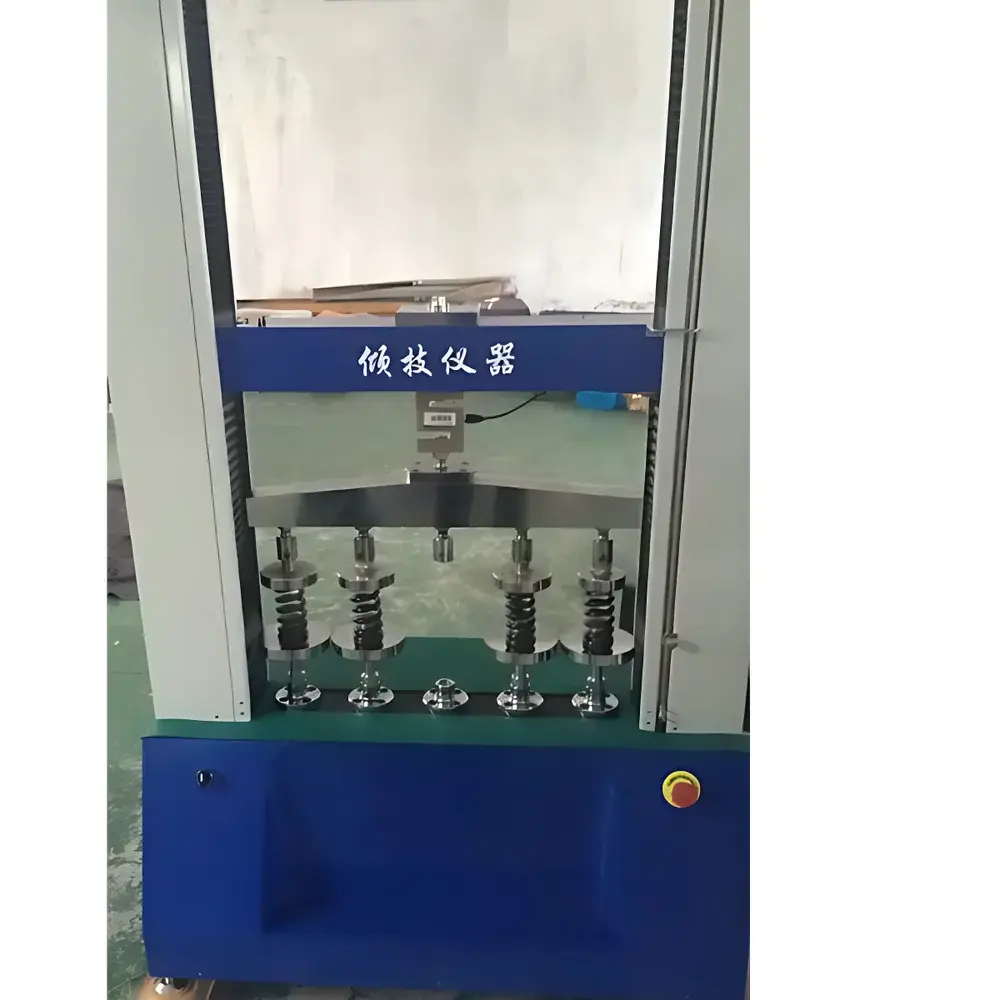
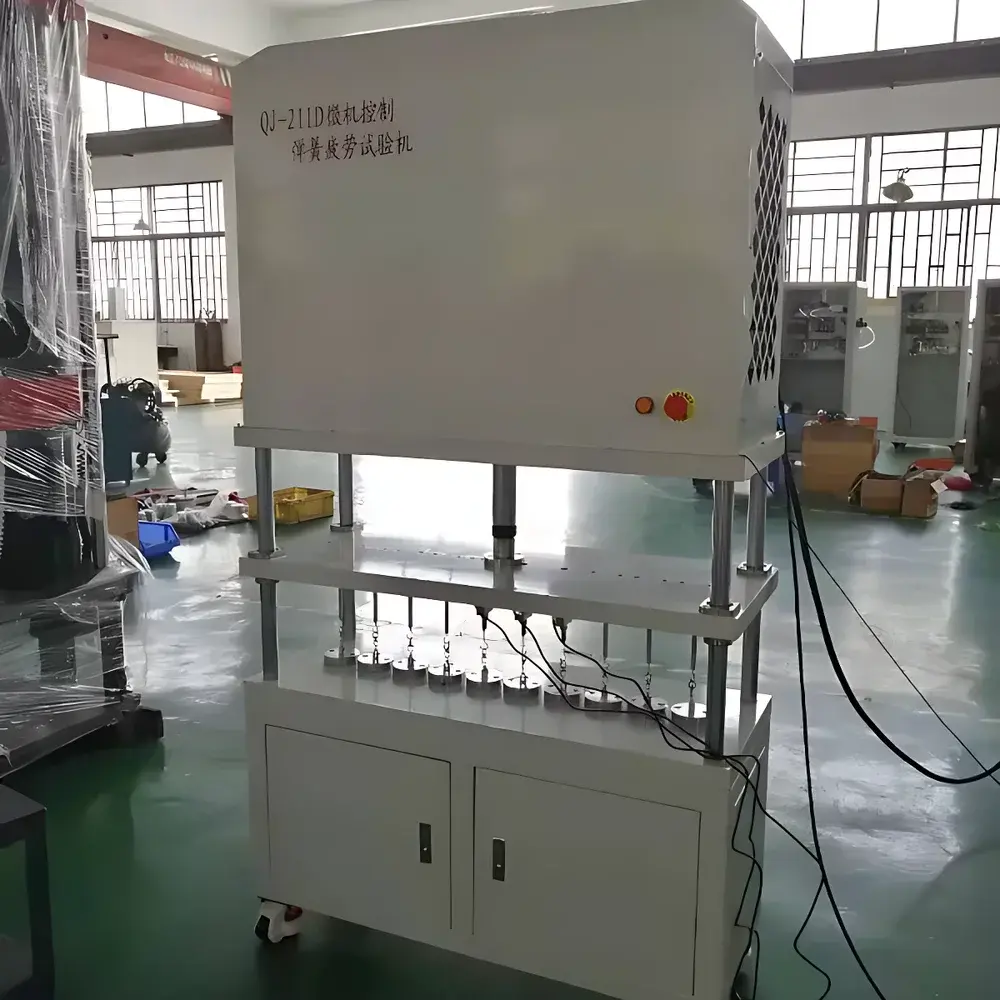
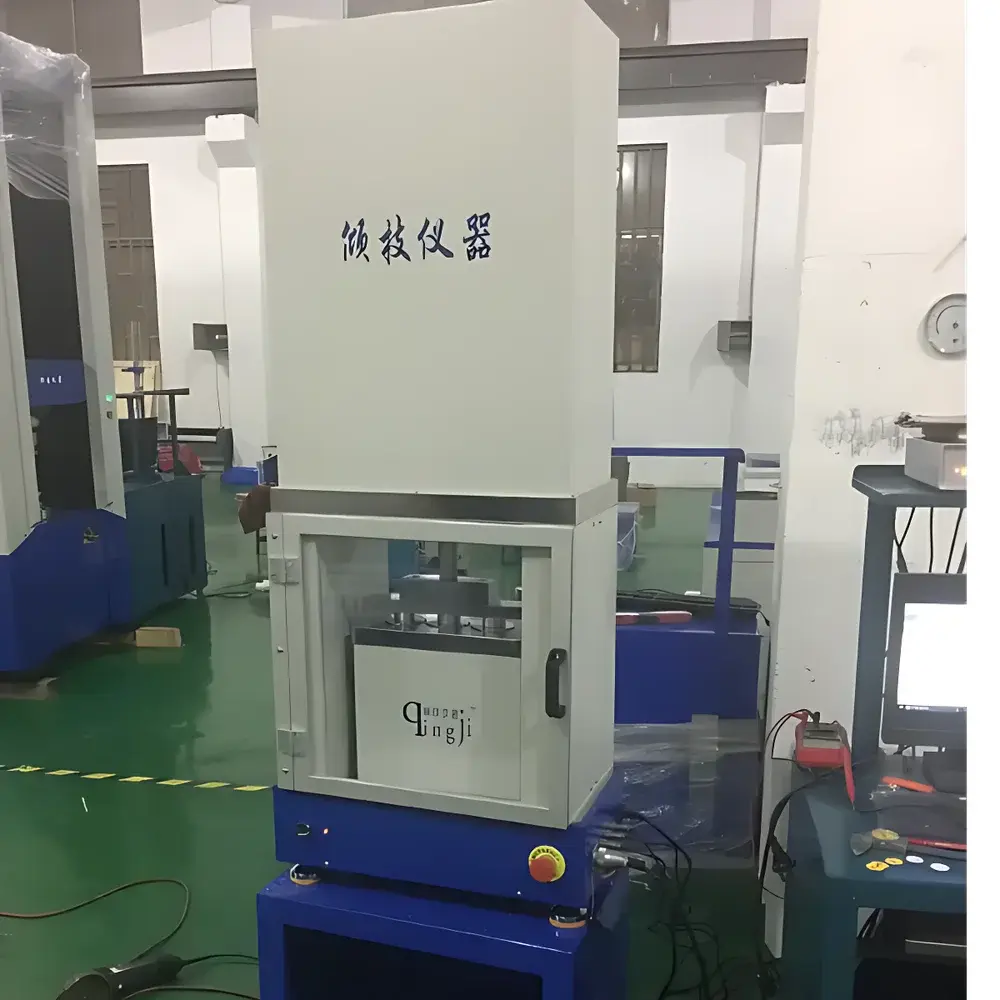
Qingji QJ211D2 Spring Fatigue Life Testing Machine
| Brand | Qingji |
|---|---|
| Origin | Shanghai, China |
| Model | QJ211D2 |
| Frequency Range | 0.01–100 Hz |
| Load Capacity | 10 kN |
| Force Accuracy | Class 0.5 |
| Effective Test Width | 420 mm |
| Effective Stroke | 500 mm |
| Test Speed | 0.01–50,000 mm/min |
| Speed Accuracy | ±0.5% of reading |
| Displacement Accuracy | ±0.5% of reading |
| Strain Measurement Accuracy | ±0.5% of reading |
| Motor Power | 400 W |
| Machine Weight | 145 kg |
Overview
The Qingji QJ211D2 Spring Fatigue Life Testing Machine is an electromechanical servo-controlled fatigue testing system engineered for high-reproducibility cyclic loading of metallic and elastomeric spring components under controlled displacement, force, or strain modes. It operates on the principle of programmed sinusoidal or block-wave actuation, applying repetitive axial loads within a precisely regulated frequency range (0.01–100 Hz) to simulate real-world service conditions such as vehicle suspension cycling, valve actuation, or precision instrumentation duty cycles. Designed in accordance with fundamental mechanical testing standards—including ISO 527-1, ASTM E466, and GB/T 2611—the system delivers traceable, repeatable performance for R&D validation, production lot sampling, and quality assurance protocols in spring manufacturing and Tier-1 automotive supply chains.
Key Features
- 10 kN dual-range load frame with Class 0.5 force accuracy per ISO 7500-1, supporting both static calibration and dynamic fatigue load application
- High-resolution force measurement: 500,000-count A/D conversion, no internal range switching required across full 0.2–100% of capacity
- Programmable test speed from 0.01 to 50,000 mm/min (standard configuration: 300 mm/min), with speed stability maintained within ±0.5% of setpoint
- Dual-mode motion control: precise displacement-driven or force-controlled waveform generation, compatible with sine, triangle, trapezoidal, and user-defined profiles
- Integrated safety architecture including electronic stroke limit protection, mechanical end-stop redundancy, and automatic over-load shutdown (>110% of rated capacity)
- Motorized crosshead with dual-speed actuation (fast positioning + fine adjustment), enabling rapid sample setup and accurate zero-positioning
- Modular sensor interface supporting interchangeable load cells (e.g., 1 kN, 5 kN, 10 kN) and optional extensometers for strain-controlled fatigue tests
Sample Compatibility & Compliance
The QJ211D2 accommodates helical compression/tension springs (wire diameters 0.5–12 mm), conical and disc springs (Belleville washers), and compact elastomeric isolators used in HVAC, aerospace actuators, and medical devices. Fixture adaptability includes threaded top/bottom platens, custom jaw inserts, and anti-rotation guides to prevent buckling during high-cycle testing. All mechanical and software operations comply with GLP documentation requirements; audit trails, user access logs, and parameter change history are retained per FDA 21 CFR Part 11 guidelines when paired with validated PC-based control software. Test reports include timestamped metadata, raw channel data export (CSV/ASCII), and compliance statements referencing ISO 12108 (fatigue crack growth) and EN 13298 (spring acceptance testing).
Software & Data Management
Control and analysis are executed via Qingji’s Windows-based FatigueTest Suite v3.2—a deterministic real-time application with sub-millisecond loop timing. The software supports multi-channel synchronized acquisition (load, displacement, cycle count, temperature if equipped), automated pass/fail criteria (e.g., stiffness degradation >5%, permanent set >0.3 mm), and customizable stopping conditions (cycle count, fracture detection, amplitude decay threshold). Data is stored in encrypted binary format with SHA-256 checksum integrity verification. Export options include PDF test certificates with digital signature fields, MATLAB-compatible .mat files, and XML schemas compliant with ASTM E1447 for inter-laboratory data exchange. Calibration certificates are digitally signed and linked to NIST-traceable master standards.
Applications
- Automotive: Durability validation of engine valve springs, clutch diaphragm springs, and shock absorber coil assemblies
- Industrial Equipment: Fatigue life mapping of safety-critical springs in hydraulic pressure regulators and pneumatic control valves
- Medical Devices: Biocompatibility-aligned cyclic testing of nitinol stent retention springs per ISO 14243-2
- Consumer Electronics: Accelerated life testing of micro-springs in haptic feedback mechanisms and switch contacts
- Academic Research: Material-level S–N curve derivation for new spring alloys (e.g., stainless steel 17-7 PH, Inconel X-750) under variable amplitude loading
FAQ
What types of springs can be tested on the QJ211D2?
Helical compression and tension springs, conical springs, disc springs (Belleville washers), and small-diameter elastomeric isolators—provided dimensional constraints (max 420 mm width × 500 mm stroke) and load limits (≤10 kN) are observed.
Does the system support closed-loop strain control?
Yes—when equipped with a calibrated clip-on or non-contact extensometer, the controller executes true strain-controlled fatigue protocols per ASTM E606.
Is the software compliant with FDA 21 CFR Part 11?
The FatigueTest Suite v3.2 supports electronic signatures, audit trails, and role-based access control when deployed on validated Windows OS environments meeting IQ/OQ specifications.
Can test data be exported to third-party analysis platforms?
Yes—raw time-series data exports to CSV, MATLAB (.mat), and HDF5 formats; report templates are configurable for LabVIEW, Python (pandas), or JMP integration.
What maintenance is required for long-term reliability?
Biannual recalibration of load cell and displacement transducer against certified reference standards; quarterly inspection of ball screw preload and guide rail lubrication per OEM service manual TS-QJ211D2-Rev4.
Related Products



