
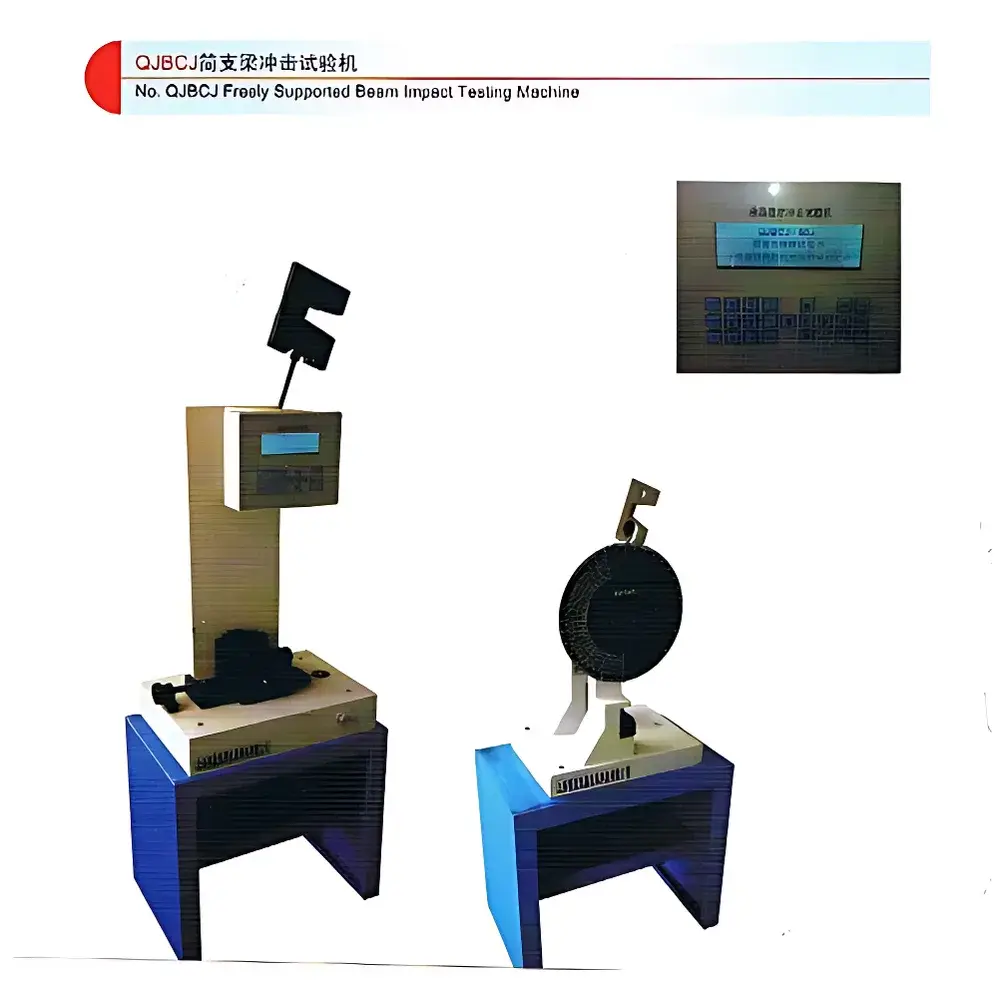
Qingji QJBCJ Charpy/IZOD Impact Tester for Rigid Plastics
| Brand | Qingji |
|---|---|
| Origin | Shanghai, China |
| Model | QJBCJ |
| Impact Energy Range | 5 J, 7.5 J, 15 J, 25 J, 50 J |
| Impact Velocity | 2.9 m/s |
| Pendulum Pre-lift Angle | 160° |
| Distance from Pendulum Axis to Specimen Center | 230 mm |
| Support Span Options | 40 mm, 60 mm, 70 mm, 95 mm |
| Notch Knife Edge Angle | 30° |
| Notch Knife Radius | 2 mm |
| Anvil Radius | 1 mm |
| Dimensions (L×W×H) | 280 × 250 × 500 mm |
| Net Weight | 50 kg |
Overview
The Qingji QJBCJ Charpy/IZOD Impact Tester is a precision mechanical testing instrument engineered for the quantitative determination of impact toughness in rigid non-metallic materials. Based on the principle of pendulum-type impact energy absorption, the system measures the energy required to fracture standardized specimens under controlled loading conditions—either in the Charpy or simply supported beam (IZOD) configuration. This dual-mode capability enables compliance with both ASTM D256 (IZOD) and ISO 179-1 (Charpy), as well as GB/T 1043, ISO 9854-1, DIN 8078, and DIN 53453. The tester employs a gravity-driven pendulum with calibrated energy levels (5 J to 50 J), ensuring high reproducibility across repeated tests on thermoplastics, reinforced composites (e.g., glass-fiber-reinforced nylon), ceramic matrix composites, cast stone, electrical insulating materials, and rigid polymer sheets and pipes. Its robust architecture, low-maintenance mechanical design, and stable energy transfer pathway minimize operator-induced variability—critical for laboratories operating under GLP or ISO/IEC 17025 quality frameworks.
Key Features
- Interchangeable anvil and hammer assemblies supporting both IZOD and Charpy configurations per standard specimen geometry requirements
- Precision-machined pendulum system with ±0.5% energy calibration traceability to national metrology standards
- Fixed support span options (40 mm, 60 mm, 70 mm, 95 mm) aligned with ISO 179-1 and ASTM D256 specimen dimensioning protocols
- Hardened steel impact blade with certified 30° included angle and 2 mm tip radius; anvil radius maintained at 1 mm per ISO 13802 specifications
- Optimized pendulum axis-to-specimen center distance of 230 mm ensures consistent moment arm and kinetic energy delivery
- Compact footprint (280 × 250 × 500 mm) suitable for benchtop deployment in QC labs, academic teaching facilities, and certification bodies
- Stainless-steel and powder-coated structural frame providing long-term dimensional stability and corrosion resistance
Sample Compatibility & Compliance
The QJBCJ accommodates standardized rectangular bar specimens (e.g., 80 × 10 × 4 mm per ISO 179, or 63.5 × 12.7 × 3.2 mm per ASTM D256), including notched and unnotched variants. It supports testing of rigid thermoplastics (e.g., PVC, PMMA, PC), fiber-reinforced polymers (e.g., GF-PA6, carbon-fiber epoxy laminates), thermoset composites (e.g., phenolic resins, unsaturated polyesters), ceramics, and electrically insulating materials such as bakelite and cast resin. All mechanical components and test procedures conform to the essential safety and performance criteria outlined in ISO 13802 (reference machines for pendulum impact testing), and the system is validated for routine use in environments requiring adherence to GB/T 1043, ISO 179-1, ISO 9854-1, DIN 8078, and DIN 53453. While the instrument itself does not embed digital audit trails, its manual operation mode aligns with laboratories maintaining paper-based or hybrid QA records compliant with ISO/IEC 17025 clause 7.7 (result reporting) and GLP principles.
Software & Data Management
The QJBCJ operates as a fully mechanical, analog impact tester without integrated digital control or data acquisition hardware. Energy values are read directly from a calibrated angular scale mounted on the pendulum housing, with resolution sufficient to resolve increments of 0.1 J across all energy ranges. Users record results manually into laboratory notebooks or LIMS-compatible spreadsheets. For institutions requiring electronic data capture, third-party optical encoders or load-cell retrofits may be implemented—though such modifications fall outside Qingji’s factory validation scope and require independent verification per ISO/IEC 17025 clause 5.5.1 (equipment verification). No proprietary software is bundled; however, the instrument’s mechanical repeatability (< ±1.5% CV for replicate tests on homogeneous reference materials) facilitates straightforward integration into statistical process control (SPC) workflows.
Applications
This impact tester serves core functions across material development, quality assurance, and regulatory conformance testing. In polymer R&D, it supports comparative evaluation of toughening agent efficacy (e.g., elastomer blends in PP), filler dispersion effects in composites, and thermal aging-induced embrittlement. Manufacturing QC labs deploy it for incoming raw material verification (e.g., batch consistency of ABS pellets or fiberglass-reinforced profiles), production line release testing, and failure analysis of brittle fractures in extruded profiles or injection-molded housings. Academic institutions utilize it for undergraduate mechanics of materials instruction and graduate-level fracture mechanics research. Certification and arbitration laboratories—including those accredited to CNAS or ILAC-MRA—apply it in conformity assessments for construction-grade plastics, automotive interior components, and electrical enclosures governed by IEC 60695-1-20 fire safety standards where impact resistance influences flame propagation behavior.
FAQ
Does the QJBCJ comply with ASTM D256 and ISO 179-1 simultaneously?
Yes—the interchangeable anvil and striker configurations allow full alignment with both IZOD (ASTM D256) and Charpy (ISO 179-1) specimen orientations and support conditions.
Is calibration documentation provided with shipment?
Each unit ships with a factory calibration certificate referencing energy verification at all five nominal levels (5 J, 7.5 J, 15 J, 25 J, 50 J) against traceable reference standards.
Can the tester accommodate non-standard specimen geometries?
Only standardized dimensions defined in GB/T 1043, ISO 179-1, or ASTM D256 are supported; custom fixtures or spans are not supplied or validated by Qingji.
What maintenance is required to sustain measurement accuracy?
Biannual inspection of knife edge wear (using optical profilometry), verification of pendulum bearing friction torque, and revalidation of zero-energy return position are recommended per ISO 13802 Annex B.
Is technical support available outside mainland China?
Qingji provides remote diagnostic assistance and English-language operation manuals; on-site service requires coordination through authorized regional distributors.



