
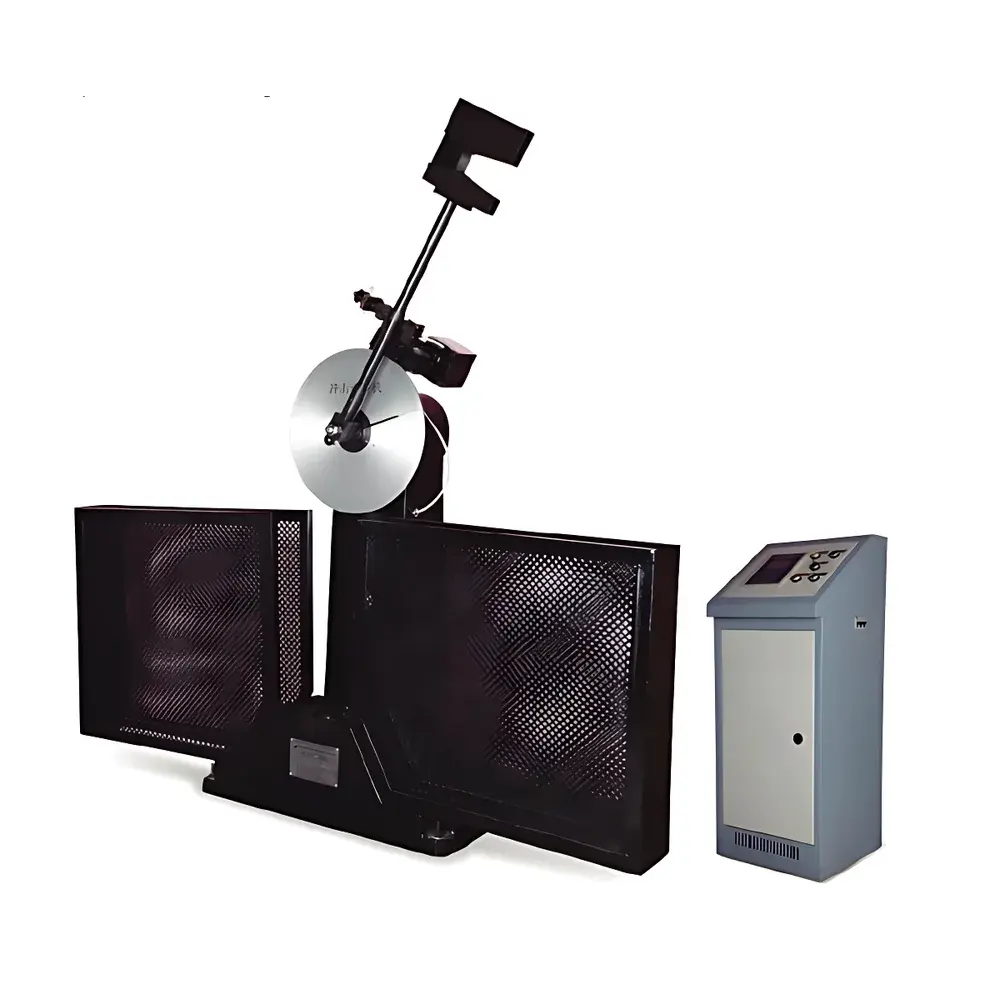
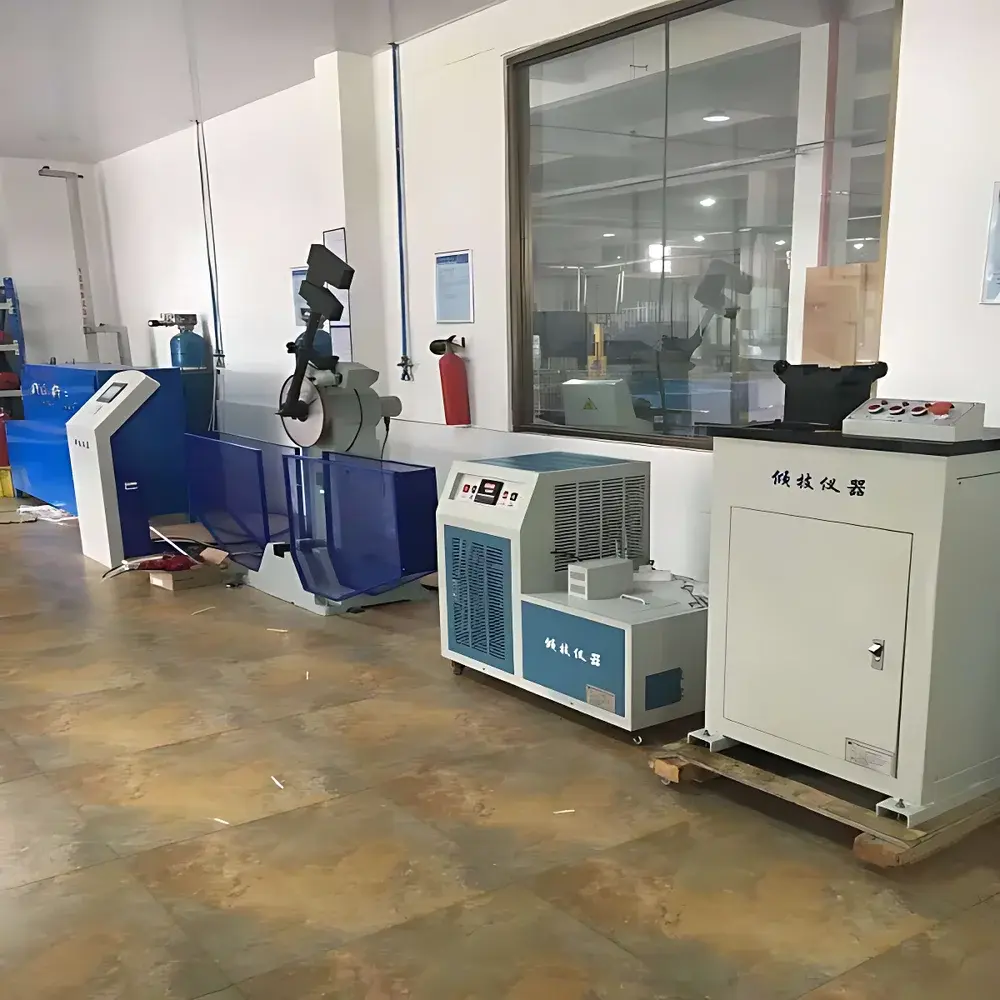
Qinji QJBCS300J Pendulum Impact Testing Machine
| Brand | Qinji |
|---|---|
| Origin | Shanghai, China |
| Model | QJBCS300J |
| Impact Energy | 150 J, 300 J, 450 J |
| Impact Velocity | ~5.2 m/s |
| Hammer Pivot-to-Striking Center Distance | 335 mm |
| Load Cell Range | 0.5 N·m |
| Maximum Pendulum Elevation Angle | 150° |
| Display | Chinese-character LCD with manual push-button control and automatic angular/energy readout |
| Power Supply | 220 V ±10%, 50 Hz |
| Net Weight | ~210 kg |
| Compliance | GB/T 1843, ISO 180, GB/T 2611, JB/T 8761 |
Overview
The Qinji QJBCS300J Pendulum Impact Testing Machine is a precision-engineered instrument designed for standardized Charpy and Izod-style impact testing of rigid and semi-crystalline non-metallic materials. Based on the classical pendulum principle—where gravitational potential energy is converted into kinetic energy upon release—the system delivers repeatable, traceable impact events to quantify material resistance to sudden mechanical loading. Unlike drop-weight or instrumented impact systems, this machine employs a calibrated swinging pendulum with fixed geometry and well-defined striking center, ensuring high reproducibility across laboratories adhering to international test standards. Its primary application domain includes quality assurance in polymer manufacturing, R&D validation of reinforced composites (e.g., glass-fiber-reinforced nylon), and regulatory compliance testing for electrical insulation materials and structural ceramics.
Key Features
- Triple-range impact energy capacity (150 J, 300 J, and 450 J) achieved via interchangeable pendulum hammers and adjustable pivot configurations—enabling full-scale evaluation from thin specimens to thick-section composites.
- Precisely engineered striking center located at 335 mm from the pendulum axis, conforming to ISO 180 and GB/T 1843 requirements for Izod-type notched-bar impact testing.
- Impact velocity maintained at approximately 5.2 m/s under standard release conditions—optimized to meet the kinematic boundary conditions specified in ASTM D256 and ISO 180 for consistent fracture propagation kinetics.
- Integrated torque-sensing load cell (0.5 N·m range) coupled with an angle-resolved encoder enables real-time energy loss calculation and digital verification of absorbed energy per strike.
- Chinese-character LCD interface with tactile push-button controls provides immediate visual feedback of pendulum elevation angle, residual swing angle, and calculated impact energy—eliminating manual interpolation errors common in analog dials.
- Robust cast-iron base and rigid column architecture minimize vibration coupling and ensure stable energy transfer during specimen fracture—critical for maintaining measurement integrity across repeated cycles.
Sample Compatibility & Compliance
The QJBCS300J supports standardized specimen geometries defined in ISO 180 (Izod) and GB/T 1843, including notched bars measuring 80 × 10 × 4 mm (for plastics) and custom cross-sections up to 15 mm thickness. It accommodates brittle and ductile non-metals such as thermosetting resins, fiber-reinforced polymers, technical ceramics, cast stone, and electrical insulating laminates. All operational parameters—including hammer radius (R0.8 mm impact edge), elevation limits (up to 150°), and energy calibration traceability—are validated against national metrological standards referenced in JJF 1306–2011 (Calibration Specification for Pendulum Impact Testing Machines). The instrument satisfies essential requirements for GLP-compliant laboratories conducting routine QC checks under ISO/IEC 17025-accredited test methods.
Software & Data Management
While the QJBCS300J operates as a standalone electromechanical tester without embedded PC connectivity, its digital display module stores up to 99 test records locally—including date/time stamp, specimen ID (manually entered), pre- and post-impact angles, and calculated absorbed energy. Data export is supported via optional RS-232 serial interface (available as accessory) for integration with LIMS or Excel-based QA reporting workflows. All energy calculations adhere to the ISO 148-1 and ISO 180 formulae: E = m·g·(h₁ − h₂), where m is effective pendulum mass, g is local gravitational acceleration, and h₁/h₂ are initial and final vertical heights of the center of mass. Audit trails for calibration adjustments and operator interventions are manually logged per internal SOPs aligned with FDA 21 CFR Part 11 principles for paper-based systems.
Applications
- Quantitative comparison of impact toughness between virgin and recycled polypropylene grades in automotive interior component qualification.
- Batch-release testing of epoxy-glass laminates used in printed circuit board substrates per IPC-4101 specifications.
- Evaluation of temperature-dependent ductile-to-brittle transitions in engineering thermoplastics (e.g., PEEK, PSU) using environmental chamber coupling.
- Verification of notch sensitivity in ceramic matrix composites subjected to thermal shock preconditioning.
- Validation of aging effects on electrical insulators exposed to UV/ozone accelerated weathering per IEC 60587 protocols.
FAQ
What standards does the QJBCS300J comply with?
It fully conforms to GB/T 1843 (Chinese national standard for plastic Izod impact), ISO 180 (international Izod method), GB/T 2611 (general requirements for testing machines), and JB/T 8761 (mechanical testing equipment specifications for plastics).
Can the machine perform both Izod and Charpy tests?
The QJBCS300J is configured for Izod-type clamping (vertical specimen orientation); Charpy testing requires a separate anvil fixture and horizontal specimen support—available as optional accessories.
Is calibration certification included with delivery?
Yes—each unit ships with a factory calibration report traceable to CNAS-accredited reference standards, covering energy accuracy (±1.0% of full scale) and angular resolution (±0.1°).
What maintenance is required for long-term stability?
Biannual verification of pendulum bearing friction, impact knife wear (R0.8 mm radius tolerance ±0.05 mm), and encoder linearity is recommended; consumables include replacement knives and specimen clamps.
Does the system support automated data logging?
Not natively—but the RS-232 port enables connection to external PCs running custom or third-party acquisition software for automated CSV export and statistical process control (SPC) charting.



