
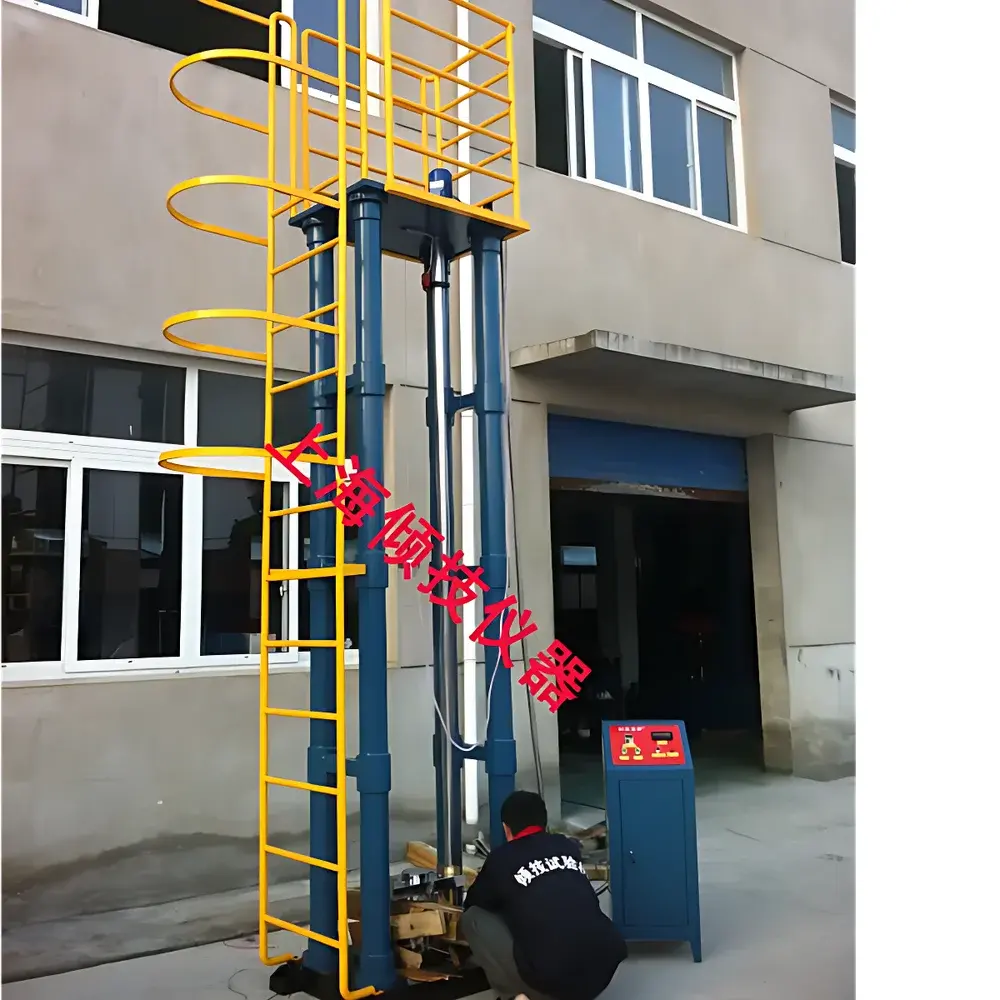
Qinji QJLC-Series Dynamic Impact Strength Tester
| Brand | Qinji |
|---|---|
| Origin | Shanghai, China |
| Model | QJLC- |
| Max Drop Height | 10000 mm (adjustable) |
| Height Resolution | 0.1 mm |
| Load Cell Range | 20–500 kN |
| Accuracy | ±1% FS |
| Impact Force Measurement | Yes |
| Impact Energy Calculation | Yes |
| Impact Duration Measurement | Yes |
| Deformation Measurement | Yes |
| Standard Weights | 2, 3, 4, 5, 10, 20, 50, 100 kg (AISI 1045 steel) |
| Weight Tolerance | ±1% |
| Compliance | ISO 148-1, ASTM E23, GB/T 229 |
| Software | QJLC17.7.Ttest Curve-Based Impact Control & Analysis System |
| Data Acquisition | High-speed synchronized sampling (≥1 MHz) |
| Output | Force-time, Energy-time, Displacement-time curves |
| Calibration Support | Sensor traceable to national metrology standards |
Overview
The Qinji QJLC-Series Dynamic Impact Strength Tester is a precision-engineered drop-weight impact testing system designed for quantitative evaluation of dynamic mechanical response under high-strain-rate loading conditions. Based on the principle of gravitational potential energy conversion into kinetic energy upon free-fall impact, the system delivers controlled, repeatable impulses to test specimens—enabling measurement of peak impact force, instantaneous deformation, energy absorption, and time-resolved load history. Engineered for compliance with international standard test methods—including ISO 148-1 (Charpy pendulum calibration framework), ASTM E23 (notched bar impact testing), and GB/T 229 (Chinese standard for metallic materials)—the QJLC-Series supports both standardized and custom impact protocols across metallurgy, geoscience, advanced ceramics, polymer composites, and hard material R&D laboratories.
Key Features
- Adjustable drop height from 0 to 10,000 mm with 0.1 mm resolution, enabling precise control over impact velocity (up to ~14 m/s at max height) and kinetic energy input.
- High-fidelity multi-channel data acquisition system operating at ≥1 MHz sampling rate, capturing transient events with sub-millisecond temporal resolution.
- Integrated 500 kN load cell with Class 1 accuracy (±1% full scale), calibrated per ISO 376 and traceable to national metrological standards.
- Modular weight set (2–100 kg, AISI 1045 steel) with certified mass tolerance ≤±1%, allowing flexible energy scaling from low-energy plastic deformation studies to high-energy fracture initiation tests.
- QJLC17.7.Ttest software platform providing real-time curve overlay (force–time, displacement–time, energy–time), post-test parametric extraction (e.g., maximum force, total absorbed energy, yield point onset), and statistical batch analysis with GLP-compliant audit trail logging.
- Robust frame architecture with guided free-fall column, electromagnetic release mechanism, and specimen alignment fixtures compatible with standard Charpy, Izod, and custom geometries.
Sample Compatibility & Compliance
The QJLC-Series accommodates specimens up to 150 mm × 150 mm × 150 mm (L×W×H), including notched and unnotched bars, cylindrical rock cores, sintered carbide tiles, diamond compacts, graphite electrodes, and structural polymer plates. Specimen clamping and support configurations conform to ISO 148-1 (support span 40 mm, radius ≤1 mm), ASTM E23 (anvil radii, striker geometry), and GB/T 229 (V-notch depth tolerance ±0.075 mm). All hardware and software modules are validated for use in environments requiring documented traceability—fully supporting FDA 21 CFR Part 11 electronic record integrity requirements when configured with user access controls and digital signature workflows.
Software & Data Management
QJLC17.7.Ttest is a Windows-based, CE-marked application developed in accordance with IEC 62304 (medical device software lifecycle) principles. It provides dual-mode operation: automated test sequence execution (predefined height/weight combinations) and manual parameter override for exploratory research. Raw waveform data is stored in HDF5 format with embedded metadata (operator ID, timestamp, environmental temperature/humidity, calibration certificate ID). Export options include CSV (for Excel or MATLAB), PDF test reports with embedded curves and pass/fail flags, and XML for LIMS integration. Audit trails record all user actions—including method edits, calibration events, and result deletions—with immutable timestamps and operator authentication logs.
Applications
- Fracture toughness screening of tungsten carbide inserts used in mining drill bits.
- Impact resistance validation of aerospace-grade carbon-fiber-reinforced polymer (CFRP) laminates under simulated hail strike conditions.
- Dynamic hardness correlation studies for synthetic diamond abrasives subjected to repeated percussive loading.
- Energy absorption characterization of blast-resistant concrete formulations via instrumented drop-weight testing.
- Comparative notch sensitivity analysis of pipeline steels across temperature gradients (−40°C to +60°C).
- Quality assurance of graphite anode materials for lithium-ion batteries under mechanical shock exposure.
FAQ
What standards does the QJLC-Series comply with for calibration and reporting?
The system adheres to ISO 17025-accredited calibration practices for force and displacement transducers; test reports include uncertainty budgets calculated per GUM (Guide to the Expression of Uncertainty in Measurement).
Can the system be integrated into an existing laboratory information management system (LIMS)?
Yes—via configurable RESTful API endpoints and scheduled CSV/XML exports with user-defined field mapping.
Is remote technical support available for software troubleshooting and method validation?
Qinji provides Tier-2 remote diagnostics and method verification services under annual support contracts, including screen-sharing sessions and firmware update deployment.
Does the QJLC-Series support variable striker geometry for specialized applications?
Custom striker tips (flat, hemispherical, conical) and anvil inserts can be ordered as optional accessories, each supplied with dimensional certification and mounting templates.
How is sensor drift compensated during long-duration testing campaigns?
The system performs automatic zero-balance verification before each test cycle and supports scheduled in-situ reference-load checks using NIST-traceable deadweight standards.
Related Products



