
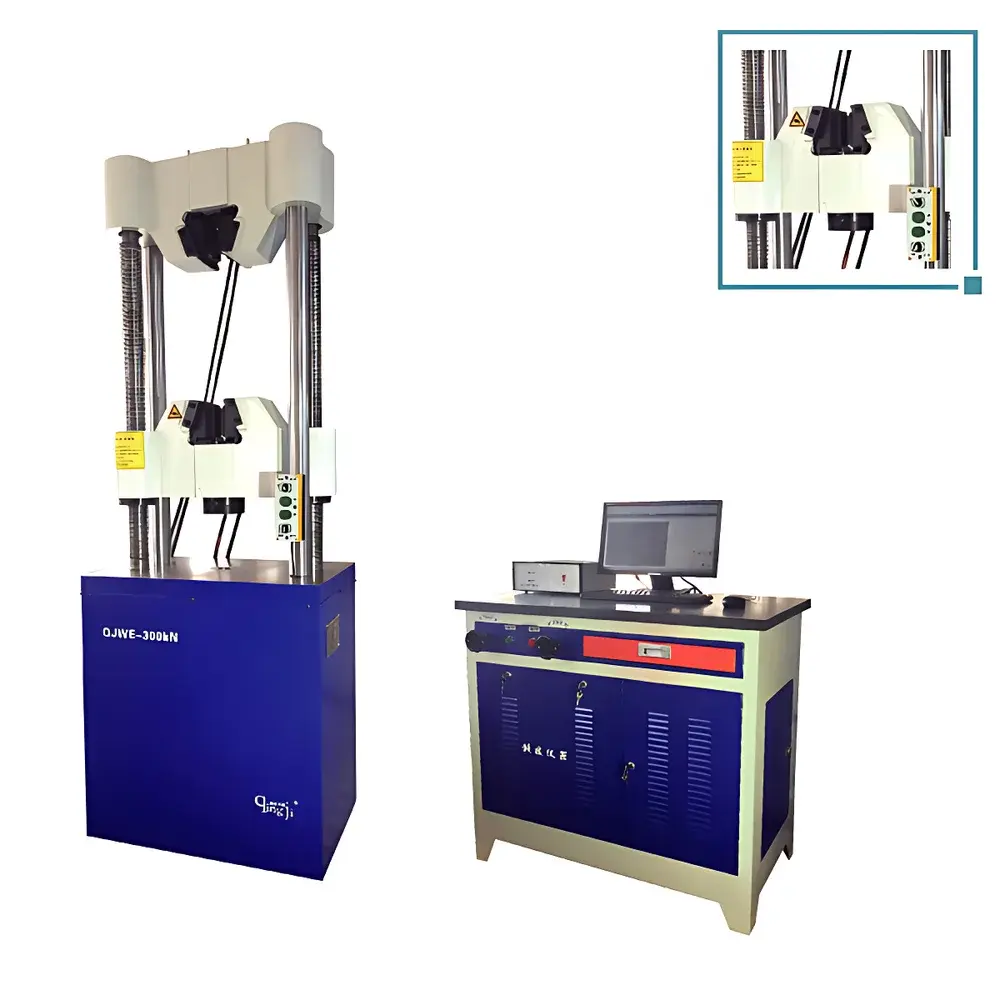
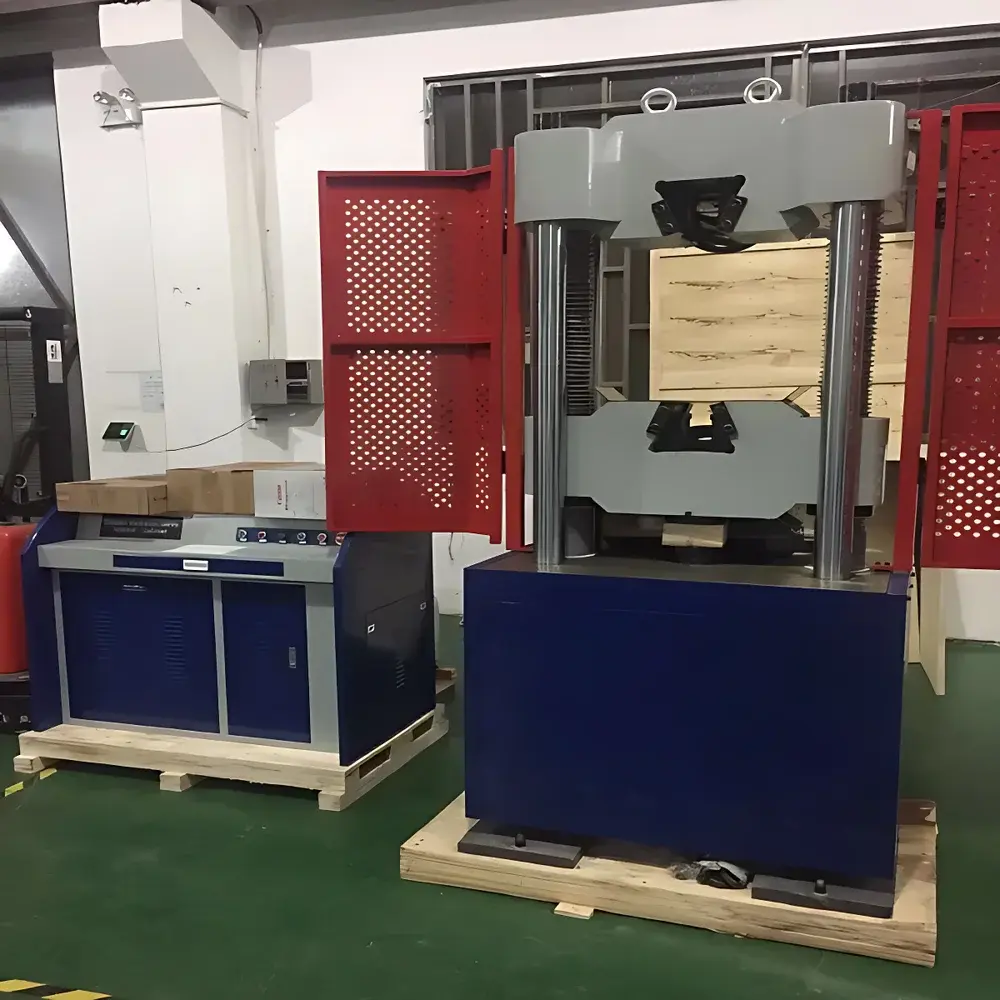
Qinji QJWE Series Electro-Hydraulic Servo Universal Testing Machine
| Brand | Qinji |
|---|---|
| Origin | Shanghai, China |
| Model | QJWE Series |
| Load Capacity | 0–1000 kN |
| Load Accuracy | ±1% |
| Relative Resolution | ≤0.5% |
| Compression Space | up to 700 mm |
| Tension Space | up to 700 mm |
| Round Specimen Grip Range | φ20–70 mm |
| Flat Specimen Grip Thickness | 0–40 mm |
| Piston Stroke | 250 mm |
| Bending Support Span | up to 1000 mm |
| Shear Specimen Diameter | up to φ30 mm |
| Dimensions (L×W×H) | 1255 × 866 × 4700 mm |
| Motor Power | 3.25 kW, 3-phase |
| Machine Weight | 6600 kg |
Overview
The Qinji QJWE Series Electro-Hydraulic Servo Universal Testing Machine is a high-capacity, force-controlled mechanical testing system engineered for precision static mechanical characterization of structural materials under uniaxial loading conditions. Based on the principle of closed-loop electro-hydraulic servo control, it delivers programmable load, displacement, or strain rate profiles with real-time feedback from high-accuracy load cells and extensometric sensors. Designed for compliance with ASTM E4, ASTM E8/E8M, ISO 6892-1, ISO 7500-1, and GB/T 228.1 standards, this machine supports full-cycle tensile, compressive, flexural, and shear testing of metallic alloys, reinforced concrete, cementitious composites, thermoplastics, and fiber-reinforced polymers. Its lower-cylinder configuration enables flexible test space adjustment—critical for accommodating large-scale civil engineering specimens or long-section metallic bars—while maintaining column stability and axial alignment per ISO 7500-1 Class 1 requirements.
Key Features
- Electro-hydraulic servo actuation with digital PID control architecture, enabling precise load ramping, hold, and cycling protocols
- Adjustable test zone: vertical clearance configurable up to 700 mm for both tension and compression, optimized for standardized specimen geometries
- High-rigidity dual-column frame with preloaded crosshead guidance, minimizing lateral deflection during high-load testing (up to 1000 kN)
- Multi-range hydraulic clamping system supporting round specimens from φ20 mm to φ70 mm and flat specimens up to 40 mm thick
- Integrated bending fixture set with adjustable support spans from 400 mm to 1000 mm, compliant with ASTM E290 and ISO 7438
- Shear test capability using standardized double-shear fixtures for specimens up to φ30 mm diameter
- Real-time synchronized acquisition of load, displacement, and axial/lateral strain via calibrated transducers traceable to national metrology institutes
Sample Compatibility & Compliance
The QJWE Series accommodates standardized and custom specimens across industrial and academic material testing workflows. Metallic test bars conforming to ASTM E8 gauge lengths (e.g., 50 mm or 200 mm) are fully supported; concrete cylinders (150 mm × 300 mm) and prisms (100 mm × 100 mm × 400 mm) fit within the compression platen area. The system meets ISO 7500-1 Class 1 accuracy certification for force measurement and is suitable for GLP-compliant environments when paired with audit-trail-enabled software. It supports test method validation per ISO/IEC 17025:2017 and provides documentation traceability required for third-party certification bodies evaluating structural material conformity.
Software & Data Management
The system operates with a Windows-based control and analysis platform featuring real-time curve plotting (load vs. displacement, stress vs. strain), automatic yield point detection (0.2% offset method), modulus calculation (tangent/secant), and fracture energy integration. All raw data streams—including timestamps, sensor calibration IDs, environmental metadata (optional temperature/humidity input), and operator credentials—are stored in encrypted binary files with XML-based metadata headers. Export formats include CSV, PDF reports (customizable templates), and image-exported stress–strain curves. Software supports 21 CFR Part 11-compliant user access levels, electronic signatures, and change audit logs—enabling deployment in regulated QC/QA laboratories operating under GMP or ISO 9001 frameworks.
Applications
- Mechanical property verification of structural steel grades (e.g., ASTM A615, EN 10025) including ultimate tensile strength, yield strength, elongation, and reduction in area
- Compressive strength and elastic modulus determination of Portland cement concrete (ASTM C39, EN 12390-3) and geopolymer binders
- Bending performance evaluation of timber beams, composite laminates, and sandwich panels per ASTM D7249/D7250
- Shear strength assessment of bolted joints, weldments, and adhesive bonds using double-shear configurations
- Calibration reference testing for secondary force standards in metrology labs accredited to ISO/IEC 17025
- Long-term creep and relaxation studies under sustained loading (when integrated with optional environmental chambers)
FAQ
What standards does the QJWE Series comply with for force measurement accuracy?
It conforms to ISO 7500-1 Class 1 requirements (±1% indication error) and is suitable for verification against ASTM E4 calibration procedures.
Can the system perform cyclic loading tests such as low-cycle fatigue?
Yes—its electro-hydraulic servo controller supports programmable sinusoidal, triangular, or trapezoidal waveforms with frequency ranges up to 5 Hz, appropriate for controlled-strain or controlled-stress hysteresis testing.
Is third-party calibration certification available?
Factory calibration includes NIST-traceable load cell certificates; optional on-site verification by ISO/IEC 17025-accredited providers can be arranged.
What safety features are integrated into the mechanical design?
Dual-channel emergency stop circuitry, hydraulic pressure relief valves, mechanical overload limit switches, and interlocked safety guarding meet ISO 13857 and CE Machinery Directive 2006/42/EC requirements.
How is software validation handled for regulated environments?
The control software includes IQ/OQ documentation templates, version-controlled release notes, and built-in electronic audit trail generation meeting FDA 21 CFR Part 11 and EU Annex 11 expectations.



