
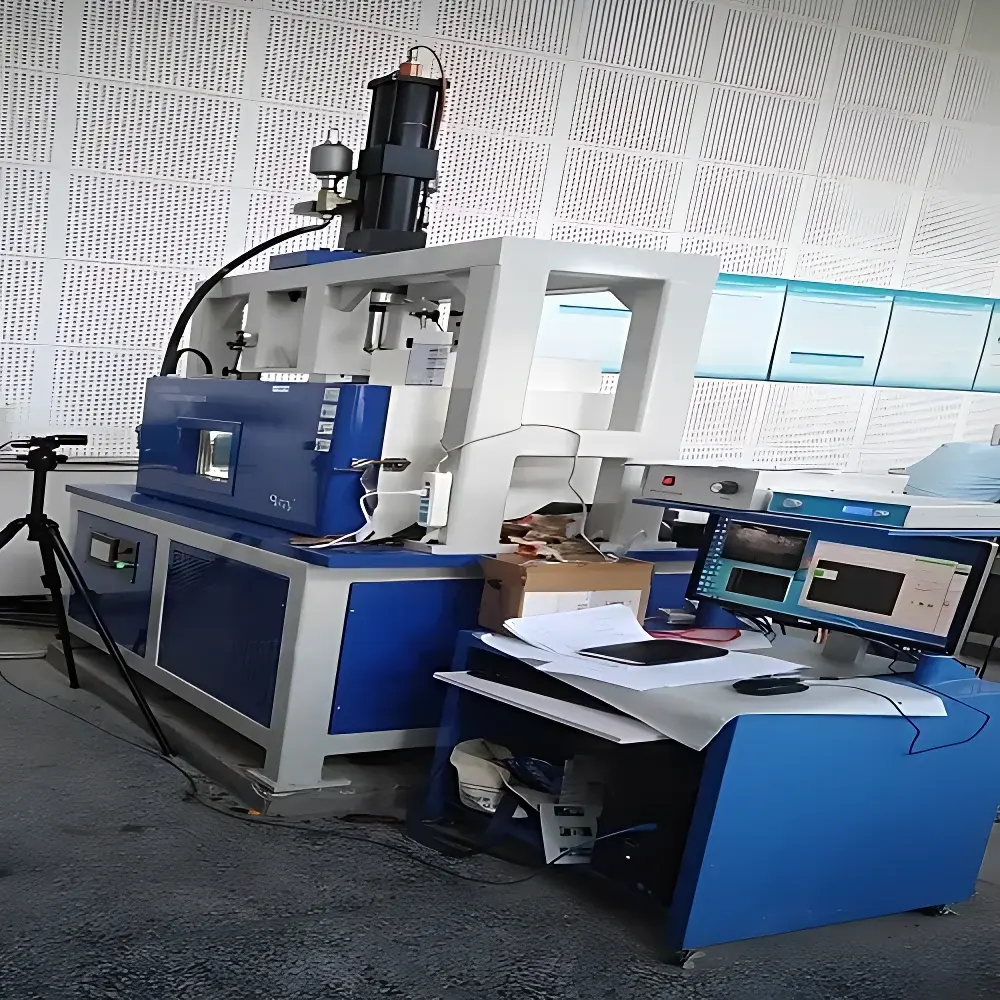
Qinji QJWE543L Tensile Fatigue Testing Machine
| Brand | Qinji |
|---|---|
| Origin | Shanghai, China |
| Model | QJWE543L |
| Frequency Range | 0.01–100 Hz (customizable) |
| Load Accuracy | ±1% within 2–100% of full scale |
| Dynamic Load Ripple | ≤2% |
| Actuator Stroke | ±50 mm (customizable) |
| Control Bandwidth | 10 kHz |
| Waveform Options | Sinusoidal, Square, Triangular, Trapezoidal, Sawtooth, Half-Sine, Half-Triangle, Random, and External Input |
| Control Modes | Force, Displacement, and Strain Closed-Loop |
| Frequency Resolution | 0.001 Hz |
| Compliance | ASTM E466, ASTM E606, ISO 1099, ISO 6892-2, GB/T 3075, GB/T 26077 |
Overview
The Qinji QJWE543L Tensile Fatigue Testing Machine is a high-performance electro-hydraulic servo fatigue testing system engineered for precision-controlled uniaxial tension-compression cyclic loading. It operates on the principle of closed-loop hydraulic actuation with real-time digital feedback, enabling rigorous evaluation of material fatigue life, crack initiation thresholds, and crack propagation kinetics under controlled stress/strain histories. Designed for research-grade mechanical characterization, this system supports both low-cycle fatigue (LCF) and high-cycle fatigue (HCF) regimes across metallic alloys, composites, polymers, and additively manufactured components. Its architecture integrates a rigid load frame, high-fidelity servo-hydraulic actuator, ultra-stable constant-pressure pump station, and a deterministic real-time controller—ensuring repeatable waveform fidelity, minimal phase lag, and robust performance up to 100 Hz (extendable per application requirements).
Key Features
- Full-digital hydraulic servo control system with 10 kHz closed-loop bandwidth, supporting seamless mode switching between force, displacement, and strain control
- Programmable waveform generation including sinusoidal, triangular, square, trapezoidal, sawtooth, half-wave, and user-defined or externally sourced analog waveforms
- High-resolution frequency tuning from 0.001 Hz to 100 Hz (extendable to 1000 Hz upon configuration), with 0.001 Hz frequency resolution for precise spectral alignment
- Actuator stroke of ±50 mm (customizable), optimized for specimen geometries ranging from miniature coupons to structural subassemblies
- Load measurement accuracy of ±1% over 2–100% of full-scale capacity; dynamic load ripple maintained at ≤2% RMS during sustained cycling
- Rigid four-column load frame with integrated thermal management and vibration-isolated mounting interface for metrological stability
- Comprehensive signal conditioning and synchronization capabilities for integration with extensometers, thermocouples, acoustic emission sensors, and digital image correlation (DIC) systems
Sample Compatibility & Compliance
The QJWE543L accommodates standardized tensile specimens per ASTM E8/E21, ISO 6892-1, and GB/T 228.1, as well as custom geometries—including notched, pre-cracked (e.g., compact tension C(T) or single-edge notched bend SENB), and miniature dog-bone configurations. It supports environmental attachments for elevated temperature testing (up to 1000 °C with optional furnace) and corrosion-assisted fatigue studies using controlled atmosphere chambers. The system complies with international fatigue testing standards including ASTM E466 (constant-amplitude axial fatigue), ASTM E606 (strain-controlled fatigue), ISO 1099 (metallic materials—fatigue testing), ISO 6892-2 (axial force-controlled methods), and GB/T 3075 and GB/T 26077 (Chinese national standards for metal fatigue behavior). All test data acquisition and control logic are structured to support GLP/GMP audit readiness and traceability.
Software & Data Management
The system is operated via Qinji’s proprietary TestMaster™ software suite—a Windows-based platform offering intuitive test sequence scripting, real-time parameter monitoring, multi-channel synchronized data logging (≥16 channels at 100 kHz sampling), and automated report generation in PDF, Excel, and XML formats. Software features include event-triggered data capture (e.g., crack detection via compliance change), cycle counting per ASTM E1049, S-N and ε-N curve fitting, and Paris law parameter extraction (da/dN vs. ΔK). Raw datasets retain full metadata (calibration certificates, operator ID, environmental conditions, hardware configuration), satisfying FDA 21 CFR Part 11 requirements for electronic records and signatures when deployed in regulated environments. Export interfaces support MATLAB, Python (via .csv/.hdf5), and third-party CAE platforms for post-test simulation correlation.
Applications
- Quantification of fatigue crack initiation life and threshold stress intensity factor (ΔKth) in aerospace titanium alloys and nickel-based superalloys
- Strain-life (ε-N) characterization of biomedical implant materials (e.g., CoCr, Ti-6Al-4V) under physiological loading waveforms
- Thermo-mechanical fatigue (TMF) assessment of turbine blade coatings using synchronized thermal and mechanical cycling protocols
- Reliability validation of welded joints and additive manufacturing lattice structures under variable amplitude loading spectra (e.g., FALSTAFF, Mini-Max)
- Fatigue-driven microstructure evolution studies via in-situ SEM or synchrotron X-ray diffraction coupling
- Quality assurance testing of automotive suspension components per OEM-specific durability specifications (e.g., Ford WSS-M1A365-B, GM GMW14872)
FAQ
What standards does the QJWE543L support for fatigue testing?
It fully supports ASTM E466, ASTM E606, ISO 1099, ISO 6892-2, GB/T 3075, and GB/T 26077 for axial fatigue, strain-controlled testing, and metal fatigue behavior evaluation.
Can the system perform thermomechanical fatigue tests?
Yes—when integrated with a programmable high-temperature furnace or environmental chamber, it enables synchronized thermal and mechanical cycling under closed-loop control.
Is the controller capable of real-time adaptive control during crack growth?
Yes—the 10 kHz control bandwidth and programmable compliance-based triggering allow dynamic adjustment of load or displacement setpoints upon detected stiffness degradation.
Does the software support automated S-N curve generation and statistical analysis?
Yes—TestMaster™ includes built-in staircase, step-stress, and probabilistic life estimation modules compliant with ASTM E739 and ISO 12107.
What is the maximum achievable frequency with full-load capacity?
Standard configuration delivers 100 Hz at rated load; higher-frequency operation (up to 1000 Hz) is available with reduced stroke or specialized actuator options.



