
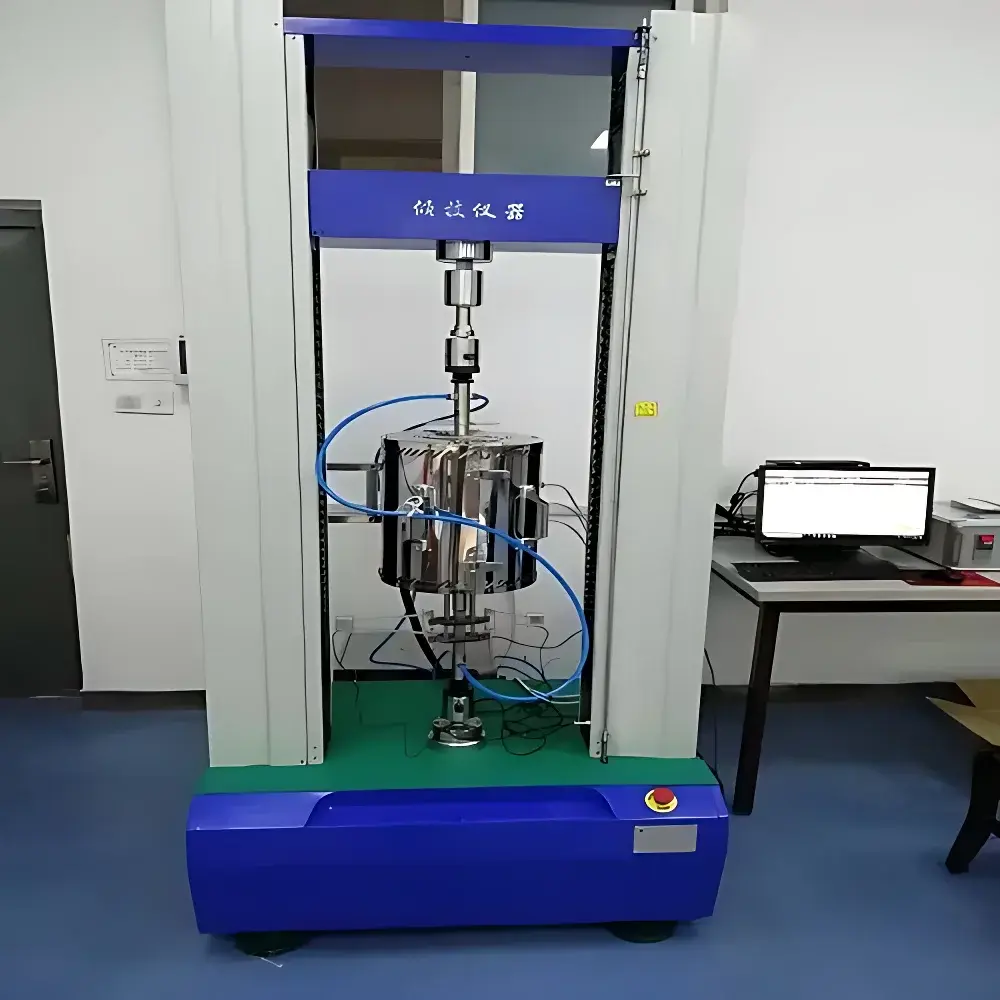
Qinsun QJ212-100KN High-Temperature Tensile Testing Machine
| Brand | Qinsun |
|---|---|
| Origin | Shanghai, China |
| Model | QJ212-100KN |
| Max Test Load | 100 kN |
| Load Accuracy | ±0.5% of reading (from 1% FS) |
| Crosshead Travel | 800 mm |
| Displacement Resolution | 0.001 mm |
| Temperature Range | Ambient to 1200 °C |
| Temperature Control Accuracy | ±0.5 °C |
| Furnace Bore Diameter | φ50 mm |
| Furnace Length | 450 mm |
| Constant-Temperature Zone Length | >150 mm |
| Creep Load Control | Servo-driven, 0–100 kN continuously adjustable |
| Load Resolution | 0.1 N |
| Power Consumption | 3 kW |
| Weight | 850 kg |
Overview
The Qinsun QJ212-100KN High-Temperature Tensile Testing Machine is an engineered solution for mechanical property characterization of metallic alloys, ceramics, composites, and high-performance polymers under controlled thermal conditions. Built upon a rigid dual-column load frame with precision-ground crosshead guidance, the system integrates a high-stability servo-controlled actuation system and a fully programmable high-temperature furnace assembly. It operates on the principle of uniaxial force application in accordance with ASTM E21, ISO 6892-2, and GB/T 4338 standards—enabling quantitative determination of tensile strength, yield strength, elongation at break, Young’s modulus, and time-dependent creep behavior across a continuous temperature range from ambient to 1200 °C. The machine is designed for laboratory-based materials R&D, quality assurance in aerospace and energy sectors, and regulatory-compliant validation under GLP/GMP environments.
Key Features
- Robust 100 kN load capacity with ±0.5% force measurement accuracy (from 1% of full scale), certified per ISO 7500-1 Class 0.5
- High-resolution displacement sensing: 0.001 mm resolution via optical encoder feedback, supporting precise strain tracking during thermal expansion compensation
- Integrated high-temperature furnace with φ50 mm bore and 450 mm total length; uniform constant-temperature zone exceeding 150 mm in length
- Precision temperature control: ±0.5 °C stability over full operating range (RT to 1200 °C), with 0.1 °C digital resolution and PID-based adaptive tuning
- Creep-specific loading architecture: servo-controlled load application with continuous 0–100 kN adjustability and ±1% load regulation accuracy
- Modular deformation measurement options including extensometers and clip-on gauges compatible with elevated-temperature operation
- Compliance-ready control architecture supporting audit trails, electronic signatures, and data integrity protocols aligned with FDA 21 CFR Part 11 requirements
Sample Compatibility & Compliance
The QJ212 accommodates standardized tensile specimens (e.g., ASTM E8/E21 dog-bone, ISO 6892-2 round/flat coupons) up to 10 mm in gauge diameter and 150 mm in total length. Specimen heating is achieved via resistive ceramic tube furnace with inert atmosphere compatibility (N₂ or Ar purge ports optional). The system meets mechanical testing requirements specified in ASTM E139 (creep testing), ASTM E21 (tensile testing at elevated temperatures), ISO 6892-2 (metallic materials – part 2: high-temperature tests), and GB/T 4338 (Chinese national standard for high-temperature tensile properties). All firmware and software modules are validated for traceability, repeatability, and calibration conformity under ISO/IEC 17025-accredited laboratories.
Software & Data Management
The embedded test controller runs Qinsun’s proprietary TMS-Link v4.2 software, offering real-time synchronized acquisition of load, displacement, temperature, and time. The interface supports multi-step test profiles—including ramp-hold-ramp thermal-mechanical cycles—and automatic parameter derivation (e.g., stress relaxation slope, creep rate, time-to-rupture). Raw data export is available in CSV, XML, and universal .tdms formats. For regulated environments, optional 21 CFR Part 11 compliance packages include role-based user access, electronic signature workflows, change history logs, and encrypted database storage. Calibration certificates are digitally linked to sensor serial numbers and auto-embedded into test reports.
Applications
- High-temperature tensile and compressive evaluation of nickel-based superalloys used in turbine blades and combustion chambers
- Ceramic matrix composite (CMC) fracture toughness and thermal shock resistance assessment
- Creep rupture life prediction for pressure vessel steels operating above 500 °C
- Thermo-mechanical fatigue (TMF) pre-characterization of intermetallics and refractory metals
- Validation of weld joint integrity in nuclear-grade piping materials per ASME Section III
- Development and qualification of high-temperature adhesives and thermal interface materials
FAQ
What is the maximum usable temperature for long-term testing?
Continuous operation at 1200 °C is supported for durations up to 100 hours with proper furnace maintenance and inert gas purging.
Can the system perform simultaneous thermal cycling and mechanical loading?
Yes—the TMS-Link software enables synchronized temperature ramps and load profiles, including dwell steps at target temperatures before or during loading.
Is third-party calibration documentation provided with shipment?
Each unit ships with factory calibration certificates for load cell, displacement transducer, and thermocouple inputs, traceable to NIM (China National Institute of Metrology) standards.
What specimen geometries are supported without custom fixtures?
Standard flat and round tensile bars per ASTM E8, ISO 6892-1, and GB/T 228.1 are accommodated using interchangeable grips; custom grip designs are available upon request.
Does the system support automated reporting for ISO/IEC 17025 accreditation?
Yes—report templates comply with ILAC-P14 requirements, including uncertainty budgets, environmental condition logging, and operator identity metadata.



