
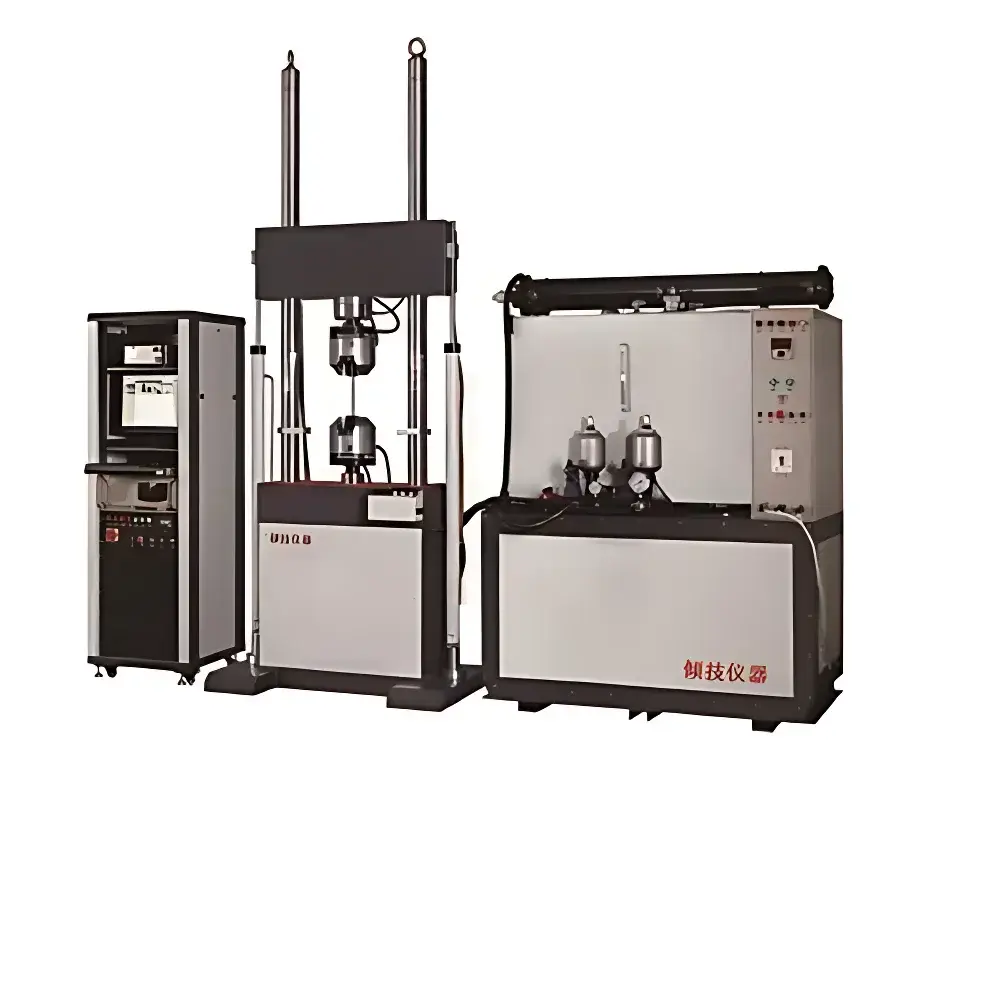
Qinsun QJWE543L Electro-Hydraulic Servo Fatigue Testing Machine
| Brand | Qinsun |
|---|---|
| Origin | Shanghai, China |
| Model | QJWE543L |
| Instrument Type | Electro-Hydraulic Servo Fatigue Testing Machine |
| Maximum Test Load | Customizable |
| Frequency Range | 0.01–150 Hz (configurable) |
| Actuator Stroke | ±50 mm (customizable) |
| Load Accuracy | ±1% of reading (2–100% FS) |
| Dynamic Load Ripple | ≤2% |
| Closed-Loop Control Bandwidth | 10 kHz |
| Control Modes | Force, Displacement, and Strain |
| Waveform Capabilities | Sine, Triangle, Square, Trapezoidal, Sawtooth, Half-Sine, Half-Triangle, Random, and User-Defined or External Input Waveforms |
| Frequency Resolution | 0.001 Hz |
| Host Weight | Customizable |
| Compliance | Designed for ASTM E466, ASTM E606, ISO 1099, and GB/T 3075 fatigue testing standards |
Overview
The Qinsun QJWE543L Electro-Hydraulic Servo Fatigue Testing Machine is a high-performance, digitally controlled dynamic mechanical testing system engineered for precise evaluation of material and component fatigue behavior under cyclic uniaxial tensile-compressive loading. Based on the principles of servo-hydraulic actuation and real-time digital feedback control, the system applies programmable waveforms—including sinusoidal, triangular, square, trapezoidal, and user-defined profiles—to replicate service-level mechanical stress histories. Its architecture supports both low-cycle fatigue (LCF) and high-cycle fatigue (HCF) regimes, making it suitable for R&D laboratories, quality assurance departments, and certification centers engaged in structural integrity validation of metallic alloys, fiber-reinforced composites, welded joints, and additively manufactured components.
Key Features
- Full-digital electro-hydraulic servo control system with 10 kHz closed-loop update rate, enabling high-fidelity tracking of complex load-displacement trajectories.
- Multi-mode closed-loop control: seamless switching between force, displacement, and strain control channels without interrupting test execution.
- Wide operational frequency range from 0.01 Hz to 150 Hz (extendable per configuration), with 0.001 Hz frequency resolution for fine-grained spectral definition.
- Standard ±50 mm actuator stroke—customizable to meet application-specific displacement requirements for large-strain or crack-growth testing.
- Load measurement accuracy of ±1% across 2–100% of full scale, verified per ISO 7500-1 Class 1 compliance protocols.
- Dynamic load stability maintained at ≤2% peak-to-peak ripple under sustained cyclic operation, ensuring repeatability in long-duration tests.
- Integrated waveform library supporting standardized and non-standard excitation profiles, including random vibration spectra and externally sourced analog/digital input signals.
Sample Compatibility & Compliance
The QJWE543L accommodates specimens ranging from miniature coupons (e.g., ASTM E606 sub-sized specimens) to full-scale structural elements up to 1000 mm in gauge length, depending on fixture and load frame configuration. It supports standard test geometries—dog-bone, hourglass, compact tension (CT), and single-edge notched bend (SENB)—with optional environmental chambers (temperature, humidity, corrosive atmosphere) for accelerated life testing. The system is architected to support international fatigue testing standards including ASTM E466 (constant-amplitude axial fatigue), ASTM E606 (strain-controlled LCF), ISO 1099 (metallic materials—fatigue testing), and GB/T 3075 (Chinese national standard for axial fatigue). All control firmware and data acquisition modules are designed to meet traceability requirements for GLP and GMP-regulated environments, with audit-ready calibration logs and electronic signature support.
Software & Data Management
The system operates under Qinsun’s proprietary FatigueTest Studio software—a Windows-based platform offering intuitive test sequence programming, real-time visualization of load/stroke/strain curves, and synchronized multi-channel data logging at up to 20 kHz sampling rate. Software features include automated S–N curve generation, hysteresis loop analysis, crack growth rate (da/dN) calculation via compliance calibration, and export to CSV, MATLAB (.mat), and universal HDF5 formats. Data integrity is ensured through time-stamped metadata embedding, user access levels (admin/operator/viewer), and optional 21 CFR Part 11 compliance packages—including electronic signatures, audit trails, and secure database encryption.
Applications
- Characterization of fatigue strength, endurance limit, and crack initiation thresholds in aerospace-grade aluminum, titanium, and nickel-based superalloys.
- Evaluation of fatigue resistance in carbon-fiber and glass-fiber reinforced polymer laminates under spectrum loading.
- Validation of weld fatigue performance per IIW recommendations and EN 15085 standards.
- Strain-life (ε–N) and stress-life (S–N) modeling for finite element model correlation and digital twin development.
- Fracture mechanics studies—including ΔK-controlled crack propagation, R-ratio effects, and overload retardation behavior.
- Component-level durability testing of orthopedic implants, automotive suspension links, and railway axle assemblies.
FAQ
What types of control modes does the QJWE543L support?
Force, displacement, and strain control—with automatic crosshead speed adaptation and mode-switching capability during active testing.
Can the system perform variable-amplitude or spectrum fatigue testing?
Yes—via imported time-history files or real-time modulation using external analog/digital triggers.
Is the controller compatible with third-party sensors (e.g., extensometers, clip gauges)?
Yes—the system accepts standard ±10 V analog inputs and supports TEDS-enabled digital transducers.
What calibration documentation is provided?
Factory calibration certificates per ISO/IEC 17025, including load cell linearity, hysteresis, and creep verification reports.
Does the system support remote monitoring or integration into lab-wide MES/QMS platforms?
Yes—through OPC UA and RESTful API interfaces for enterprise-level data orchestration and predictive maintenance workflows.



