
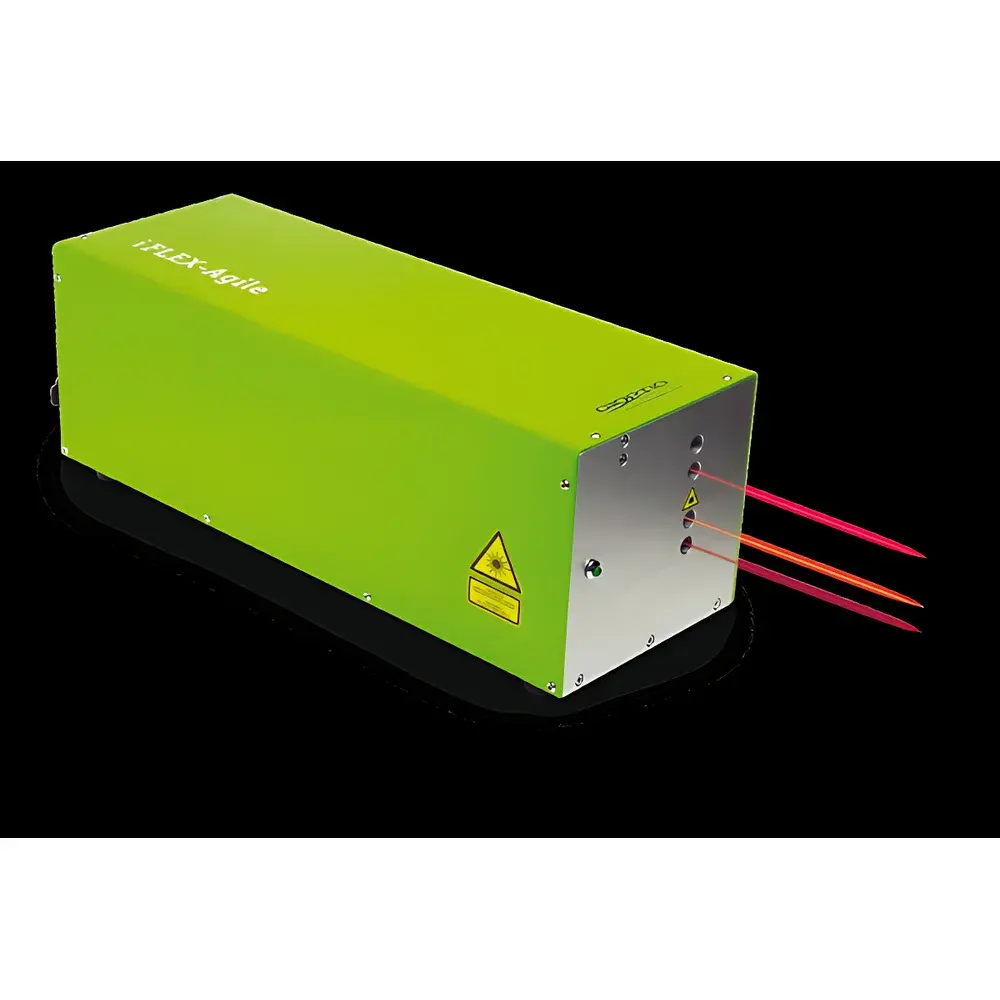
Qioptiq iFLEX-Agile Continuous-Wave Optical Parametric Oscillator (OPO) Laser System
| Brand | Qioptiq |
|---|---|
| Origin | Germany |
| Model | iFLEX-Agile |
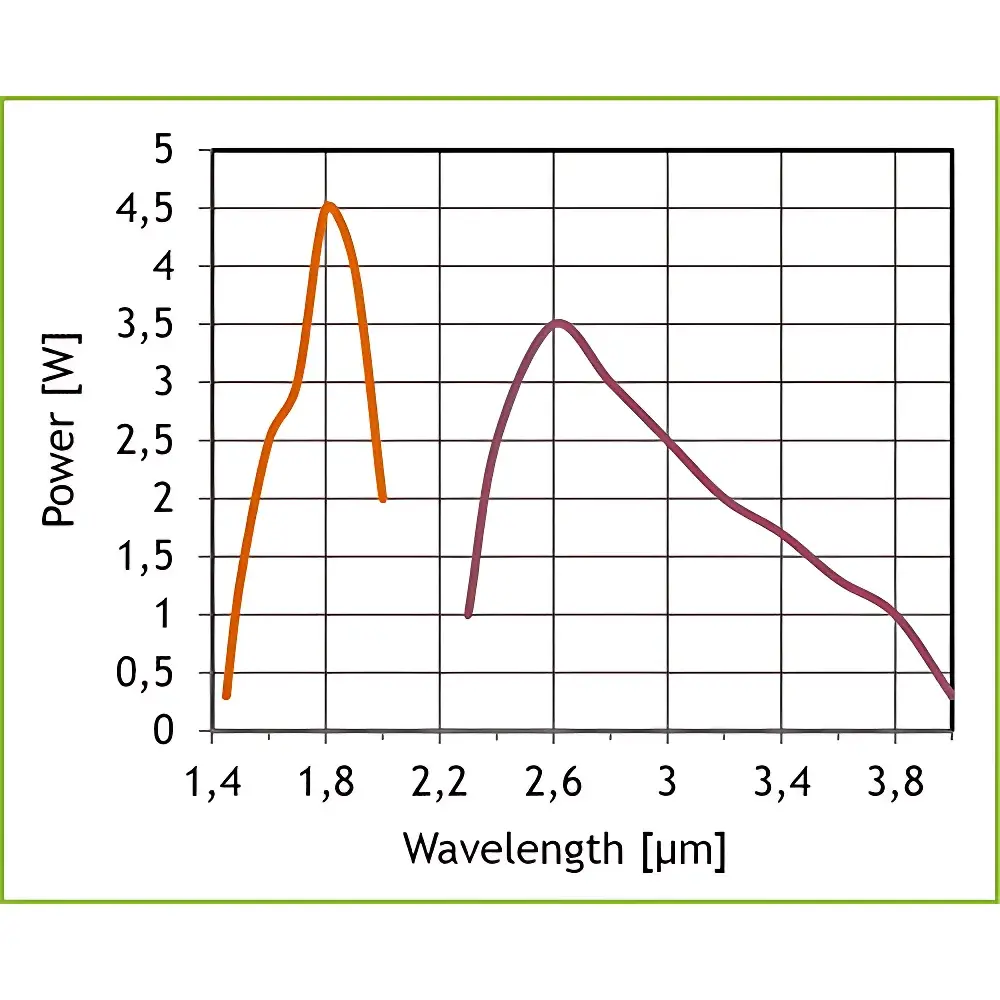
| Output Power | >1 W (signal, 2.4–3.7 µm) |
| Tuning Range | 1.48–1.95 µm and 2.4–4.0 µm |
| Linewidth | <200 GHz to <1 MHz (configurable) |
| Control Interface | USB |
| Cooling | Air-cooled |
| Power Supply | 220–230 V AC, ~500 W |
| Form Factor | 19″ rack-mountable 3U chassis + OPO module (48 × 24 × 15 cm³) |
| Polarization | Linear |
| Intensity Noise (RMS) | <5% |
| Pump Coupling | Fiber-coupled (~2 m) |
Overview
The Qioptiq iFLEX-Agile is a fully integrated, continuous-wave (CW) optical parametric oscillator (OPO) laser system engineered for high-precision mid-infrared (MIR) and near-infrared (NIR) spectroscopy applications. Based on intracavity singly resonant OPO architecture with periodically poled lithium niobate (PPLN) or orientation-patterned gallium arsenide (OP-GaAs) gain media—depending on configuration—the system delivers widely tunable, narrow-linewidth, diffraction-limited output without mechanical realignment. Unlike pulsed OPOs, the iFLEX-Agile operates in CW mode, enabling coherent detection schemes, heterodyne spectroscopy, and long-interaction-length absorption measurements essential for trace gas analysis and high-resolution molecular fingerprinting. Its dual-band coverage—spanning 1.48–1.95 µm (NIR signal band) and 2.4–4.0 µm (MIR idler band)—addresses key atmospheric transmission windows and fundamental vibrational absorption bands of hydrocarbons, NOx, CO, CH4, NH3, and halogenated compounds. The system is designed for laboratory integration into FTIR, cavity-enhanced absorption spectroscopy (CEAS), photoacoustic spectroscopy (PAS), and frequency-comb-referenced metrology platforms.
Key Features
- Simultaneous dual-band tuning: seamless electronic selection between 1.48–1.95 µm (signal) and 2.4–4.0 µm (idler) without optical realignment or component swapping
- High output power: >1 W at 2.4–3.7 µm; >1 W at 1.5–1.95 µm; configurable up to 0.5 W in extended MIR (3.8–4.5 µm)
- Linewidth flexibility: selectable operation from <200 GHz (broadband spectroscopy) to <1 MHz (Doppler-limited line profiling), optimized via pump source and cavity stabilization options
- Fully software-controlled: intuitive Windows-based GUI communicates via USB 2.0; supports scripting (Python, LabVIEW) for automated wavelength sweeps and closed-loop feedback integration
- Air-cooled, rack-mounted architecture: compact 3U 19″ chassis housing pump laser, OPO cavity, temperature-stabilized nonlinear crystal oven, and beam conditioning optics
- Low intensity noise: <5% RMS amplitude fluctuation over 10 Hz–10 MHz bandwidth—critical for lock-in and balanced detection schemes
- Linear polarization output with extinction ratio >100:1; M² <1.2 across full tuning range
Sample Compatibility & Compliance
The iFLEX-Agile is compatible with standard optical breadboards, vacuum-compatible gas cells (e.g., Herriott-type multi-pass cells), cryogenic sample stages, and fiber-coupled probe interfaces (FC/APC or SMA905). Its spectral purity and stability meet requirements for ISO/IEC 17025-accredited calibration laboratories performing traceable gas concentration measurements. While not inherently FDA 21 CFR Part 11 compliant, the control software supports audit-trail logging and user-access-level management when deployed within validated GxP environments (e.g., pharmaceutical residual solvent analysis per USP ). All electrical components conform to IEC 61000-6-3 (EMC) and IEC 61010-1 (safety); laser emission complies with IEC 60825-1:2014 Class 4 specifications, requiring interlocked enclosures and certified laser safety officers (LSOs) per ANSI Z136.1.
Software & Data Management
The iFLEX-Agile Control Suite provides real-time monitoring of crystal temperature, cavity alignment status, pump power, and output wavelength (via internal wavemeter or external reference interferometer input). Data export is supported in CSV, HDF5, and MATLAB .mat formats. The API enables synchronization with external devices—including choppers, lock-in amplifiers, and DAQ systems—via TTL triggers and analog voltage outputs. For GLP/GMP workflows, optional firmware modules add electronic signature support, session-based data versioning, and tamper-evident log archiving. All configurations are stored as encrypted XML profiles, ensuring reproducibility across instrument deployments in multi-site R&D or production QC labs.
Applications
- High-resolution molecular spectroscopy: rovibrational line shape analysis of transient species in combustion diagnostics and plasma chemistry
- Trace gas detection: ppb-level quantification of industrial emissions (e.g., SF6, H2S, HCl) using direct absorption or wavelength modulation spectroscopy (WMS)
- Materials characterization: phonon-mode mapping in 2D materials (MoS2, h-BN), polymer degradation studies, and semiconductor defect analysis via photothermal deflection
- Atomic physics: optical pumping of metastable molecular states and precision measurement of hyperfine structure in diatomic radicals
- Metrology: calibration source for FTIR spectrometers (ASTM E1421), validation of quantum cascade laser (QCL) wavelength accuracy, and development of optical frequency standards in the MIR
FAQ
Is the iFLEX-Agile suitable for field-deployable instrumentation?
The system is designed for laboratory use with stable AC power and ambient temperature control (18–25°C, <60% RH). While ruggedized versions exist for specific defense contracts, standard units are not rated for shock, vibration, or wide thermal cycling.
Can the tuning range be extended beyond 4.0 µm?
Yes—optional OP-GaAs crystal modules extend idler output to 4.5 µm (typ.) with reduced power; operation beyond 5 µm requires custom quasi-phase-matching design and is subject to thermal lensing limitations.
What pump sources are compatible?
Standard configurations integrate single-frequency Yb-fiber or Tm-fiber pump lasers (1064 nm or 1950 nm). External pump coupling via FC/APC fiber is supported for users supplying their own narrow-linewidth sources.
Does the system include wavelength calibration traceability?
Each unit ships with NIST-traceable calibration certificate for the internal wavemeter (±0.05 cm⁻¹ uncertainty at 3 µm); optional external wavemeter integration enables sub-MHz absolute accuracy.
How is thermal drift managed during long-duration scans?
Active crystal oven control (±0.01°C stability) combined with cavity length feedback via piezoelectric transducer (PZT) ensures <50 MHz/h drift under constant operating conditions.




