
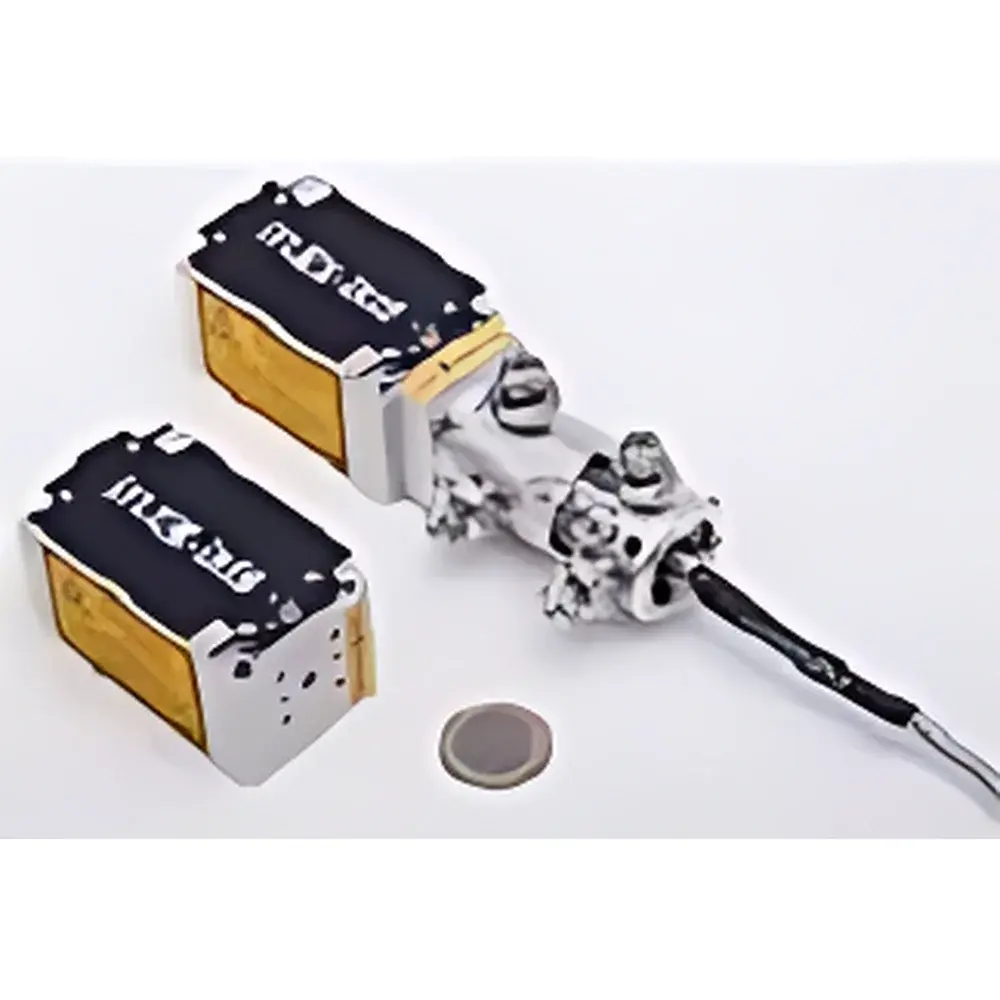
Qioptiq iFLEX-IRIS Compact Single-Wavelength Fiber-Coupled Laser System
| Brand | Qioptiq |
|---|---|
| Origin | United Kingdom |
| Model | iFLEX-IRIS |
| Dimensions | 70 mm × 40 mm × 38 mm |
| Output | Single-wavelength, fiber-coupled (single-mode, polarization-maintaining) |
| Modulation | Closed-Loop Modulation (CLM) with automatic power control |
| Thermal Stability | Active temperature stabilization, mode-hop-free operation |
| Beam Quality | TEM₀₀, high pointing stability |
| Compliance | Designed for integration into CE-compliant OEM instrumentation |
| Fiber Interface | KineFLEX® PM-fiber coupling, free-space/fiber-output dual configuration |
Overview
The Qioptiq iFLEX-IRIS is a compact, single-wavelength, fiber-coupled diode laser system engineered for precision optical instrumentation and laboratory integration. Based on solid-state semiconductor laser technology, it operates via direct current injection into a monolithic cavity, delivering stable, diffraction-limited output in TEM₀₀ mode. The system employs a proprietary closed-loop modulation (CLM) architecture that continuously monitors and adjusts output power using real-time photodiode feedback—ensuring amplitude stability better than ±0.5% over 8 hours under constant thermal conditions. Integrated thermoelectric coolers (TECs) maintain junction temperature within ±0.02 °C, eliminating mode-hopping across the full operating range and enabling wavelength stability of <±5 pm (typical). Its miniature footprint—70 mm × 40 mm × 38 mm—makes it suitable for space-constrained platforms including confocal microscopes, flow cytometers, Raman spectrometers, and portable analytical devices.
Key Features
- Compact OEM-ready form factor (70 × 40 × 38 mm) with integrated driver, TEC, and monitoring electronics
- Closed-Loop Modulation (CLM): Enables analog and digital modulation up to 1 MHz with <1% RMS amplitude noise (10 Hz–10 MHz bandwidth)
- Active thermal stabilization ensures continuous-wave (CW) operation without spectral discontinuities or wavelength drift
- KineFLEX® polarization-maintaining (PM) single-mode fiber delivery (e.g., PM980 or PM1550, depending on wavelength variant), with FC/APC or SMA905 termination
- Dual-output capability: factory-configurable free-space collimated beam (M² < 1.1) and fiber-coupled output via interchangeable optical head
- Compliance-ready design: meets IEC 60825-1:2014 Class 3R/3B safety requirements; RoHS and REACH compliant
- OEM interface support: TTL/RS-232/USB-C control options; analog modulation input (0–5 V); status monitoring via digital I/O
Sample Compatibility & Compliance
The iFLEX-IRIS is designed for use with optically transparent, non-fluorescent, and low-scattering samples in transmission, reflection, or epi-illumination configurations. Its narrow linewidth (<0.1 nm), high spatial coherence, and polarization fidelity make it compatible with interferometric setups, holographic recording, and polarization-sensitive detection schemes. The system conforms to ISO 13406-2 for laser safety classification documentation and supports traceable calibration per ISO/IEC 17025 when deployed in accredited laboratories. For regulated environments—including pharmaceutical QC labs and clinical diagnostics platforms—the laser’s firmware supports audit-trail logging and user-access controls aligned with FDA 21 CFR Part 11 principles (when integrated with compliant host software).
Software & Data Management
Qioptiq provides the iFLEX Control Suite—a cross-platform application (Windows/macOS/Linux) supporting device discovery, power ramping, modulation profile definition, and real-time power/temperature telemetry. The SDK includes C/C++, Python, and LabVIEW APIs with full register-level access to DACs, ADCs, and fault registers. All communication uses ASCII-based serial protocol over USB-C or RS-232, enabling deterministic timing for synchronized acquisition in time-resolved experiments. Data logs are exportable in CSV and HDF5 formats, preserving metadata such as timestamp, ambient temperature, setpoint deviation, and error flags—facilitating GLP/GMP-aligned record retention.
Applications
- Confocal and super-resolution fluorescence microscopy (e.g., STED, PALM) requiring stable, diffraction-limited excitation
- Optical trapping and holographic optical tweezers systems demanding high pointing stability (<2 µrad/°C) and low intensity noise
- Portable Raman spectrometers where size, power efficiency, and spectral purity are critical
- Interferometric biosensors and OCT light sources requiring long coherence length (>10 m) and polarization extinction ratio >20 dB
- Industrial machine vision illumination for high-speed inspection of micro-optics and semiconductor wafers
- Calibration reference sources for photodetector linearity testing and radiometric transfer standards
FAQ
What wavelengths are available in the iFLEX-IRIS series?
Standard offerings include 405 nm, 488 nm, 532 nm, 640 nm, and 785 nm; custom wavelengths between 375–1064 nm are available under OEM agreement.
Is the fiber coupling truly polarization-maintaining?
Yes—the KineFLEX® interface delivers >20 dB polarization extinction ratio (PER) over the full operating temperature range (15–35 °C) with minimal PER degradation after 10⁶ mating cycles.
Can the laser be modulated at frequencies above 1 MHz?
The CLM circuit supports analog modulation up to 1 MHz; for higher-frequency applications (e.g., 10–100 MHz), external electro-optic modulation is recommended using the free-space output port.
Does the system support remote calibration or field recalibration?
No end-user recalibration is required; factory calibration is NIST-traceable and remains valid for 24 months under standard operating conditions. Field verification protocols are provided in the technical manual.
How is thermal management handled during extended operation?
A two-stage TEC and heatsink assembly maintains junction temperature within ±0.02 °C even during 24/7 operation at maximum rated power, with thermal dissipation managed passively or via optional forced-air cooling.




