
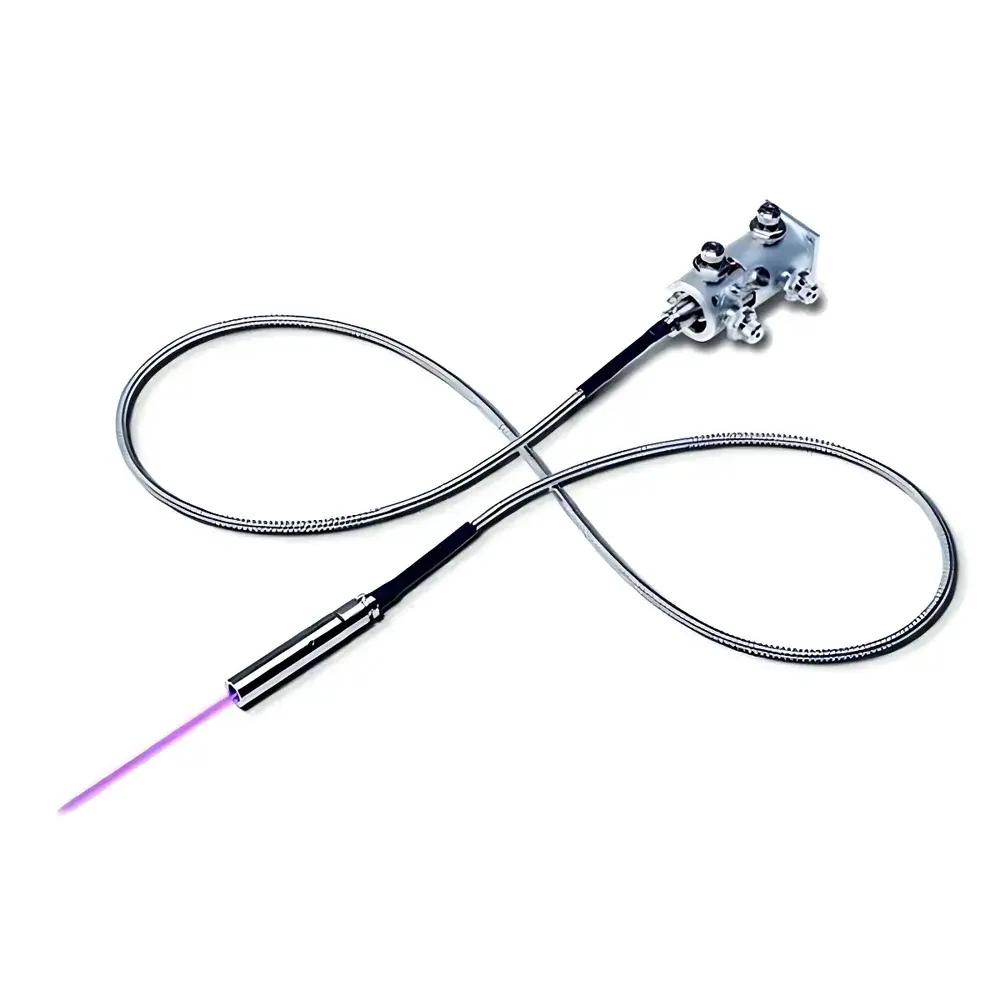
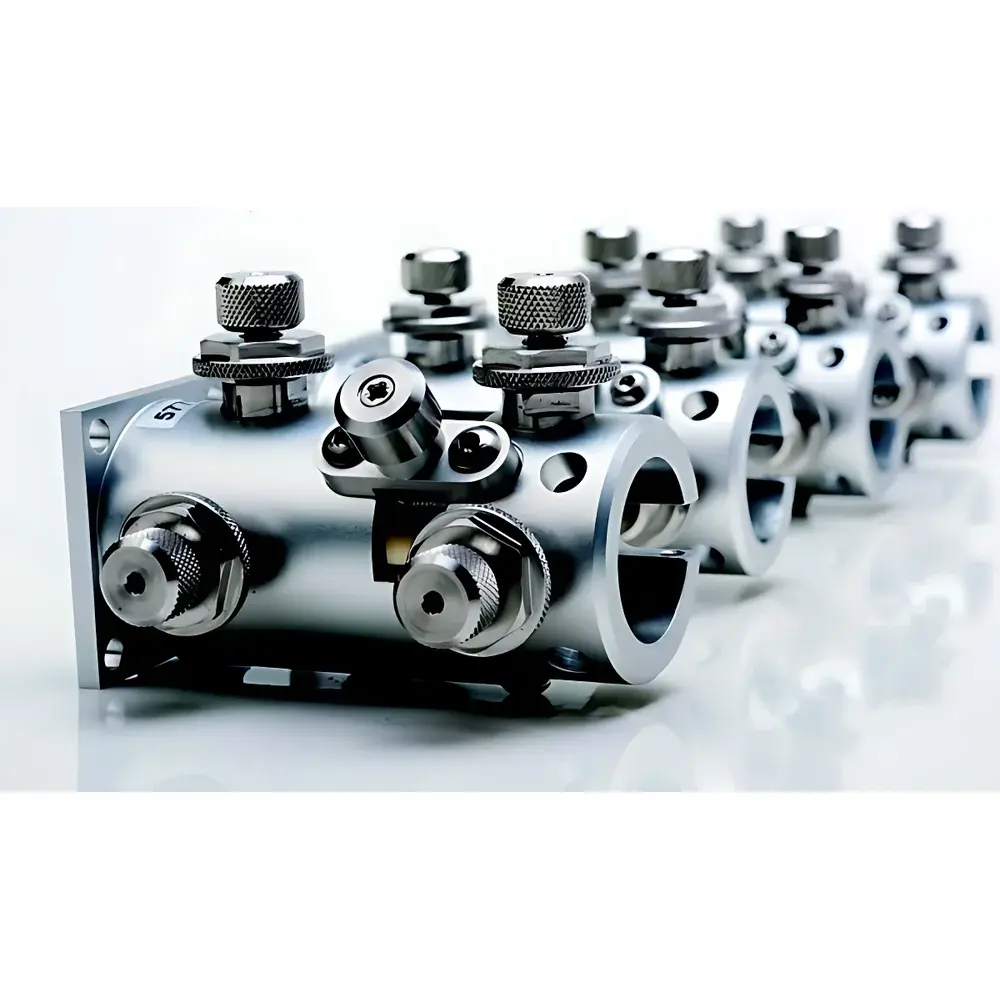
Qioptiq kineFLEX-DUO™ / iFLEX-Adder™ Single-Mode Polarization-Maintaining Fiber Coupler and Beam Combiner
| Brand | Qioptiq |
|---|---|
| Origin | United Kingdom |
| Model | kineFLEX-DUO™ / iFLEX-Adder™ |
| Wavelength Range | 405–640 nm (model-dependent) |
| Transmission Efficiency | ≥60% (kineFLEX-DUO™), ≥40% (iFLEX-Adder™) |
| Fiber Type | Single-mode, polarization-maintaining (PM) |
| Fiber Length | 1–3 m |
| Jacket | Stainless steel, Ø5 mm |
| Output Connector | FC/PC or FC/APC (PM-compatible) |
| Collimated Beam Diameter | 0.7 mm |
| Beam Quality (M²) | ≤1.1 |
| Pointing Stability | ≤1 µrad/°C |
| Beam Position Stability | ≤±0.15 mm |
| Beam Angle Stability | ≤±0.5 mrad |
| Operating Temperature | 10–40 °C |
| Storage Temperature | 10–50 °C |
| Relative Humidity | Non-condensing |
| Collimator Dimensions | Ø12 × 50 mm |
| Compliance | Designed for integration into ISO/IEC 17025-compliant optical test benches and GLP/GMP-aligned instrumentation platforms |
Overview
The Qioptiq kineFLEX-DUO™ and iFLEX-Adder™ are precision-engineered single-mode, polarization-maintaining (PM) fiber combiners designed for stable, low-loss spectral multiplexing of visible-wavelength laser sources. Unlike conventional free-space beam combiners, these modules integrate collimation, spatial filtering, and polarization-resolved coupling into a monolithic, alignment-free architecture. Based on Qioptiq’s proprietary kineFLEX™ platform, the system leverages PM fiber (e.g., PANDA or bow-tie type) to preserve input polarization states while enabling deterministic co-propagation of discrete wavelengths—405 nm, 445 nm, 488 nm, 515/532 nm, 561 nm, 633/640 nm—depending on model selection. The core principle relies on wavelength-selective dichroic interference coatings deposited onto fused-fiber couplers and integrated micro-optics, ensuring minimal modal distortion and high extinction ratio (>25 dB) between channels. This architecture eliminates sensitivity to thermal drift and mechanical perturbation, making it suitable for long-duration interferometric imaging, confocal microscopy, flow cytometry, and quantum optics setups where beam pointing stability (<1 µrad/°C) and wavefront fidelity (M² ≤ 1.1) are non-negotiable.
Key Features
- Modular, plug-and-play integration with OEM laser systems—no active alignment required post-installation
- Single-mode PM fiber output (SMF-28 or equivalent PM fiber) with stainless-steel armored jacket (Ø5 mm) for vibration- and flexure-resistant routing in compact instruments
- Integrated collimator (Ø12 × 50 mm) delivering diffraction-limited divergence and sub-0.15 mm positional repeatability over temperature cycles
- Optimized input optics pre-focus and mode-match common CW solid-state lasers (e.g., diode-pumped DPSS, Fabry–Pérot diodes), supporting FC/PC and FC/APC interface standards
- Vacuum-, UHV-, and cleanroom-compatible construction; no outgassing materials used in optical path or housing
- Thermally passive design—no active cooling or piezo actuators—ensuring long-term reliability under continuous operation
- Customizable beam-shaping optics embedded at the fiber facet (e.g., anamorphic correction, top-hat generation) without introducing additional air-glass interfaces
Sample Compatibility & Compliance
The kineFLEX-DUO™ and iFLEX-Adder™ accept collimated, TEM₀₀ inputs from commercially available visible-wavelength lasers—including 405 nm diode, 488 nm argon-ion or solid-state, 532 nm Nd:YAG, and 640 nm diode lasers—with beam diameters up to 3 mm and divergence <1.5 mrad. Input polarization extinction ratio must exceed 20 dB for optimal PM maintenance. All units undergo factory verification per ISO 10110-7 (surface quality), ISO 11146 (beam propagation), and IEC 60825-1 (laser safety classification). The mechanical housing conforms to IP54 dust/moisture protection when connectors are mated. For regulated environments, the system supports audit-ready documentation packages compliant with FDA 21 CFR Part 11 (when paired with validated control software) and meets traceability requirements under ISO/IEC 17025 for calibration laboratories performing laser power and beam parameter validation.
Software & Data Management
While the kineFLEX-DUO™ and iFLEX-Adder™ operate as fully passive optical components, they are engineered for seamless integration into automated instrument control frameworks. Qioptiq provides comprehensive mechanical drawings (STEP, IGES), spectral transmission reports (per channel, measured via calibrated spectroradiometer), and polarization crosstalk matrices for each serial-numbered unit. These datasets are supplied in CSV and PDF formats compatible with LabVIEW, MATLAB, and Python-based metrology pipelines. Optional firmware-enabled monitoring (via external photodiode arrays coupled to the fiber output) allows real-time tracking of relative channel power drift—critical for quantitative fluorescence applications requiring ratiometric stability. All calibration certificates include measurement uncertainty budgets aligned with EURAMET cg-18 guidelines.
Applications
- Multi-color confocal and super-resolution microscopy (STED, STORM), where simultaneous excitation at 488/561/640 nm demands phase-stable, co-aligned beams
- Flow cytometry illumination engines requiring >99% spatial overlap of excitation lines across 10⁶ cells/sec throughput
- Fiber-delivered photostimulation in optogenetics, leveraging PM preservation for polarization-sensitive opsins
- Interferometric displacement sensing and heterodyne vibrometry, benefiting from sub-µrad pointing stability over 8-hour acquisition windows
- OEM integration into portable Raman spectrometers and handheld LIBS devices where size, weight, and thermal robustness are constrained
- Quantum key distribution (QKD) testbeds requiring indistinguishable photon pair injection via PM fiber networks
FAQ
Can the kineFLEX-DUO™ combine more than two wavelengths?
Yes—the kineFLEX-DUO™ is specifically configured for dual-wavelength combination, while the iFLEX-Adder™ supports up to six discrete visible channels using cascaded dichroic stacking; custom configurations beyond six wavelengths are available upon request.
Is the output truly single-mode and polarization-maintaining?
Yes—output is delivered via certified PM fiber (e.g., Thorlabs P1-460PM-FC) with measured PER >20 dB over full operating temperature range and guaranteed modal content <0.5% LP₁₁ contamination.
What is the maximum input power per channel?
For continuous-wave operation, the recommended limit is 500 mW per channel; higher powers require customized thermal management and are subject to individual optical damage threshold validation.
Do you provide alignment fixtures or mating adapters for specific laser models?
Yes—Qioptiq offers application-specific mounting brackets, kinematic laser-to-fiber interface plates, and FC/APC-to-C-mount adapters compatible with Coherent OBIS, Toptica iChrome, and MPB Communications laser platforms.
Is vacuum compatibility validated experimentally?
Yes—all stainless-steel-jacketed variants have undergone 10⁻⁷ mbar bake-out testing per ASTM E595, with total mass loss (TML) <0.5% and collected volatile condensable materials (CVCM) <0.05%.






