
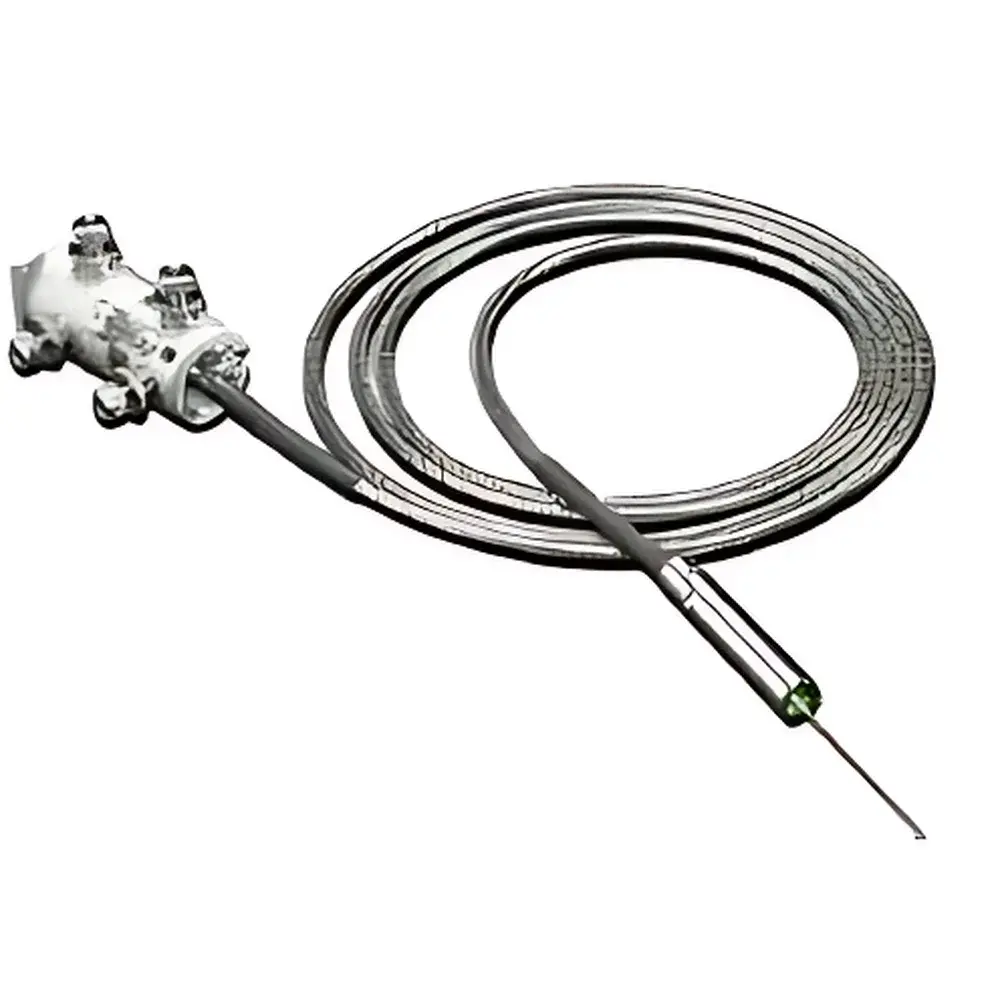
Qioptiq KineFLEX Plug-and-Play Single-Mode Fiber Coupler
| Brand | Qioptiq |
|---|---|
| Origin | UK |
| Model | KineFLEX |
| Wavelength Range | 405–640 nm |
| Polarization Extinction Ratio | ≤ −20 dB |
| Transmission Efficiency | ≥ 65% |
| Fiber Length | 1–3 m |
| Fiber Jacket | Stainless Steel, Ø5 mm |
| Output Connector | FC/PC or FC/APC (8° angled polish) |
| Collimated Beam Diameter | 0.7 mm |
| Beam Quality (M²) | Typ. 1.1 |
| Pointing Stability | ≤ 1 µrad/°C |
| Beam Position Accuracy | ≤ ±0.15 mm |
| Beam Angle Accuracy | ≤ ±0.5 mrad |
| Collimator Dimensions | Ø12 × 50 mm |
| Operating Temperature | 10–40 °C |
| Storage Temperature | 10–50 °C |
| Relative Humidity | Non-condensing |
| Atmospheric Pressure | Standard |
Overview
The Qioptiq KineFLEX Plug-and-Play Single-Mode Fiber Coupler is a precision-engineered optical interface designed for deterministic, high-fidelity coupling of free-space laser beams into single-mode fiber (SMF) with zero realignment required across hundreds of insertion cycles. Built upon a passive, kinematic mounting architecture, the system leverages mechanical self-alignment principles—rather than active feedback or manual micrometer adjustment—to achieve sub-micron repeatability in beam coupling position and angle. This eliminates drift-induced misalignment common in thermally sensitive or vibration-prone optical tables, making it especially suited for confocal microscopy, super-resolution imaging, quantum optics setups, and other applications demanding long-term spatial stability under repeated instrument reconfiguration. The coupler operates across a broad visible spectrum (405–640 nm), supporting multi-wavelength laser sources without hardware modification. Its transmission efficiency ≥65% reflects optimized anti-reflection coatings on all optical surfaces and precise mode-field diameter matching between the collimated input beam and the fundamental LP01 mode of the SMF.
Key Features
- Plug-and-play operation: No recalibration needed after >1,000 insertions—mechanically locked alignment ensures repeatable coupling performance.
- Sub-micron positional repeatability (≤ ±0.15 mm beam position; ≤ ±0.5 mrad angular deviation) validated per ISO 10110-7 for optical component stability.
- Integrated stainless-steel armored fiber (Ø5 mm) rated for UHV-compatible environments (10−9 mbar), enabling deployment in vacuum chambers without outgassing concerns.
- Modular collimator design with interchangeable FC/PC or FC/APC (8° polished) output interfaces—supports polarization-maintaining (PM) fiber integration for coherent or interferometric applications.
- Diffraction-limited collimation (M² ≈ 1.1) with 0.7 mm beam diameter, ensuring minimal divergence (< λ/πw₀) and compatibility with standard microscope scan lenses and objective back apertures.
- Thermal pointing stability ≤ 1 µrad/°C over 10–40 °C operating range, meeting specifications for GLP-compliant optical metrology systems.
Sample Compatibility & Compliance
The KineFLEX coupler accommodates common continuous-wave (CW) and pulsed visible lasers—including diode lasers at 405 nm, DPSS sources at 532 nm, and HeNe systems at 633 nm—without wavelength-specific recalibration. Its PM fiber output option (FC/APC with 8° polish) preserves state-of-polarization (SOP) for applications requiring polarization fidelity, such as stimulated emission depletion (STED) microscopy or fiber-based interferometers. The device conforms to IEC 61300-2-2 (mechanical endurance), IEC 61300-2-1 (vibration resistance), and RoHS 2015/863/EU directives. All optical coatings meet ISO 9211-3 standards for laser-induced damage threshold (LIDT > 500 MW/cm² for 10 ns pulses at 532 nm). It is routinely deployed in ISO/IEC 17025-accredited laboratories performing traceable optical power and beam parameter measurements.
Software & Data Management
As a purely passive optical component, the KineFLEX coupler requires no firmware, drivers, or software control. Its performance is fully characterized during factory calibration using NIST-traceable beam profiling systems (e.g., Ophir NanoScan or Gentec-EO Maestro). Calibration reports include measured M², beam centroid displacement vs. temperature, and polarization extinction ratio (PER) across the full operational wavelength band. These reports are archived with unique serial-numbered certificates compliant with 21 CFR Part 11 audit trail requirements when integrated into FDA-regulated instrumentation platforms (e.g., clinical confocal endomicroscopes). End users may import these datasets into LabVIEW, MATLAB, or Python-based optical modeling workflows (e.g., using PyOptica or LightPipes) for system-level beam propagation analysis.
Applications
- Confocal and multiphoton microscopy: Enables rapid interchange of excitation lasers while maintaining diffraction-limited focus at the sample plane.
- Quantum optics experiments: Delivers stable, polarization-preserving coupling for SPDC sources, cavity QED setups, and photonic integrated circuit testing.
- Industrial laser metrology: Serves as a reference-grade beam delivery module in interferometric surface profilometers and laser Doppler vibrometers.
- Space-qualified instrumentation: Stainless-steel housing and vacuum-rated construction support use in satellite-borne optical communication terminals and planetary spectrometers.
- Teaching laboratories: Provides robust, alignment-free introduction to single-mode fiber coupling principles without requiring optical bench expertise.
FAQ
Is the KineFLEX coupler compatible with non-PM single-mode fibers?
Yes—it supports standard SMF-28 and HI1060 fibers via FC/PC connectors. PM fiber integration is optional and requires specification at time of order.
Can it be used with femtosecond pulsed lasers?
Yes, provided pulse energy remains below the LIDT threshold for coated optics and fiber endface. Chirped pulse dispersion must be managed externally; the coupler itself introduces negligible group delay variation.
Does it require periodic recalibration?
No. Mechanical self-alignment and stress-relieved fiber termination eliminate drift mechanisms. Factory calibration remains valid for the product lifetime under specified environmental conditions.
What vacuum compatibility level is certified?
The stainless-steel armored fiber assembly has been tested to 10−9 mbar with outgassing rates < 1×10⁻¹² Pa·m³/s per ISO 11341, suitable for UHV electron microscopy and atomic physics chambers.
How is beam pointing stability quantified?
Measured per ISO 10110-10 using a quadrant photodiode and closed-loop thermal chamber (±0.1 °C stability), reporting centroid shift normalized to temperature change (µrad/°C).



