
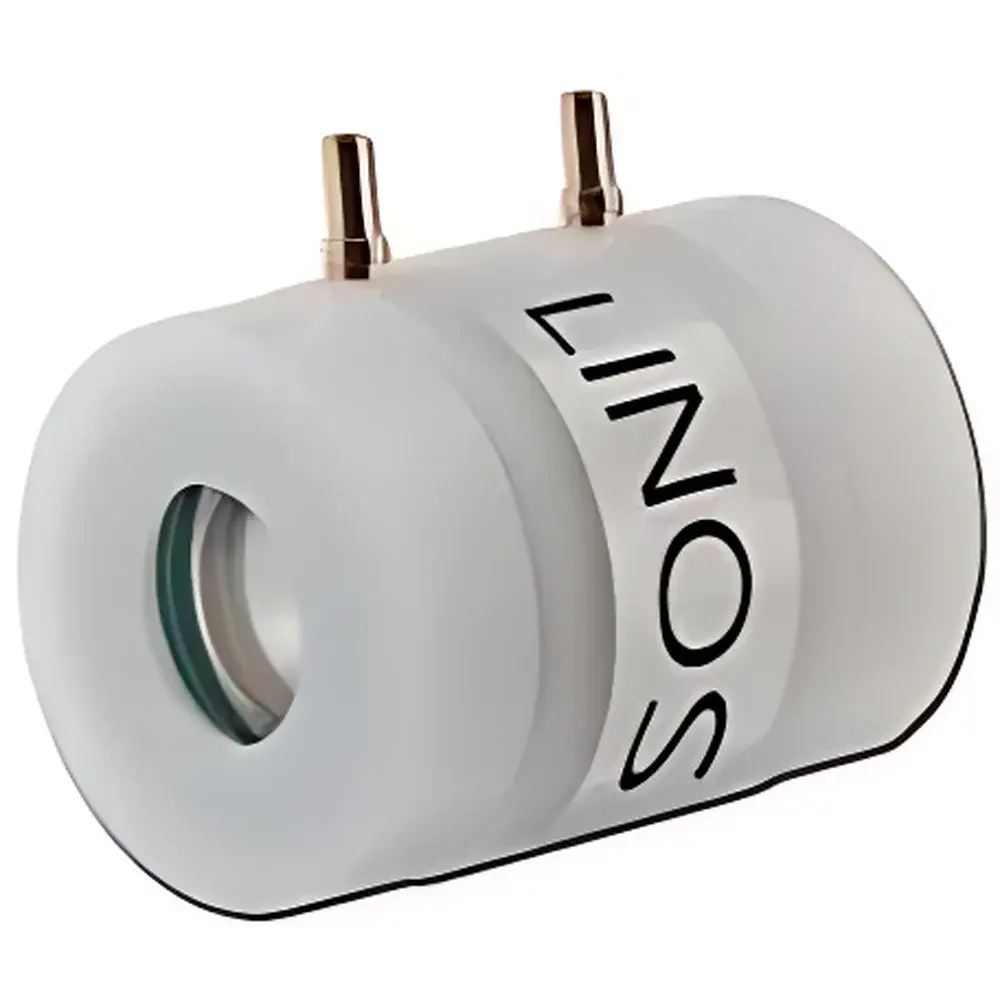
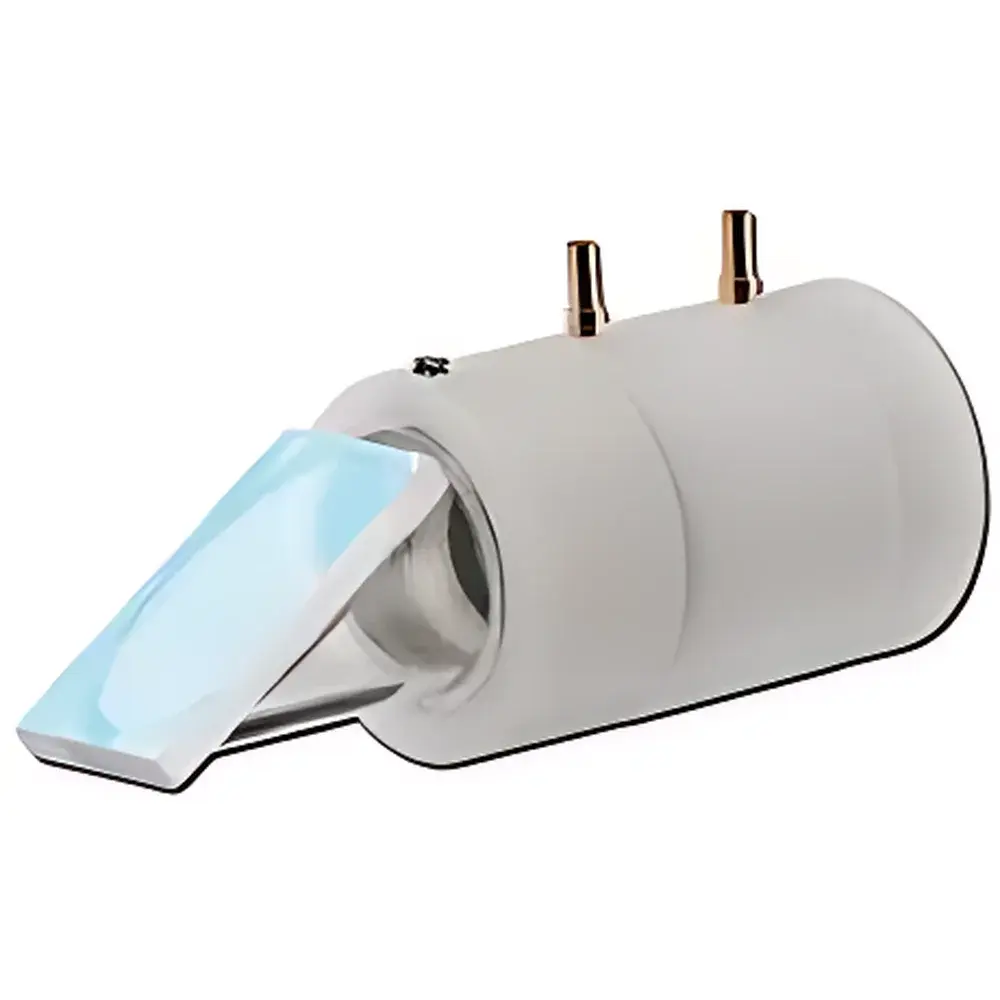
Qioptiq LINOS KD*P Pockels Cell
| Brand | Qioptiq |
|---|---|
| Origin | Germany |
| Manufacturer Type | Authorized Distributor |
| Import Status | Imported |
| Model | KD*P |
| Core Application | Solid-State Laser Systems & Electro-Optic Q-Switching |
| Crystal Material | Deuterated Potassium Dihydrogen Phosphate (KD*P) |
| Aperture Diameter | Ø3.5–Ø15 mm |
| Transmission | 84–99% @ 1064 nm |
| Extinction Ratio (Zero Voltage) | 500:1–3000:1 |
| Quarter-Wave Voltage | 3.2–8 kV @ 1064 nm |
| Capacitance | 4–8 pF |
| Wavefront Distortion | < λ/4 |
| Laser-Induced Damage Threshold | > 500 MW/cm² @ 1064 nm, 10 ns, 1 Hz (typ.) |
| Housing Options | Standard, Water-Immersion (IM), Sol-Gel Coated (SG) |
| Mounting | Precision Kinematic Mount with Pitch/Yaw/Rotation Adjustment, Compatible with Cells up to 35 mm Height |
Overview
The Qioptiq LINOS KD*P Pockels Cell is a high-performance electro-optic modulator engineered for precise, nanosecond-scale control of laser polarization and intensity in demanding solid-state laser systems. Based on deuterated potassium dihydrogen phosphate (KD*P) crystal—optimized for >98% deuteration—the device operates via the linear electro-optic (Pockels) effect, inducing birefringence proportional to an applied high-voltage field. This enables deterministic, voltage-controlled phase retardation between orthogonal polarization components, facilitating applications such as Q-switching, cavity dumping, pulse picking, and optical gating. Its design targets high-repetition-rate (>10 kHz) and high-peak-power environments, with proven stability under multi-megawatt/cm² fluences at 1064 nm. The cell’s low wavefront distortion (<λ/4) ensures minimal beam degradation, preserving M² and spatial mode fidelity critical for amplifier seeding and interferometric setups.
Key Features
- High-deuteration KD*P crystal (≥98% D-content) for enhanced transparency and reduced absorption at 1064 nm and harmonics (532 nm, 355 nm)
- Optimized electrode geometry and anti-reflective coatings yielding transmission >84% (up to 99%) across standard Nd:YAG and Yb:fiber wavelengths
- Extinction ratio of 500:1–3000:1 at zero bias, enabling robust contrast in polarization-sensitive architectures
- Quarter-wave voltage range of 3.2–8 kV (dependent on aperture and crystal length), calibrated for 1064 nm operation with ±15% tolerance at 2 µm
- Capacitance of 4–8 pF supports fast voltage risetimes (<5 ns with matched drivers) and low power dissipation
- Three mechanical configurations: standard air-spaced, water-immersion (IM) for thermal management in CW-pumped systems, and sol-gel coated (SG) for humidity resistance and long-term vacuum compatibility
- Kinematic mounting platform with micrometer-adjustable pitch, yaw, and rotation axes; accommodates cells up to 35 mm in height for OEM integration
Sample Compatibility & Compliance
The LINOS KD*P Pockels Cell is compatible with pulsed and quasi-CW solid-state lasers including Nd:YAG, Nd:YLF, Yb:YAG, and thin-disk amplifiers. It meets ISO 10110-7 surface quality standards (scratch-dig 10-5) and complies with IEC 61000-6-3 (EMC emission) and IEC 61000-6-2 (immunity) for laboratory and industrial deployment. While not certified to FDA 21 CFR Part 11, its passive optical architecture and traceable calibration data support GLP/GMP-aligned validation protocols when integrated into regulated laser processing or medical device manufacturing lines. No intrinsic radiation hazard; operation requires external high-voltage driver meeting IEC 61010-1 safety requirements.
Software & Data Management
As a purely electro-optic passive component, the Pockels cell does not incorporate embedded firmware or digital interfaces. However, it is fully interoperable with industry-standard high-voltage pulse generators (e.g., Quantum Composers, Berkeley Nucleonics) and timing controllers supporting TTL, LVDS, or analog trigger inputs. Integration with LabVIEW, MATLAB, or Python-based automation frameworks is achieved via driver-level synchronization of HV pulses with laser pump diodes or cavity dump triggers. Full optical performance characterization reports—including measured extinction ratio vs. voltage curves, wavefront maps (Zygo interferometer data), and LIDT test logs—are provided per unit for metrological traceability and system-level modeling (e.g., in Synopsys CODE V or Zemax OpticStudio).
Applications
- Active Q-switching in diode-pumped solid-state lasers (DPSSL), enabling sub-10 ns pulse generation at repetition rates up to 100 kHz
- Cavity dumping for high-energy, low-repetition-rate ultrafast amplifiers (e.g., regenerative Ti:sapphire systems)
- Optical pulse selection in multi-stage amplifier chains for time-resolved spectroscopy and LIBS
- Polarization gating in pump-probe experiments requiring femtosecond temporal resolution
- Laser safety interlocks and beam shuttering in Class IV laser enclosures compliant with IEC 60825-1
- OEM integration into compact lidar transceivers and quantum optics platforms requiring stable, low-drift EO modulation
FAQ
What is the maximum recommended repetition rate for continuous operation?
For standard air-cooled configurations, sustained operation at ≤10 kHz is advised with average power loading <1 W. Water-immersion (IM) variants support ≥50 kHz under active thermal management.
Is the quarter-wave voltage temperature-dependent?
Yes—KD*P exhibits a thermo-optic coefficient of ~−2.5×10⁻⁵ /°C; voltage drift of ~0.03%/°C is typical. Active temperature stabilization (±0.1°C) is recommended for metrology-grade stability.
Can this Pockels cell be used at 532 nm or 355 nm?
Yes—high-deuteration KD*P maintains >80% transmission and >1000:1 extinction at 532 nm; for 355 nm, antireflection coating must be specified at order entry.
Does Qioptiq provide custom apertures or electrode geometries?
Yes—OEM designs including rectangular apertures, RF-shielded housings, and fiber-coupled variants are available under NDA with lead times of 12–16 weeks.
How is damage threshold verified?
Each batch undergoes ISO 21254-1 testing using 1064 nm, 10 ns pulses at 1 Hz; reported values reflect median LIDT across five locations per crystal face, with statistical confidence >95%.





