
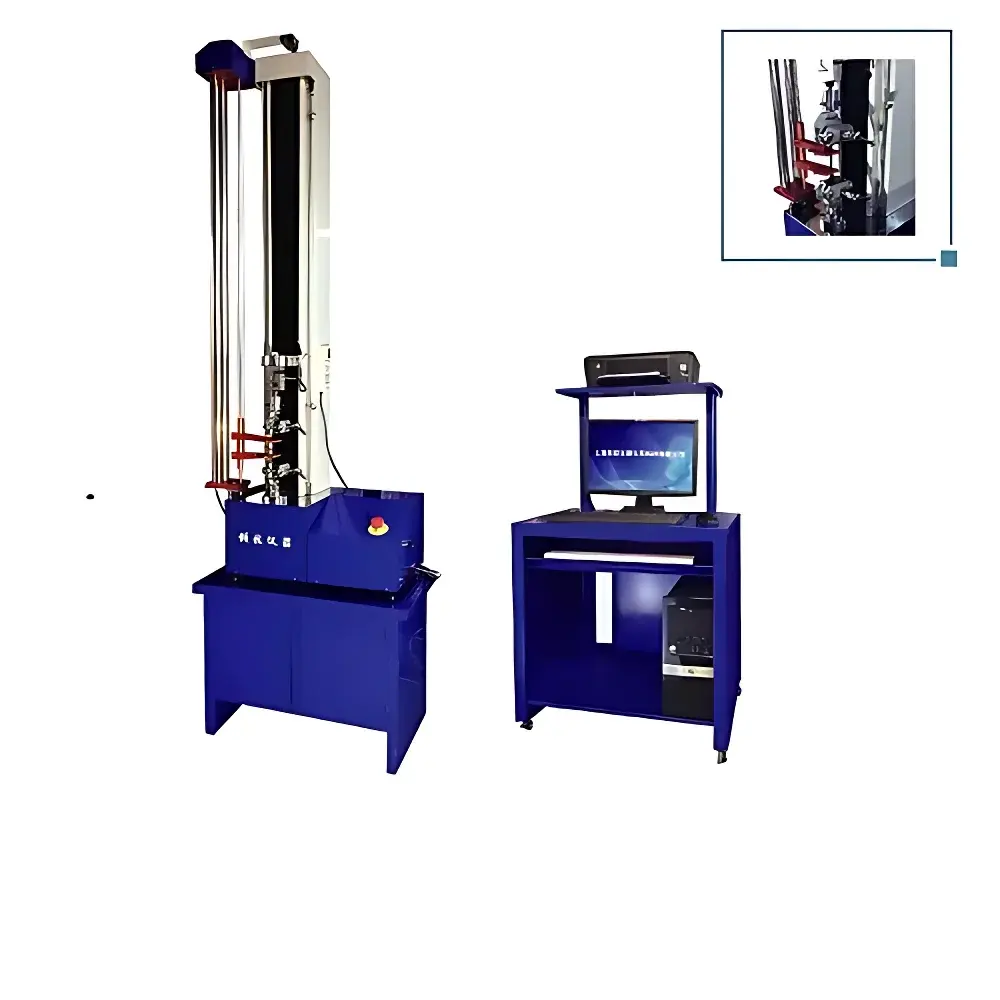
QJ210A Universal Tensile Testing Machine for Rubber and Plastic Elastic Modulus Measurement
| Origin | Shanghai, China |
|---|---|
| Manufacturer Type | Authorized Distributor |
| Origin Category | Domestic (PRC) |
| Model | QJ210A |
| Quotation | USD 6,300 (FOB Shanghai) |
| Instrument Type | Electromechanical Universal Testing Machine |
| Maximum Test Load | 5 kN |
| Force Range | 0.2%–100% of Full Scale (FS) |
| Force Accuracy | ±0.5% of reading (per ISO 7500-1 Class 0.5) |
| Crosshead Travel | 800 mm |
| Effective Test Width | 150 mm |
| Displacement Resolution | ±0.5% of reading |
| Test Speed Range | 0.01–500 mm/min (adjustable, speed accuracy ±0.5%) |
| Load Cell | High-precision strain-gauge sensor (USA-sourced) |
| Controller | Panasonic全数字交流伺服控制系统 |
| Safety Protection | Dual-mode (software-based overload diagnosis + hardware electronic limit switch) |
| Power Supply | 200 V AC, 400 W |
| Dimensions (L×W×H) | 590 × 355 × 1640 mm |
| Net Weight | 85 kg |
| Compliance | ASTM D412, D638, D882, ISO 37, ISO 527-2, GB/T 528, GB/T 1040.2, JIS K6251, DIN 53504 |
Overview
The QJ210A Universal Tensile Testing Machine is an electromechanical materials testing system engineered for precise determination of elastic modulus, tensile strength, elongation at break, yield point, and other fundamental mechanical properties of elastomeric and thermoplastic polymers. It operates on the principle of controlled uniaxial loading via a servo-driven crosshead, with real-time acquisition of force-displacement data through traceable high-resolution load cells and linear encoders. Designed in accordance with ISO 7500-1:2018 (static calibration of universal testing machines) and classified as Class 0.5, the QJ210A delivers certified repeatability and linearity across its full 5 kN capacity range. Its modular architecture supports standardized test configurations—including tension, compression, tear, shear, and puncture—via interchangeable fixtures, enabling laboratories to maintain single-platform compliance with multiple international material characterization protocols.
Key Features
- Class 0.5 force measurement accuracy per ISO 7500-1, validated over 0.2%–100% FS without range switching
- Full-scale resolution of 500,000 counts maintained continuously—no internal or external range segmentation required
- Panasonic digital AC servo drive system ensuring stable velocity control from 0.01 to 500 mm/min (±0.5% speed accuracy)
- Dual-mode safety architecture: programmable software-based overload detection (110% FS threshold) plus independent electronic travel limits
- Adjustable crosshead lift mechanism with separate fast/slow modes for rapid specimen setup and fine positioning
- Integrated LCD controller with real-time graphical display of force–displacement curves, peak load capture, and automatic zeroing
- Standardized unit conversion across gf, kgf, N, kN, and lbf for direct reporting alignment with ASTM, ISO, and GB documentation requirements
- Rigid structural frame with extruded aluminum enclosure and electrostatic powder-coated finish for long-term dimensional stability and corrosion resistance
Sample Compatibility & Compliance
The QJ210A accommodates specimens conforming to standard geometries defined in ASTM D638 (Type I–V plastics), ASTM D412 (vulcanized rubber), ISO 37 (rubber tensile properties), and GB/T 528 (Chinese rubber standards). With an effective test width of 150 mm and 800 mm vertical stroke, it supports dumbbell, strip, ring, and dog-bone configurations up to 15 mm thick. Fixture adaptability includes pneumatic grips, wedge-action clamps, compression platens, trouser-tear jigs, and puncture probes—all configurable to meet method-specific alignment tolerances. The system is fully compatible with GLP/GMP-aligned workflows: audit trails, user access levels, and electronic signatures can be implemented via optional PC-based software compliant with FDA 21 CFR Part 11 requirements.
Software & Data Management
When connected to a Windows-based host computer (e.g., Lenovo ThinkCentre M-series), the QJ210A interfaces via USB/RS232 with dedicated materials testing software supporting ISO 17025-compliant data integrity practices. Raw force–displacement datasets are stored in ASCII CSV format with timestamped metadata (operator ID, sample ID, environmental conditions, calibration certificate ID). Automated report generation includes stress–strain curves, modulus calculation (secant, tangent, chord), statistical summaries (mean, SD, CV%), and pass/fail evaluation against user-defined specification limits. All test parameters—including pre-load, extension rate, hold time, and cycle count—are programmable and recallable as reusable test methods. Software logs include full change history for all critical parameters, satisfying traceability requirements under ISO/IEC 17025 Clause 7.7.
Applications
- Evaluation of Young’s modulus and Poisson’s ratio in vulcanized natural rubber, SBR, EPDM, silicone, and TPE compounds
- Tensile property verification of polyethylene (LDPE/HDPE), polypropylene, PET, PVC, and ABS sheets, films, and molded parts
- Quality control of automotive sealing systems, medical tubing, conveyor belts, and footwear components
- R&D validation of polymer blends, filled composites, and biodegradable plastics under ambient and conditioned environments
- Support for accelerated aging studies by integrating sequential mechanical testing before/after thermal, UV, or humidity exposure
- Preparation of technical dossiers for regulatory submissions requiring mechanical performance evidence (e.g., ISO 10993-12, YY/T 0127 series)
FAQ
What standards does the QJ210A support out-of-the-box?
ASTM D412, D638, D882; ISO 37, ISO 527-2; GB/T 528, GB/T 1040.2; JIS K6251; DIN 53504 — with fixture and parameter configuration.
Is the system suitable for cyclic or fatigue testing?
No — the QJ210A is designed for static and quasi-static monotonic tests only. For dynamic or low-cycle fatigue applications, a dedicated servo-hydraulic or electromagnetic fatigue tester is recommended.
Can test data be exported for third-party statistical analysis?
Yes — all raw data is exportable as CSV files with column headers corresponding to time, load, displacement, strain (if extensometer used), and calculated engineering stress/strain.
What calibration documentation is provided upon delivery?
A factory calibration certificate traceable to NIM (National Institute of Metrology, China) is included, covering force (5 kN), displacement (800 mm), and speed (0.01–500 mm/min) axes.
Does the machine require periodic recalibration?
Per ISO/IEC 17025 and internal QA policies, annual recalibration is recommended; load cell verification using certified deadweights should be performed quarterly in high-usage environments.



