
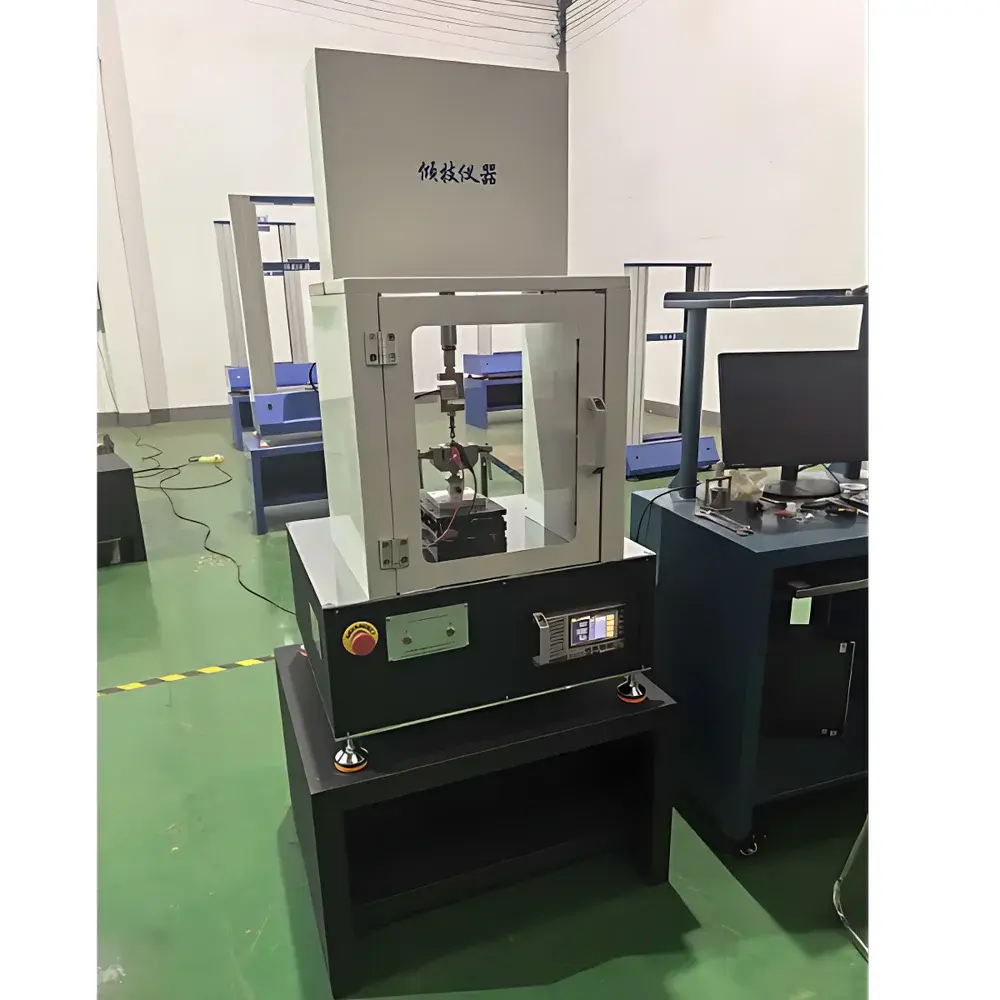
QJ210V Electromagnetic Valve Performance Tester
| Brand | Qingji |
|---|---|
| Origin | Shanghai, China |
| Manufacturer Type | Authorized Distributor |
| Country of Origin | China |
| Model | QJ210V |
| Price Range | USD 7,000 – 28,000 |
| Instrument Type | Electromagnetic Fatigue Testing Machine |
| Maximum Test Force | 500 N |
| Frequency Range | 61–2604 Hz |
| Host Weight | 50 kg |
| Load Accuracy Class | 0.5 |
| Voltage Measurement Range | 0–80 V (±1% FS) |
| Current Measurement Range | 0–2600 mA (±1% FS) |
| Response Time Resolution | 0.1 ms |
| Data Sampling Rate | 20 kHz |
| Hysteresis Loop Sampling Rate | 1000 Hz |
| Proportional Power Supply | Output Current 500–2600 mA (programmable), PWM Frequency 61–2604 Hz, Dither Frequency 60–400 Hz |
| Programmable DC Power Supply | 0–32 V / 6 A |
Overview
The QJ210V Electromagnetic Valve Performance Tester is a purpose-built dynamic characterization system engineered for the rigorous evaluation of electromagnetic actuators—specifically solenoid on/off valves and proportional control valves—under real-world operational conditions. It implements a hybrid electromechanical test architecture combining high-fidelity force transduction, synchronized electrical parameter acquisition, and programmable excitation waveforms to quantify critical performance metrics including response latency, force-stroke hysteresis, coil thermal behavior, dynamic linearity, and fatigue-induced degradation. Unlike generic servo-hydraulic or electrodynamic shakers, the QJ210V integrates dedicated current-controlled PWM drivers, precision voltage/current monitoring channels, and real-time displacement-force-electrical phase analysis—enabling ISO 15407-1/2-compliant validation of valve static and dynamic characteristics per industrial pneumatic and hydraulic control standards.
Key Features
- Integrated dual-domain measurement: Simultaneous acquisition of mechanical force (up to 500 N, Class 0.5 accuracy), coil voltage (0–80 V ±1% FS), and current (0–2600 mA ±1% FS) with sub-millisecond time alignment.
- Programmable excitation engine supporting three operational modes: fixed-frequency sinusoidal PWM, swept-frequency dither (60–400 Hz), and arbitrary waveform generation (61–2604 Hz bandwidth) for resonance mapping and harmonic distortion analysis.
- High-speed data capture at 20 kHz sampling rate, with dedicated 1 kHz hysteresis loop acquisition mode optimized for B-H curve reconstruction and energy loss quantification per cycle.
- Real-time response time measurement with 0.1 ms resolution, enabling precise determination of rise/fall times, dwell delays, and dead-band characteristics under varying load and temperature conditions.
- Rugged benchtop design (50 kg mass, vibration-damped base) ensuring mechanical stability during high-frequency cycling; compatible with external environmental chambers for thermal stress testing (-20°C to +85°C).
- Windows-based control software featuring full digital oscilloscope functionality: live curve overlay, differential time-domain analysis, zoom/pan/print, and export to CSV, MATLAB .mat, or HDF5 formats.
Sample Compatibility & Compliance
The QJ210V accommodates standard ISO 4400 and DIN 24333 mounting interfaces for direct integration of solenoid valves ranging from miniature 6 mm pilot-stage units to industrial 25 mm main-stage designs. It supports both normally closed (NC) and normally open (NO) configurations, as well as bi-stable latching variants. Electrical interface complies with IEC 60529 IP20 for indoor laboratory use. Mechanical loading adheres to ASTM F1876-20 Annex A1 for electromagnetic actuator endurance testing protocols. Data audit trails meet GLP requirements, and software supports optional 21 CFR Part 11 compliance packages (electronic signatures, user access logs, immutable history).
Software & Data Management
The embedded Windows application provides deterministic real-time control via multi-threaded DAQ scheduling and low-latency USB 2.0 communication. All test sequences—including ramp profiles, step-response sweeps, and fatigue cycles—are defined in XML-based protocol templates, enabling traceable method reuse across laboratories. Raw datasets are stored with embedded metadata (timestamp, operator ID, calibration ID, ambient temperature/humidity). Built-in statistical post-processing calculates mean response time, cycle-to-cycle variation (σ), hysteresis area (mJ/cycle), and cumulative energy dissipation. Export modules support automated report generation compliant with ISO/IEC 17025 documentation frameworks.
Applications
- Validation of proportional valve linearity and bandwidth for aerospace fuel metering systems (per SAE AS5673).
- Accelerated life testing of automotive transmission solenoids under combined thermal-electrical stress (SAE J2711).
- Characterization of hysteresis and eddy-current losses in high-frequency pneumatic servo valves used in semiconductor wafer handling.
- Development of closed-loop current control algorithms for industrial motion controllers requiring sub-100 µs current regulation fidelity.
- Root-cause analysis of valve sticking or delayed actuation due to coil heating, armature wear, or magnetic saturation effects.
FAQ
Does the QJ210V support third-party controller integration via analog or digital I/O?
Yes—it features isolated 0–10 V analog inputs/outputs and TTL-compatible trigger lines for synchronization with external PLCs, DAQ systems, or thermal chambers.
Can test parameters be saved and recalled as standardized methods for QA/QC compliance?
Absolutely. All configuration sets—including excitation profiles, sampling rates, and pass/fail thresholds—are saved as version-controlled .qjm files with SHA-256 checksums.
Is calibration traceable to national standards?
Force and electrical channels are factory-calibrated against NIST-traceable reference standards; calibration certificates include uncertainty budgets per ISO/IEC 17025.
What maintenance intervals are recommended for long-term reliability?
Annual verification of load cell linearity and current shunt resistance is advised; no routine lubrication or mechanical adjustment is required due to solid-state actuation architecture.
Is remote operation supported for unattended overnight fatigue testing?
Yes—the software includes watchdog timers, automatic error logging, email alerts on test completion or fault detection, and secure RDP-accessible headless mode.



