
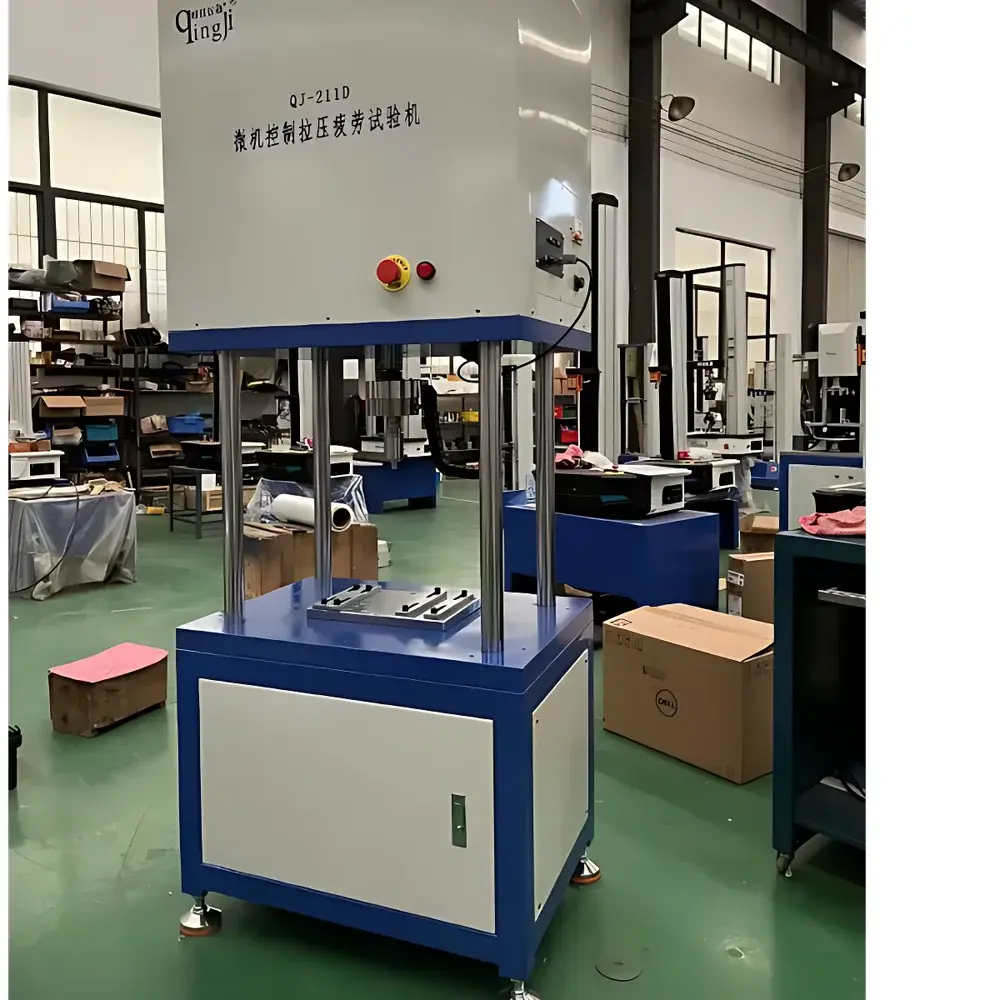
QJ211D Dynamic Fatigue Testing Machine by Qingji
| Brand | Qingji |
|---|---|
| Origin | Shanghai, China |
| Model | QJ211D |
| Maximum Test Force | 0–500 kN |
| Frequency Range | 0.001–1000 Hz |
| Actuator Stroke | ±200 mm (customizable) |
| Force Measurement Accuracy | ±1% of reading (2–100% FS) |
| Dynamic Force Ripple | ≤2% |
| Displacement Measurement Accuracy | ±0.5% of full scale |
| Closed-Loop Control Bandwidth | 10 kHz |
| Waveform Options | Sine, Square, Triangle, Trapezoidal, Sawtooth, Half-Sine, Half-Triangle, Random, User-Defined, and External Input |
| Control Modes | Force, Displacement, and Strain (seamless mode switching) |
| Host Weight | 150–850 kg |
Overview
The QJ211D Dynamic Fatigue Testing Machine is a high-performance electro-hydraulic servo system engineered for precision-controlled cyclic loading of metallic, polymeric, composite, and ceramic specimens under uniaxial or multiaxial stress states. Operating on the principle of closed-loop hydraulic actuation with real-time digital feedback, it delivers reproducible sinusoidal, transient, and stochastic waveforms across a broad frequency spectrum—from ultra-low-frequency creep-fatigue interaction studies (0.001 Hz) to high-cycle fatigue (HCF) evaluation at 1000 Hz. Designed in accordance with ISO 23788:2022 (Metallic materials — Fatigue testing — Axial-force-controlled method) and compatible with ASTM E466, E606, and E1012 test standards, the system supports both R-ratio-controlled and load-controlled fatigue protocols. Its modular architecture integrates seamlessly into materials R&D labs, aerospace component validation centers, and automotive durability testing facilities where traceable, GLP-compliant mechanical characterization is required.
Key Features
- High-fidelity electro-hydraulic servo actuation with 10 kHz closed-loop control bandwidth, enabling precise tracking of complex dynamic waveforms without phase lag.
- Triple-variable closed-loop control—force, displacement, and strain—with automatic, bumpless mode switching during test execution to maintain data continuity across loading regimes.
- Digital hydraulic controller with 24-bit ADC resolution and adaptive gain scheduling, ensuring stable operation across the full force range (0–500 kN) and stroke envelope (±200 mm).
- Real-time waveform synthesis engine supporting standard (sine, triangle, square) and non-standard profiles—including user-defined piecewise functions and externally acquired signals via analog input (±10 V, 16-bit).
- Robust mechanical frame with rigid four-column load train and preloaded crosshead guidance, minimizing parasitic bending moments and ensuring axial alignment per ISO 7500-1 Class 0.5 requirements.
- Integrated safety architecture including hardware-based emergency stop, pressure relief valves, over-travel limit switches, and software-enforced operational bounds compliant with EN 61508 SIL2 functional safety principles.
Sample Compatibility & Compliance
The QJ211D accommodates standardized tensile specimens (ASTM E8/E9), notched fatigue coupons (ASTM E647), threaded fasteners, welded joints, and structural subassemblies up to 850 kg total mass. Gripping solutions include wedge-action hydraulic clamps, pneumatic vise fixtures, and custom adapter plates for non-standard geometries. All test procedures align with ISO/IEC 17025 accreditation requirements for testing laboratories. Data acquisition meets FDA 21 CFR Part 11 criteria for electronic records and signatures when paired with validated software configurations. System calibration certificates are traceable to NIM (National Institute of Metrology, China) and optionally to NIST or PTB upon request.
Software & Data Management
Control and analysis are performed using Qingji’s proprietary TestMaster Pro v4.x software suite—a Windows-based platform supporting multi-channel synchronized acquisition (up to 32 channels at 100 kHz sample rate), real-time FFT spectral analysis, and automated S–N curve generation. The software implements audit trail logging with user-level permissions, timestamped event markers, and immutable raw-data archiving in HDF5 format. Export options include CSV, MATLAB .mat, and universal MDF4 files compatible with third-party post-processing tools (e.g., nCode DesignLife, FE-SAFE). For regulated environments, optional 21 CFR Part 11 modules provide electronic signature workflows, change control logs, and role-based access restrictions.
Applications
- Aerospace: High-cycle fatigue (HCF) life prediction of turbine blades, landing gear components, and airframe fasteners under variable-amplitude loading.
- Automotive: Durability validation of suspension arms, brake calipers, and battery module mounting structures subjected to road-spectrum simulation.
- Biomaterials: Cyclic mechanical testing of orthopedic implants (e.g., hip stems, spinal cages) per ISO 14801 and ASTM F2193.
- Energy: Low-cycle fatigue (LCF) assessment of wind turbine blade root joints and nuclear reactor piping welds under thermal-mechanical cycling.
- Academic Research: Multiaxial fatigue studies, crack initiation/propagation monitoring via DIC integration, and viscoelastic characterization of polymer composites.
FAQ
What is the minimum resolvable frequency step size?
The system achieves a frequency resolution of 0.001 Hz across its full 0.001–1000 Hz operating range.
Can the machine perform thermomechanical fatigue (TMF) tests?
Yes—when integrated with compatible environmental chambers (e.g., -70°C to +1200°C) and temperature-controlled grips, the QJ211D supports out-of-phase and in-phase TMF protocols per ASTM E2368.
Is third-party calibration support available?
Qingji provides factory calibration with NIM-traceable documentation; additionally, users may engage ISO/IEC 17025-accredited calibration service providers for on-site verification.
How is data integrity ensured during long-duration fatigue tests?
Continuous checksum validation, dual-storage redundancy (SSD + network-attached archive), and periodic CRC-32 integrity checks prevent data corruption over multi-week test campaigns.
Does the system support remote monitoring and diagnostics?
Yes—via secure TLS-encrypted web interface, authorized personnel can monitor live test status, view real-time plots, receive SMS/email alerts on threshold breaches, and initiate diagnostic routines without local access.
Related Products



