
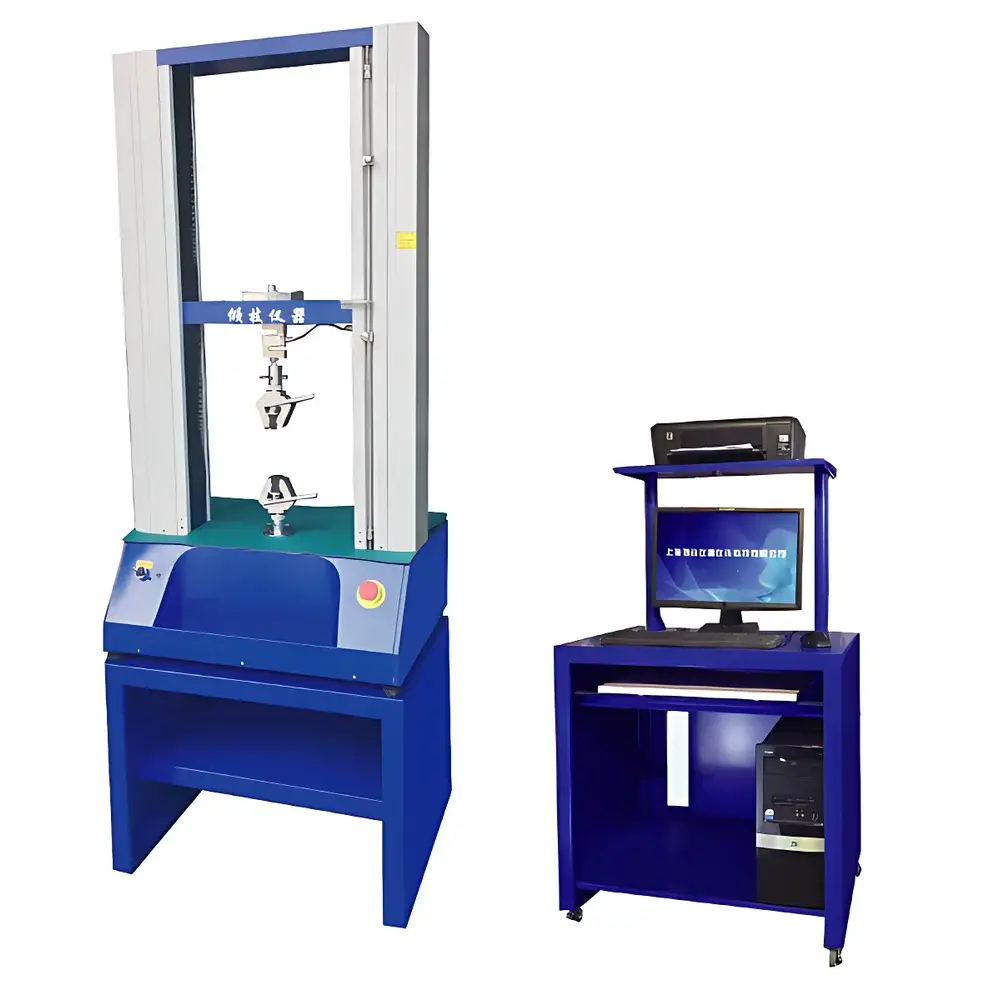
QJ211S Automotive Component Tensile Testing Machine
| Origin | Shanghai, China |
|---|---|
| Manufacturer Type | Authorized Distributor |
| Origin Category | Domestic (PRC) |
| Model | QJ211S |
| Quotation | USD 6,300 (FOB Shanghai) |
| Instrument Type | Electromechanical Tensile Testing Machine |
| Maximum Test Load | 30 kN |
| Load Range | 0–30 kN (fully adjustable) |
| Force Accuracy Class | ISO 7500-1 Class 1 |
| Stroke | ~420 mm |
| Displacement Resolution | ±0.5% of reading |
| Load Cell Accuracy | 0.01% FS |
| Test Speed Range | 0.001–500 mm/min |
| Speed Accuracy | ±0.5% |
| Effective Width | ~420 mm |
| Effective Tensile Travel | ~800 mm |
| Strain Measurement Accuracy | ±0.5% |
| Safety Features | Electronic stroke limit, emergency stop button, overload cutoff |
| Mass | ~140 kg |
Overview
The QJ211S Automotive Component Tensile Testing Machine is a precision electromechanical universal testing system engineered for static mechanical characterization of automotive structural and functional parts under controlled uniaxial loading conditions. Based on servo-controlled ball-screw actuation and high-stiffness dual-column frame architecture, it complies with fundamental principles of force transduction per ISO 7500-1 and displacement metrology per ISO 2041. Designed specifically for OEM Tier-1 suppliers, Tier-2 component manufacturers, and automotive R&D laboratories, the system delivers repeatable, traceable, and auditable mechanical data—including tensile strength, yield point, elongation at break, modulus of elasticity, and compressive yield—across metallic, polymeric, composite, and elastomeric materials used in chassis, powertrain, interior trim, and safety-critical assemblies.
Key Features
- Robust dual-column steel frame with preloaded linear guides ensures minimal deflection (<0.05 mm under full 30 kN load), critical for accurate stress–strain curve fidelity during high-force metal bracket or suspension arm testing.
- High-resolution digital load cell (0.01% FS accuracy) coupled with real-time closed-loop PID control enables stable force regulation across the full 0.1–30 kN range, supporting both low-force gasket compression and high-load brake caliper anchor testing.
- Adjustable crosshead travel (up to 800 mm) and 420 mm test width accommodate diverse part geometries—from small ABS airbag housings to large stamped steel control arms—without reconfiguration.
- Programmable speed profile (0.001–500 mm/min, ±0.5% tolerance) supports quasi-static ductility assessment and accelerated durability screening per SAE J2334 or ISO 12109.
- Integrated electronic stroke limit and hardware-based emergency stop meet ISO 13850 requirements for operator safety; overload cutoff halts motion immediately upon exceeding 105% of set load limit.
- Automatic return-to-start, auto-zeroing, and multi-range auto-scaling eliminate manual intervention between sequential tests—enhancing throughput in high-volume QC environments.
Sample Compatibility & Compliance
The QJ211S accommodates standardized and custom fixtures for ASTM D638 (plastics), ISO 6892-1 (metals), ISO 37 (rubber), GB/T 228.1 (China national standard), JIS Z 2241, and SAE J1397-compliant specimen configurations. With optional extensometers (contact or non-contact), it supports strain-controlled cyclic tests up to 10⁵ cycles for low-amplitude fatigue evaluation of fasteners or bushings. All test methods, parameters, and raw data are timestamped and logged with user ID, satisfying GLP/GMP audit trail requirements per FDA 21 CFR Part 11 when paired with compliant software configuration.
Software & Data Management
Controlled via Windows-based proprietary software, the system provides real-time dynamic plotting of force–displacement, stress–strain, and time-history curves. Raw ASCII/CSV export enables post-processing in MATLAB, Python (NumPy/Pandas), or Minitab. Curve analysis tools include automatic yield point detection (0.2% offset method), tangent modulus calculation, area-under-curve integration for toughness estimation, and statistical batch reporting (mean, SD, Cp/Cpk). Audit logs record all parameter changes, calibration events, and test executions—including who initiated, when, and from which workstation—supporting ISO/IEC 17025 laboratory accreditation.
Applications
- Tensile strength and elongation testing of seat belt webbing (ISO 1140), airbag fabric (SAE J1887), and door panel substrates.
- Compression testing of rubber mounts, hydraulic brake hoses, and foam headliner materials per ISO 3386-1.
- Peel and shear adhesion evaluation of bonding interfaces in bonded aluminum closures or composite fenders.
- Bending stiffness and fracture resistance of instrument panel carriers and HVAC ducts (ASTM D790).
- Cyclic load testing of pedal assemblies, throttle linkages, and latch mechanisms under defined displacement envelopes.
FAQ
Does the QJ211S support ASTM E8/E21 high-temperature tensile testing?
No—this model operates at ambient temperature only. High-temperature capability requires optional furnace integration and thermocouple-equipped extensometry, available as a custom configuration.
Can test data be exported directly to LIMS or SAP QM modules?
Yes—via configurable ODBC drivers and XML-based API interface, enabling automated transfer of pass/fail status, measured values, and metadata into enterprise quality management systems.
Is ISO/IEC 17025 calibration documentation included with shipment?
A factory calibration certificate traceable to NIM (National Institute of Metrology, China) is provided. Full ISO/IEC 17025-accredited calibration requires third-party service and is recommended annually.
What maintenance intervals are specified for long-term reliability?
Lubrication of ball screws and guideways every 500 operational hours; load cell verification every 6 months; annual mechanical alignment check per ISO 7500-1 Annex B.
Are pneumatic or hydraulic grips available for high-grip-force applications?
Yes—custom pneumatic wedge grips (up to 12 MPa clamping pressure) and self-tightening serrated jaws are available for high-friction composites or coated sheet metal specimens.



