
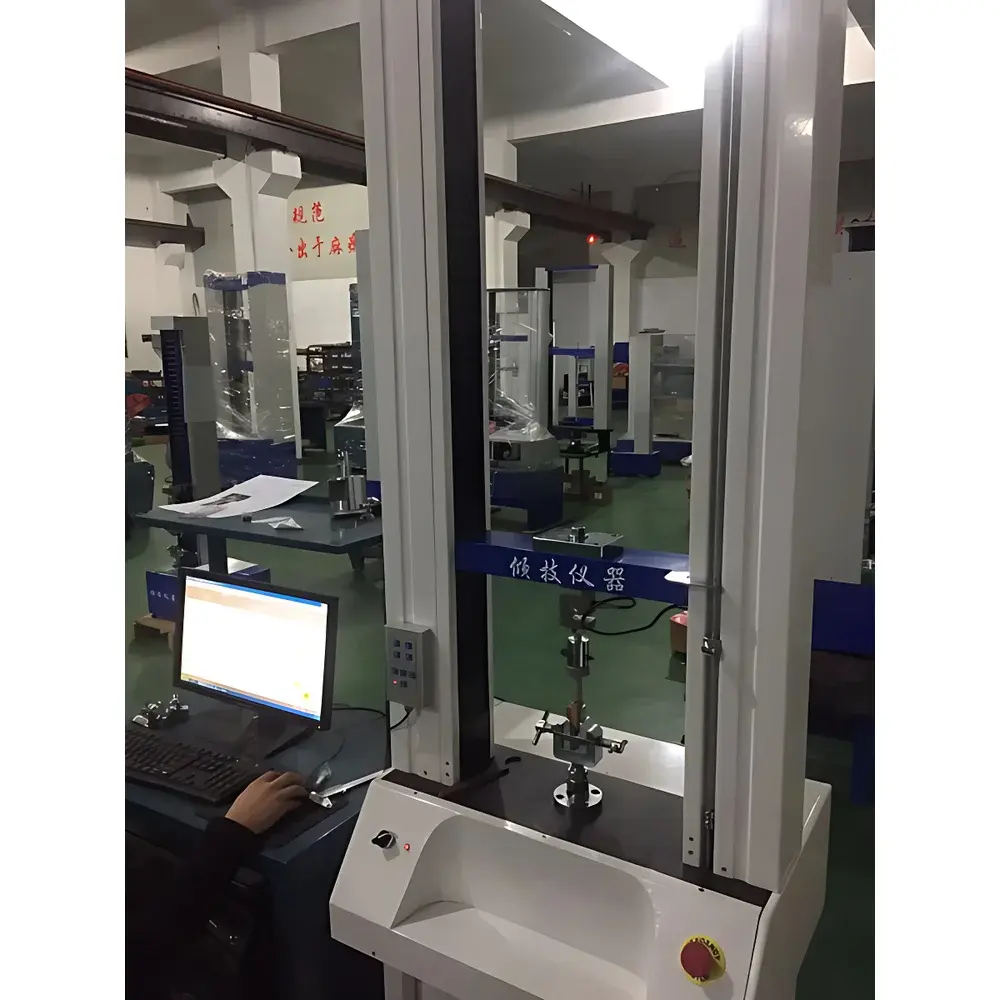
QJ211S Universal Testing Machine for Silicone Elastomer Tensile Deformation Analysis
| Origin | Shanghai, China |
|---|---|
| Manufacturer Type | Authorized Distributor |
| Origin Category | Domestic (PRC) |
| Load Capacity | 30 kN |
| Load Cell Accuracy | 0.01% FS |
| Test Accuracy | < ±0.5% |
| Control Interface | Windows-based PC Control System |
| Effective Test Width | ~420 mm |
| Effective Stroke | ~800 mm |
| Speed Range | 0.001–500 mm/min |
| Speed Accuracy | ±0.5% |
| Displacement Measurement Accuracy | ±0.5% |
| Strain Measurement Accuracy | ±0.5% |
| Safety Features | Electronic stroke limit, emergency stop button, overload auto-shutdown |
| Weight | ~140 kg |
| Instrument Type | Electromechanical Universal Testing Machine |
Overview
The QJ211S Universal Testing Machine is an electromechanical materials testing system engineered for high-reproducibility tensile deformation characterization of silicone elastomers and other soft polymeric materials. It operates on the principle of controlled uniaxial force application via a precision ball-screw-driven crosshead, coupled with real-time load, displacement, and strain feedback from calibrated transducers. Designed to ASTM D412, ISO 37, and GB/T 528 standards for elastomer mechanical testing, the system delivers traceable, repeatable data for modulus (e.g., tensile modulus at 100%, 200%, 300% elongation), ultimate tensile strength, elongation at break, yield point (where applicable), and stress relaxation profiles. Its modular architecture supports both static and quasi-static loading protocols, making it suitable for R&D labs, QC laboratories in medical device manufacturing, and silicone compound formulation centers requiring GLP-compliant mechanical validation.
Key Features
- Precision electromechanical actuation with closed-loop servo control ensures consistent speed fidelity across the full 0.001–500 mm/min range, critical for capturing rate-dependent viscoelastic behavior in silicone gels and RTV rubbers.
- High-resolution load cell (0.01% full-scale accuracy) enables reliable measurement of low-force transitions—such as initial elastic response and Mullins effect onset—in low-modulus silicones (e.g., 0.1–2 MPa Shore A equivalents).
- Integrated automatic return-to-initial-position function post-fracture eliminates manual repositioning, reducing operator variability and enabling batch testing of multiple specimens without intervention.
- Multi-range auto-ranging capability allows seamless switching between load cells (e.g., 500 N, 5 kN, 30 kN) without recalibration—supporting diverse sample geometries from thin films to molded O-rings.
- Real-time dynamic plotting of force–displacement, stress–strain, and modulus–strain curves during test execution, with on-the-fly annotation of key events (yield, necking, rupture).
- Rugged aluminum extrusion frame with powder-coated finish provides thermal stability and mechanical damping, minimizing vibration-induced noise in low-force measurements.
- Dual-limit protection system—comprising programmable software stroke limits and hardware-based emergency stop circuitry—meets IEC 61000-6-2 electromagnetic compatibility and functional safety requirements.
Sample Compatibility & Compliance
The QJ211S accommodates standard dumbbell-shaped (ISO 37 Type 2, ASTM D412 Die C), ring, and dog-bone specimens fabricated from addition-cure and condensation-cure silicones, liquid silicone rubber (LSR), and high-purity medical-grade elastomers. Grip options include pneumatic wedge grips (for flat sheets), roller grips (for cords/tubes), and custom fixture interfaces for ASTM F2193-compliant suture anchor pullout or ISO 14607 catheter balloon burst testing. All firmware and data handling comply with FDA 21 CFR Part 11 Annex 11 principles for electronic records and signatures, including audit trail logging, user access levels, and data immutability upon report generation. Calibration certificates are NIST-traceable and issued per ISO/IEC 17025 requirements.
Software & Data Management
Control and analysis are performed using the proprietary WinTest Pro v4.2 software suite, compatible with Windows 10/11 (64-bit). The platform supports multi-channel synchronized acquisition (load, displacement, extensometer input), automated test sequence scripting (e.g., preconditioning cycles, cyclic loading, hold-relax protocols), and export of raw ASCII/CSV files for third-party statistical analysis (Minitab, Python Pandas, MATLAB). Reports conform to ISO 14289-1 (PDF/A-1b) archival standards and include metadata such as operator ID, environmental conditions (optional hygrometer/thermometer integration), calibration dates, and uncertainty budgets per GUM (JCGM 100:2008). Audit trails record all parameter changes, test starts/stops, and data exports with timestamped user attribution.
Applications
- Quantification of tensile set and permanent deformation in high-elongation silicone encapsulants used in aerospace potting applications.
- Comparative evaluation of filler dispersion effects (e.g., fumed silica vs. precipitated silica) on tear resistance and hysteresis loss in medical tubing compounds.
- Validation of shelf-life-related embrittlement in platinum-catalyzed LSRs stored under accelerated aging (ASTM D573).
- Characterization of adhesion strength between silicone substrates and thermoplastic polyurethane (TPU) overmolds per ISO 8510-2.
- Supporting ISO 10993-10 biocompatibility testing through mechanical integrity verification of implant-grade silicone after extraction exposure.
FAQ
What standards does the QJ211S support for silicone elastomer testing?
It natively supports ASTM D412, ISO 37, GB/T 528, and DIN 53504, with customizable test templates for non-standard protocols.
Can the system interface with an external extensometer for true strain measurement?
Yes—it features dual analog inputs compatible with contact and non-contact video extensometers (e.g., DIC systems) for Poisson’s ratio and localized strain field analysis.
Is the software compliant with regulatory data integrity requirements?
WinTest Pro implements ALCOA+ principles (Attributable, Legible, Contemporaneous, Original, Accurate, Complete, Consistent, Enduring, Available) and generates 21 CFR Part 11–compliant audit logs.
What maintenance is required during the first year of operation?
No scheduled maintenance is required; however, quarterly verification of load cell linearity and crosshead alignment is recommended using certified reference weights and laser alignment tools.
How is traceability ensured for calibration records?
Each instrument ships with a factory calibration certificate referencing NIST-traceable standards, and calibration intervals are tracked within the software’s instrument management module.



