
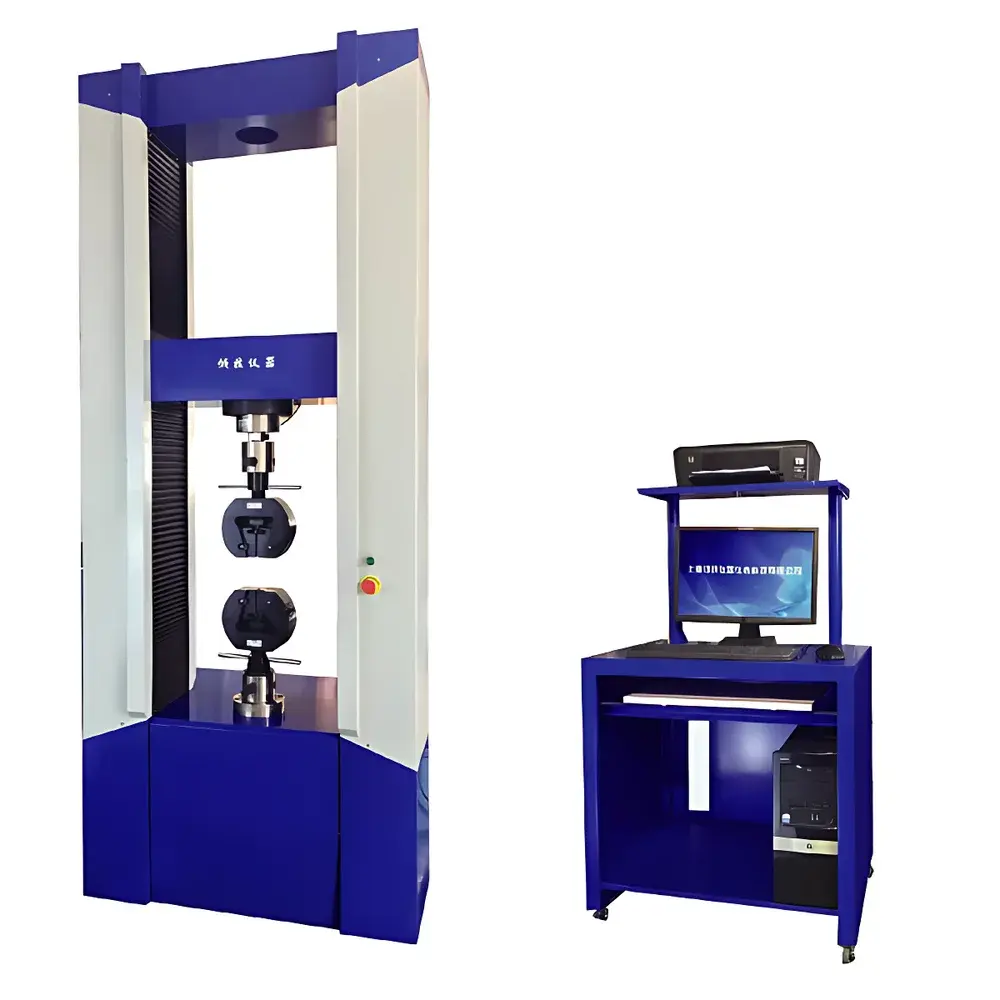
QJ212C Universal Testing Machine by Qingji
| Brand | Qingji |
|---|---|
| Origin | Shanghai, China |
| Model | QJ212C |
| Load Capacity | 50 kN / 100 kN / 200 kN / 300 kN / 500 kN (interchangeable within 500 kN) |
| Load Accuracy | ±0.5% |
| Effective Test Width | 520 mm |
| Max Tensile Travel | 800 mm |
| Speed Range | 0.01–1000 mm/min (standard configuration: 300 mm/min) |
| Speed Accuracy | ±0.5% of reading |
| Displacement Measurement Accuracy | ±0.5% of reading |
| Strain Measurement Accuracy | ±0.5% of reading |
| Force Resolution | 500,000 counts (full-scale, no range switching) |
| Control System | Panasonic全-digital AC servo controller |
| Sensor Origin | USA |
| Software Architecture | Full-digital closed-loop control supporting constant stress, constant strain, and constant displacement modes |
| Safety Features | Electronic limit switches, software-based overload diagnosis, auto-return function, 110% over-load protection |
| Power | 2–5 kW |
| Dimensions (W×D×H) | 1000 × 680 × 2450 mm |
| Weight | ~1450 kg |
Overview
The QJ212C Universal Testing Machine by Qingji is a high-precision electromechanical system engineered for static mechanical property characterization of metallic, polymeric, composite, ceramic, and elastomeric materials. It operates on the principle of controlled uniaxial force application—via a digitally regulated AC servo motor—and simultaneous multi-channel acquisition of load, displacement, and strain signals. The machine complies with fundamental mechanical testing standards including ASTM E4, ASTM E8/E8M (tension), ASTM E9 (compression), ASTM D695 (rigid plastics), ISO 6892-1, ISO 7500-1 (load cell calibration), and GB/T 228.1–2021. Its modular architecture integrates a U.S.-sourced high-stability load cell, a Panasonic full-digital AC servo drive, and a real-time closed-loop control firmware that enables precise trajectory tracking under constant load, constant strain, or constant displacement conditions—essential for creep, relaxation, and low-cycle fatigue protocols.
Key Features
- Load capacity options from 50 kN to 500 kN, field-interchangeable without recalibration due to unified transducer design and digital signal conditioning.
- Force measurement resolution of 500,000 counts across full scale, maintained uniformly without hardware range switching—ensuring consistent signal-to-noise ratio from 0.02% to 100% of rated capacity.
- Wide-speed actuation capability: 0.01–1000 mm/min, with standard compliance at 300 mm/min per ISO 527 and ASTM D3039; speed accuracy maintained within ±0.5% of setpoint across the entire range.
- Robust structural frame with 1450 kg mass and reinforced base geometry minimizes resonance effects during high-force dynamic loading, supporting stable data acquisition up to 50 Hz sampling in transient mode.
- Dual-mode crosshead positioning: rapid manual adjustment plus programmable slow-speed approach—optimized for brittle sample alignment and pre-load establishment.
- Integrated safety architecture includes hardware-based electronic limit switches, software-monitored overload detection (>110% FS), automatic emergency stop, and post-test auto-return functionality.
Sample Compatibility & Compliance
The QJ212C accommodates standardized test specimens per ASTM, ISO, and GB geometries—including dog-bone tensile bars, compression cylinders, three/four-point bending beams, peel coupons, and shear fixtures. Custom grips and fixtures are fabricated per user-specified dimensions and surface requirements (e.g., serrated, pneumatic, hydraulic, or wedge-action clamping). All mechanical validation procedures align with ISO/IEC 17025 requirements for testing laboratories. Force calibration traceability is maintained to NIST-traceable reference standards, and system verification reports comply with ASTM E4 Annex A2 for verification of testing machines. The machine supports GLP/GMP-aligned audit trails when paired with optional 21 CFR Part 11-compliant software modules.
Software & Data Management
The embedded test control software provides real-time graphical display of stress–strain, load–displacement, and time-series curves with configurable axes, scaling, and annotation layers. Raw data export is supported in CSV, Excel (.xlsx), and universal ASCII formats. Advanced analysis tools include Young’s modulus calculation via tangent/secant methods, yield point determination (0.2% offset), ultimate tensile strength (UTS), elongation at break, reduction in area, and compression modulus derivation. All test parameters, operator IDs, environmental metadata (optional via external sensor integration), and digital signatures are archived in encrypted project files. Audit log generation meets FDA 21 CFR Part 11 requirements when deployed with validated user access controls and electronic signature workflows.
Applications
- Mechanical qualification of aerospace alloys (Ti-6Al-4V, AA7075-T6) under ambient and elevated temperature conditions (when integrated with environmental chambers).
- Quality assurance of medical device polymers (PEEK, UHMWPE, silicone elastomers) per ISO 5832 and USP / biocompatibility-linked mechanical screening.
- Development and validation of structural adhesives and composite laminates—supporting ASTM D1002 (lap shear), D3163 (T-peel), and D5528 (double cantilever beam) test methods.
- Creep and stress relaxation studies on thermoplastics and viscoelastic biomaterials using programmable hold segments and logarithmic time stepping.
- Raw material certification for automotive suppliers requiring IATF 16949-aligned test documentation and SPC-ready output.
FAQ
What standards does the QJ212C comply with for force calibration and verification?
It conforms to ISO 7500-1 (Class 0.5), ASTM E4, and GB/T 7722 for static calibration, with annual verification supported by certified third-party labs.
Can the system perform cyclic loading tests?
Yes—the closed-loop controller supports programmed sinusoidal, triangular, and trapezoidal waveforms for low-cycle fatigue testing up to 5 Hz with optional high-speed data acquisition modules.
Is remote operation and monitoring possible?
The system supports Ethernet-based TCP/IP communication and OPC UA integration for SCADA and MES environments, enabling centralized fleet monitoring and script-based batch testing.
How is traceability ensured for test reports?
Each report embeds digital signatures, timestamped operator credentials, instrument ID, calibration certificate expiry dates, and raw binary data hashes—fully compliant with ISO/IEC 17025 clause 7.8.2.
What maintenance intervals are recommended?
Biannual mechanical inspection of guide rails and load train components; annual recalibration of the load cell and encoder; quarterly verification of software integrity and audit trail functionality.



