
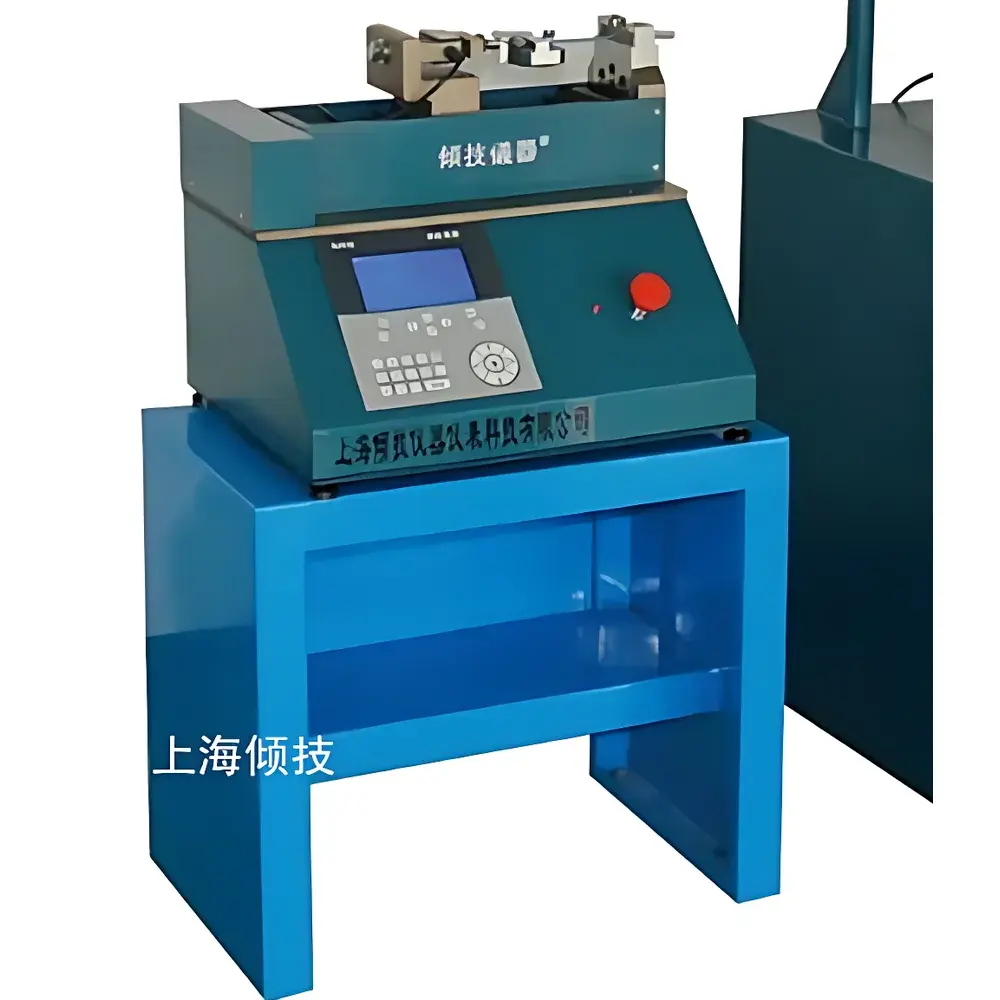
QJ310 Plug-and-Play Connector Tensile Testing Machine
| Origin | Shanghai, China |
|---|---|
| Manufacturer Type | Authorized Distributor |
| Origin Category | Domestic (PRC) |
| Model | QJ310 |
| Price Range | USD 7,000 – 14,000 |
| Instrument Type | Electromechanical Tensile Testing Machine |
| Max Load Capacity | 2500 N or 5000 N |
| Load Cell Accuracy | ±0.01% FS |
| Test Accuracy | ±0.5% of reading |
| Test Speed Range | 0.001–300 mm/min (standard) |
| Effective Test Stroke | ≥200 mm |
| Power Supply | AC 220 V, 50/60 Hz |
| Dimensions (W×D×H) | 600 × 300 × 300 mm |
| Net Weight | ~40 kg |
Overview
The QJ310 Plug-and-Play Connector Tensile Testing Machine is an electromechanical force-testing system engineered for the quantitative evaluation of mechanical retention integrity in electrical interconnect components. It operates on the principle of controlled uniaxial tensile displacement, applying calibrated axial force to measure pull-out resistance, insertion force, separation strength, and peel adhesion in connectors, crimped terminals, wire harness assemblies, lamp holders, PCB-mounted sockets, adhesive-bonded modules, and other miniaturized electro-mechanical interfaces. Designed specifically for quality assurance laboratories, R&D centers, and production line QA/QC environments, the QJ310 delivers repeatable, traceable mechanical performance data aligned with international test standards including IEC 60512-2, ISO 8092-2, USCAR-21, and SAE J2223. Its closed-loop servo-controlled actuation architecture ensures high fidelity in low-force (<5 N) and high-force (up to 5000 N) regimes—critical for validating both delicate micro-connectors and heavy-duty industrial couplers.
Key Features
- High-precision ball screw drive system with backlash-free transmission and sub-micron positioning resolution
- Industrial-grade load cell with ±0.01% full-scale accuracy and temperature-compensated analog signal conditioning
- Real-time dynamic display of force-displacement curves, peak load, yield point, and displacement at break via 7-inch TFT LCD touchscreen interface
- Programmable test profiles supporting multi-stage ramp-hold-relax sequences, cyclic loading, and stepwise displacement control
- Rigid welded steel frame with powder-coated structural housing (600 × 300 × 300 mm footprint) optimized for vibration damping and long-term dimensional stability
- USB and RS-232 interfaces for bidirectional communication with Windows-based PC software; supports ASTM E4-compliant calibration certificate generation
Sample Compatibility & Compliance
The QJ310 accommodates a broad spectrum of connector geometries through interchangeable grip fixtures—including pneumatic wedge grips, vise-type clamps, custom-designed socket adapters, and dual-axis alignment jigs for coaxial plug-in testing. It complies with essential regulatory frameworks governing medical device interconnect validation (ISO 13485), automotive electronics qualification (AEC-Q200), and consumer electronics safety (IEC 62368-1). All firmware and control logic are designed to support GLP/GMP audit trails, including user authentication, electronic signature capability, and immutable test log archiving—fully compatible with FDA 21 CFR Part 11 requirements when deployed with validated software configuration.
Software & Data Management
The bundled PC software provides comprehensive test method definition, real-time data streaming, automated pass/fail evaluation against configurable limits, and export-ready reporting in PDF, Excel, and XML formats. Raw data files include timestamped metadata (operator ID, sample ID, environmental conditions, calibration status), enabling full traceability across production batches. The software supports batch processing of up to 999 sequential tests with auto-generated statistical summaries (mean, SD, CV%, min/max) per parameter set. Calibration routines follow ISO/IEC 17025 guidelines and integrate with external reference standards traceable to NIM (National Institute of Metrology, China) or NIST-equivalent national metrology institutes.
Applications
- Quantification of mating/unmating forces in USB-C, HDMI, M.2, and PCIe edge connectors
- Evaluation of crimp joint integrity between AWG 28–10 wires and insulated terminals
- Peel strength assessment of pressure-sensitive adhesive (PSA) mounting tapes used in LED module assembly
- Retention force validation of push-pull locking mechanisms in industrial sensor connectors
- Long-term creep behavior analysis under sustained load (via extended hold function)
- Interlaboratory comparison studies supporting ISO/IEC 17043 proficiency testing programs
FAQ
What standards does the QJ310 support for connector testing?
The system is pre-configured with test templates compliant with IEC 60512-2-1 (insertion/extraction force), ISO 8092-2 (automotive wiring harnesses), and USCAR-21 (terminal retention), with additional method libraries available upon request.
Can the QJ310 perform cyclic fatigue testing?
Yes—it supports programmable load/displacement cycling with user-defined upper/lower limits, dwell times, and cycle counts up to 10⁶ cycles, with real-time monitoring of stiffness degradation and hysteresis loop evolution.
Is third-party calibration certification included?
Each unit ships with a factory calibration certificate traceable to national standards; optional UKAS-accredited calibration services are available through authorized service partners.
How is data integrity ensured during regulatory audits?
All test sessions generate digitally signed audit logs containing operator credentials, instrument ID, calibration history, environmental metadata, and raw time-series data—enabling full reconstruction of any test event per FDA 21 CFR Part 11 and EU Annex 11 requirements.



