
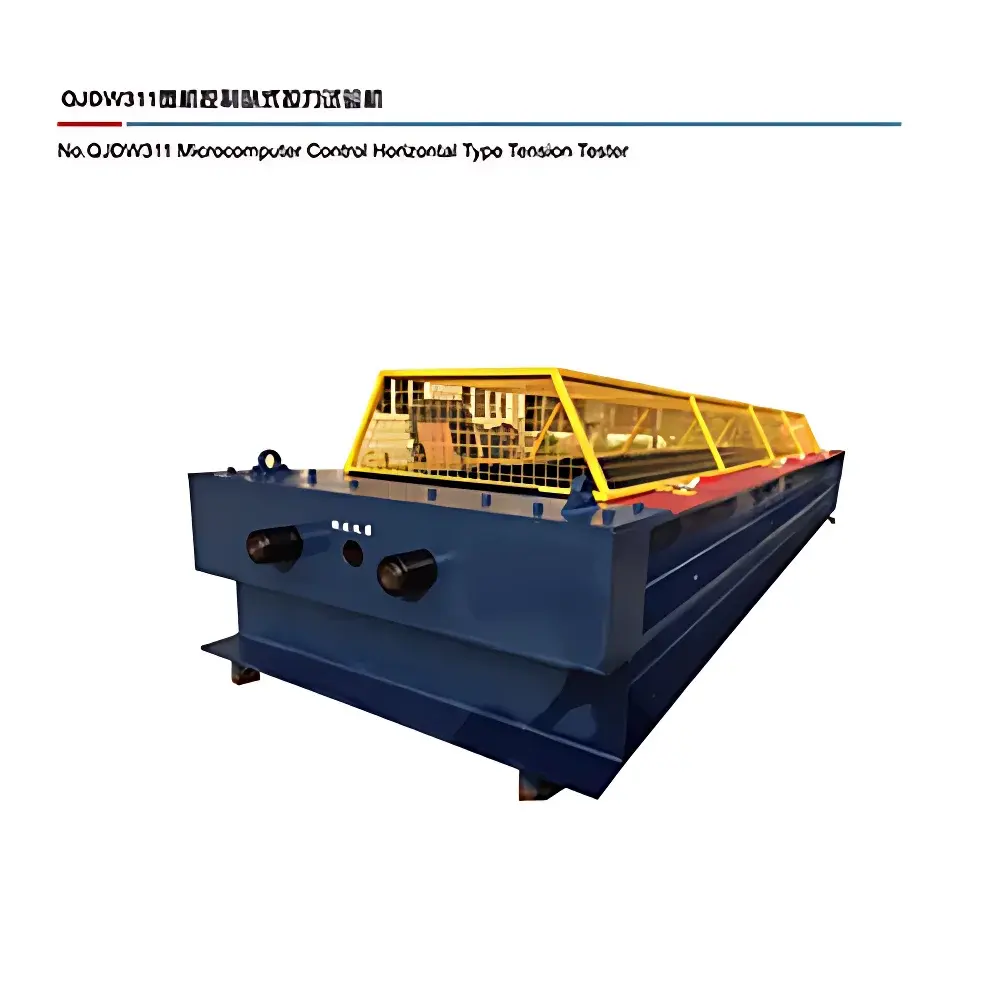
QJDW311 200t Horizontal Electronic Tensile Testing Machine
| Origin | Shanghai, China |
|---|---|
| Manufacturer Type | Authorized Distributor |
| Origin Category | Domestic (PRC) |
| Model | QJDW311 |
| Quotation | USD 31,500 (FOB Shanghai) |
| Instrument Type | Electromechanical Horizontal Tensile Tester |
| Maximum Test Load | 2000 kN (200 t) |
| Force Measurement Range | 1–100% FS (full scale) |
| Force Accuracy | ±0.5% of reading (per ISO 7500-1 Class 1) |
| Displacement Resolution | ≤0.01 mm |
| Strain Measurement Accuracy | ≤1% of reading |
| Control System | Full PC-based closed-loop servo control |
| Effective Test Length | Custom-configurable (standard: 3–15 m) |
| Compliance | ASTM E4, ASTM E8/E21, ISO 6892-1, GB/T 228.1, JIS Z 2241, DIN 50125 |
Overview
The QJDW311 200t Horizontal Electronic Tensile Testing Machine is a high-capacity, electromechanical static testing system engineered for the precise mechanical characterization of elongated, flexible, and high-strength structural components under uniaxial tensile loading. Unlike vertical frame testers, its horizontal architecture eliminates gravitational sag effects and enables stable, low-friction axial alignment—critical for evaluating long-format specimens such as marine anchor chains, overhead transmission conductors, fiber-reinforced polymer (FRP) cables, high-tensile steel ropes, ceramic insulators, and safety harness assemblies. The machine operates on a servo-controlled electromechanical actuation principle, delivering smooth, programmable load application with real-time feedback from dual-channel, temperature-compensated load cells and high-resolution linear encoders. Designed to meet static tensile performance requirements up to 2000 kN (200 metric tons), it conforms to the metrological traceability and repeatability benchmarks defined in ISO 7500-1 (Class 1), ensuring data integrity for quality assurance, certification, and regulatory submission.
Key Features
- Horizontal load train configuration with rigid welded steel frame and precision-aligned guide rails for minimal lateral deflection during extended-stroke testing
- Dual-range, hermetically sealed S-type load cells (200 kN / 2000 kN) calibrated to ISO 376, offering ±0.5% force accuracy across full dynamic range
- High-torque servo motor coupled with planetary gearbox and ball-screw transmission system, enabling controlled strain rates from 0.001 to 500 mm/min
- Integrated digital displacement measurement via non-contact optical encoder and redundant linear variable differential transformer (LVDT) for crosshead position tracking
- Modular gripping system supporting wedge-action hydraulic grips (for metallic wires/rods), pneumatic clamps (for textile/fiber cords), and custom fixture interfaces per ASTM E83 or ISO 9513
- Real-time overload protection with hardware-limited torque cutoff and software-defined safety thresholds compliant with EN ISO 13857
Sample Compatibility & Compliance
The QJDW311 accommodates specimens up to 15 meters in effective gauge length and 300 mm in maximum cross-sectional diameter. It supports standardized test geometries for wire rope (ISO 3154), anchor chain (ISO 1704), electrical cable (IEC 61196-1), and composite tendons (ASTM D4018). All force, displacement, and strain measurements are traceable to national standards (e.g., NIM, CNAS-accredited calibration certificates available). The system satisfies mechanical testing requirements for ISO/IEC 17025 accredited laboratories and supports audit-ready documentation for GLP and GMP environments. Test reports include metadata stamps for operator ID, environmental conditions (temperature/humidity), calibration validity, and instrument serial traceability.
Software & Data Management
Control and analysis are performed using proprietary TensilePro v5.2 software—a Windows-based platform compliant with FDA 21 CFR Part 11 for electronic records and signatures. The software provides multi-step test sequencing (pre-load, ramp, hold, relaxation), automatic yield point detection per ISO 6892-1 Annex B, and stress–strain curve derivation with true stress/strain conversion options. Raw data is exported in CSV, XML, and ASTM E1435-compliant .tdf formats. Audit trails log all parameter changes, user actions, and calibration events with time-stamped, immutable entries. Optional integration with LIMS (e.g., LabWare, Thermo SampleManager) is supported via OPC UA and RESTful API protocols.
Applications
- Breaking strength and elongation-at-break evaluation of galvanized steel anchor chains per ISO 1704 and DNV-OS-F101
- Tensile property verification of ACSR (aluminum conductor steel-reinforced) cables under thermal-mechanical cycling per IEEE 1138
- Proof-load and failure-mode analysis of composite insulators per IEC 61109 and GB/T 19519
- Creep and stress-relaxation behavior assessment of synthetic fiber ropes used in offshore mooring systems (API RP 2SK)
- Quality conformance testing of personal protective equipment (PPE) including fall arrest lanyards and energy-absorbing systems per EN 361 and ANSI Z359.1
- Material qualification for aerospace-grade braided cables and high-modulus polyethylene (HMPE) tethers
FAQ
What is the maximum effective test length supported by the QJDW311?
Standard configurations support 3–15 m; custom extensions up to 25 m are available upon engineering review.
Does the system comply with ISO/IEC 17025 requirements for accredited labs?
Yes—hardware calibration, software validation protocols, and uncertainty budgets are documented per ILAC-G8:2022 and included in the delivery package.
Can the machine perform cyclic or fatigue tests?
No—the QJDW311 is designed exclusively for static and quasi-static tensile testing. For dynamic or high-cycle fatigue applications, consider the companion QJDL series with electro-hydraulic actuation.
Is third-party calibration certification provided at shipment?
Yes—a full CNAS-accredited calibration certificate (force, displacement, and strain channels) is issued prior to dispatch, valid for 12 months.
What maintenance intervals are recommended for long-term reliability?
Lubrication of ball screws and guide rails every 500 operational hours; annual load cell recalibration and encoder alignment verification are advised.



