
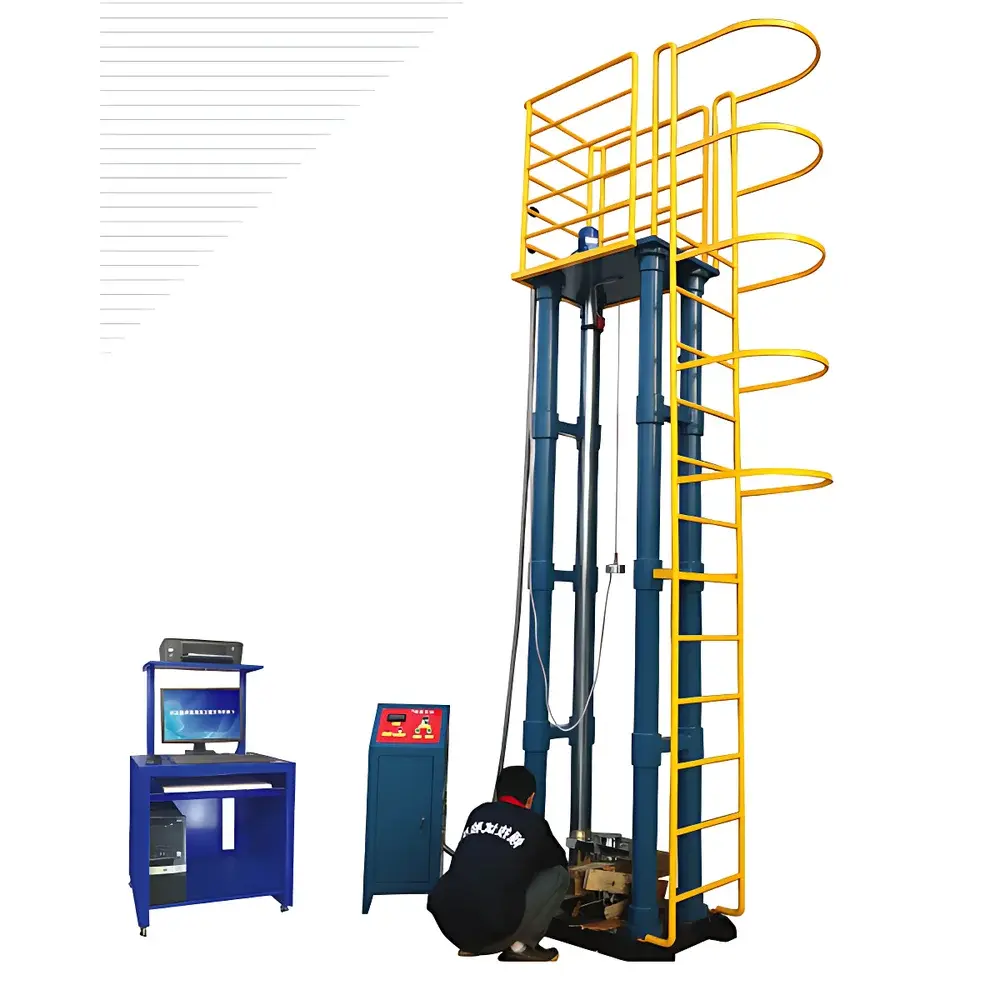
QJLC Drop-Weight Impact Tester
| Origin | Shanghai, China |
|---|---|
| Manufacturer Type | Authorized Distributor |
| Origin Category | Domestic (China) |
| Model | QJLC |
| Quotation | USD 4,200 (FOB Shanghai) |
| Instrument Type | Drop-Weight Impact Testing Machine |
| Impact Energy | 300 J |
| Maximum Lift Height | ≤2000 mm |
| Load Cell Range | 0.5 kN |
| Hammer Mass Range | 0.5–6.3 kg |
| Hammer Tip Radii | R50 for Ø25 mm & Ø90 mm anvils |
| Height Accuracy | ±2 mm |
| Specimen Diameter Range | Ø16–Ø800 mm |
| Power Supply | 220 V, 50 Hz |
| Dimensions (W×D×H) | 800×800×4100 mm |
| Net Weight | 380 kg |
Overview
The QJLC Drop-Weight Impact Tester is a precision-engineered mechanical impact testing system designed to evaluate the resistance of rigid and semi-rigid non-metallic materials—including thermoplastic pipes, profiles, sheets, and ceramic or glass specimens—to sudden dynamic loading. It operates on the classical drop-weight principle: a calibrated hammer mass is elevated to a defined height and released under gravity to strike a standardized specimen supported on a fixed anvil. The impact energy (E = m·g·h) is precisely controlled via adjustable mass and lift height, enabling compliance with standardized pass/fail or energy-to-failure assessment protocols. This instrument is specifically configured for high-reproducibility Charpy-type impact evaluation where pendulum-based systems are unsuitable—particularly for large-diameter tubular geometries (up to Ø800 mm), thick-walled extrusions, and flat-sheet configurations common in infrastructure-grade polymer applications.
Key Features
- Gravity-driven impact mechanism with pneumatic anti-rebound arrest to eliminate secondary impact artifacts and ensure single-event energy delivery.
- Touchscreen-controlled height adjustment with real-time digital display (resolution: 1 mm), calibrated to ±2 mm accuracy across the full 0–2000 mm lift range.
- Dual-standardized hammer tips: R50 radius hemispherical indenters for Ø25 mm and Ø90 mm support fixtures—fully compliant with ISO 6603-2, ASTM D7192, and GB/T 14152 test configurations.
- Modular hammer assembly supporting interchangeable masses from 0.5 kg to 6.3 kg, enabling precise energy tuning between 10 J and 300 J at nominal drop heights.
- Vertical guidance system featuring hardened steel guide rods with 0.5–1.0 mm clearance tolerance, ensuring axial alignment within 1/1000 plumb deviation per JB/T 9389 requirements.
- Integrated optical sensor array for automated impact detection and position verification—critical for GLP-aligned test documentation and audit readiness.
Sample Compatibility & Compliance
The QJLC tester accommodates a broad spectrum of specimen geometries: circular pipes (Ø16–Ø800 mm), flat sheets (up to 25 mm thickness), and molded plates conforming to ISO 179-1, ISO 180, and ASTM D256 edge-notched configurations. Its mechanical architecture satisfies structural and metrological requirements of multiple international standards, including GB/T 14152 (thermoplastic pipes), GB/T 14153 (rigid PVC pipes), GB/T 6112 (polyethylene pressure pipes), GB/T 18477 (corrugated drainage pipes), and JTT 529–2016 (MPP power conduit specifications). All mechanical tolerances—including hammer tip geometry, anvil radius, and guide rod straightness—are traceable to national metrology institutes per JJG 1028–2007 calibration guidelines. The system supports both pass/fail classification (e.g., TIR ≤10% per GB/T 14152) and quantitative fracture energy reporting.
Software & Data Management
While the base configuration operates via embedded PLC control with local touchscreen HMI, optional PC-integrated software (QJLC-DataLink v3.2) provides full 21 CFR Part 11-compliant data capture. This includes electronic signatures, audit trails for parameter changes, automatic timestamping of each test event, and exportable CSV/Excel reports containing impact height, mass, calculated energy, pass/fail status, and operator ID. All raw sensor signals—including load cell output (0.5 kN range, ±0.5% FS accuracy) and photogate timing—are logged at 10 kHz sampling rate for post-test waveform analysis. Data files are stored in encrypted SQLite databases with role-based access control, supporting GMP laboratory environments requiring full traceability.
Applications
- Evaluation of impact resistance in municipal water distribution pipes (PVC-U, PE100, MPP) under simulated trench-loading conditions.
- Quality assurance testing of corrugated HDPE drainage conduits per ASTM F2736 and EN 13476-1.
- Development-stage screening of polymer blends and filled composites for automotive interior trim and construction panels.
- Regulatory conformance testing for CE-marked plastic piping systems under EN ISO 1452-2 and EN ISO 4427-2.
- Failure mode analysis of brittle fracture initiation in tempered glass substrates used in façade engineering.
FAQ
What standards does the QJLC tester directly support?
It meets the mechanical and procedural requirements of GB/T 14152, GB/T 14153, GB/T 6112, GB/T 18477, JTT 529–2016, ISO 6603-2, and ASTM D7192.
Is calibration certification included with shipment?
Yes—each unit ships with a factory calibration certificate traceable to CNAS-accredited reference standards, covering height encoder linearity, hammer mass verification, and guide rod verticality.
Can the system be integrated into a LIMS environment?
Via optional Ethernet-enabled QJLC-DataLink software, it supports ASTM E1482-compliant HL7 and ASTM E2500-07 data exchange protocols.
What maintenance intervals are recommended?
Monthly visual inspection of guide rod lubrication (ISO VG 32 mineral oil), quarterly verification of optical sensor alignment, and annual recalibration of load cell and height encoder.
Does the tester include safety interlocks?
Yes—dual-channel electromagnetic door locks, emergency stop circuitry compliant with IEC 60204-1, and real-time hammer position monitoring prevent unauthorized operation during lift cycles.
Related Products



