
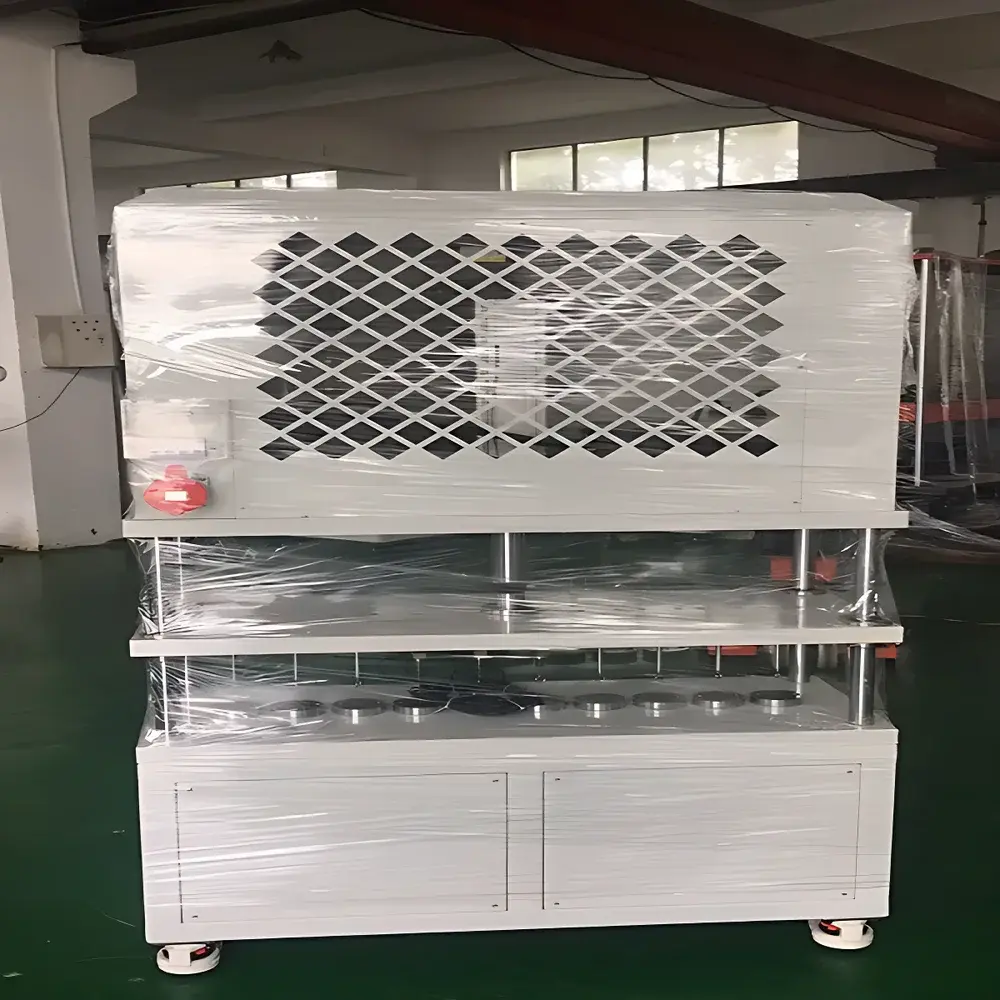
QJPL-3KN Spring Fatigue Life Testing Machine
| Origin | Shanghai, China |
|---|---|
| Manufacturer Type | Authorized Distributor |
| Origin Category | Domestic (PRC) |
| Model | QJPL-3KN |
| Max Test Load | 3 kN |
| Frequency Range | 0.001–10 Hz (amplitude-dependent) |
| Actuator Stroke | 50 mm (adjustable mid-stroke) |
| Effective Test Width | 60 mm |
| Max Spring Outer Diameter | ≤60 mm |
| Max Free Length | ≤240 mm |
| Amplitude Range | 0.001–50 mm (user-defined) |
| Load Accuracy Class | 0.5 |
| Load Measurement Range | 0.2–100% of full scale |
| Load Resolution | 1/30,000 (dynamic analog channel: 30,000 counts @ 10 kHz, no range switching) |
| Displacement Measurement Accuracy | ±0.002 mm |
| Deformation Accuracy | ±1% of reading |
| Speed Control | Dual-speed (fast/slow), jog-capable |
| Safety Features | Mechanical limit switches, overload protection (>110% FS), automatic return post-test |
| Power Supply | 220 V AC, 2 kW |
| Host Weight | ~850 kg |
| Standard Accessories | 10 sets of custom spring compression fatigue fixtures (designed per customer’s spring geometry), dedicated control software suite (with backup DVD), operation manual & data interface cables |
Overview
The QJPL-3KN Spring Fatigue Life Testing Machine is an electromechanically actuated axial fatigue testing system engineered for high-reproducibility evaluation of metallic and composite helical springs under controlled cyclic loading. It operates on the principle of servo-controlled sinusoidal or programmed waveform displacement excitation, enabling precise simulation of real-world service conditions—including clutch spring engagement cycles, suspension rebound damping, pneumatic valve actuation, and vibration isolation duty profiles. Unlike general-purpose universal testers, this machine integrates a high-stiffness load frame, low-inertia linear actuator, and synchronized force/displacement feedback loops to maintain phase fidelity across the full 0.001–10 Hz frequency spectrum. Its architecture complies with fundamental mechanical test standards including ISO 527-1 (plastics), ISO 10293 (metallic spring testing), and ASTM E466 (constant-amplitude axial fatigue testing), forming a traceable foundation for fatigue life prediction, S–N curve generation, and failure mode analysis.
Key Features
- High-precision 0.5-class load measurement system with 1/30,000 resolution and dynamic sampling at 10 kHz—ensuring accurate force quantification across the entire 0.2–100% FS range without range switching or calibration drift.
- Adjustable actuator stroke of 50 mm with mid-stroke positioning capability, supporting both compression-only and compression-tension fatigue protocols for coil springs with free lengths up to 240 mm and outer diameters ≤60 mm.
- Programmable amplitude control from 0.001 mm to 50 mm, enabling low-strain high-cycle fatigue (HCF) studies as well as high-strain low-cycle fatigue (LCF) characterization.
- Dual-speed test table actuation (fast positioning + slow testing speed), jog functionality, and programmable automatic return to home position post-test—reducing operator intervention and improving throughput in multi-sample validation batches.
- Integrated mechanical limit protection, electronic overload cutoff (>110% FS), and emergency stop circuitry compliant with IEC 60204-1 safety standards for industrial machinery.
- Rigid welded steel frame (~850 kg mass) minimizes resonant amplification and ensures stable boundary conditions during high-frequency testing, critical for maintaining waveform integrity at frequencies approaching 10 Hz.
Sample Compatibility & Compliance
The QJPL-3KN accommodates a wide range of helical spring geometries—including clutch springs, buffer springs, pneumatic springs, cylindrical compression springs, and spiral torsion variants—via ten standard fixture sets, each customizable to match customer-specific spring dimensions (free length, wire diameter, coil pitch, and end configuration). Fixture design follows ISO 2691 guidelines for spring mounting alignment and load-path coaxiality. The system supports concurrent testing of 2–6 identical specimens using synchronized actuation, facilitating statistical assessment of batch homogeneity per ISO 3856-2. All mechanical and electrical components meet CE marking requirements, and the control architecture is structured to support future GLP/GMP audit readiness through optional timestamped event logging and user-access-level permission controls.
Software & Data Management
The included Windows-based control software provides real-time dual-channel oscilloscope-style visualization of force vs. displacement hysteresis loops, cycle-by-cycle peak load tracking, and automated termination criteria (e.g., stiffness degradation >10%, cycle count threshold, or sudden load drop ≥15%). Raw data is exported in CSV and ASCII formats compatible with MATLAB, Python (NumPy/Pandas), and commercial fatigue analysis tools such as nCode DesignLife. The software includes built-in reporting templates aligned with ASTM E739 and ISO 12107 for fatigue data presentation, and supports configurable audit trails for user actions, parameter changes, and test start/stop events—laying groundwork for FDA 21 CFR Part 11 compliance when paired with network authentication and electronic signature modules.
Applications
- Quantitative determination of fatigue life (Nf) and endurance limits for automotive clutch and suspension springs under variable-amplitude road-spectrum loading.
- Evaluation of spring relaxation behavior and permanent set accumulation during thermal-mechanical cycling (when integrated with environmental chamber interfaces).
- Validation of finite element models (FEM) by correlating predicted stress distribution with measured hysteresis energy dissipation per cycle.
- Quality conformance testing per OEM specifications (e.g., Ford WSS-M1A352-A2, GM GMW14872) for production release of high-volume spring components.
- Academic research into microstructural fatigue mechanisms in stainless steel (e.g., AISI 302, 17-7PH) and music wire (ASTM A228) under fully reversed axial loading.
FAQ
What types of springs can be tested on the QJPL-3KN?
The system is optimized for axial compression fatigue of helical coil springs—including clutch, buffer, pneumatic, cylindrical, and spiral configurations—with outer diameters ≤60 mm and free lengths ≤240 mm.
Can multiple springs be tested simultaneously?
Yes—up to six identical specimens can be mounted and cycled synchronously using custom multi-position fixtures, enabling statistical life distribution analysis.
Is the system suitable for high-cycle fatigue (HCF) testing?
Yes—the 0.001 Hz lower frequency bound and sub-micron displacement resolution allow rigorous HCF characterization over 10⁷+ cycles when combined with appropriate thermal management.
Does the software support automated pass/fail criteria?
Yes—users may define termination conditions based on cycle count, accumulated plastic deformation, stiffness decay, or abrupt load loss, with real-time alerts and report generation.
What maintenance is required to sustain metrological accuracy?
Annual verification of load cell linearity and displacement transducer calibration is recommended; all critical components are field-serviceable, and spare parts—including load cells, actuators, and fixture inserts—are available under lifetime support terms.



