
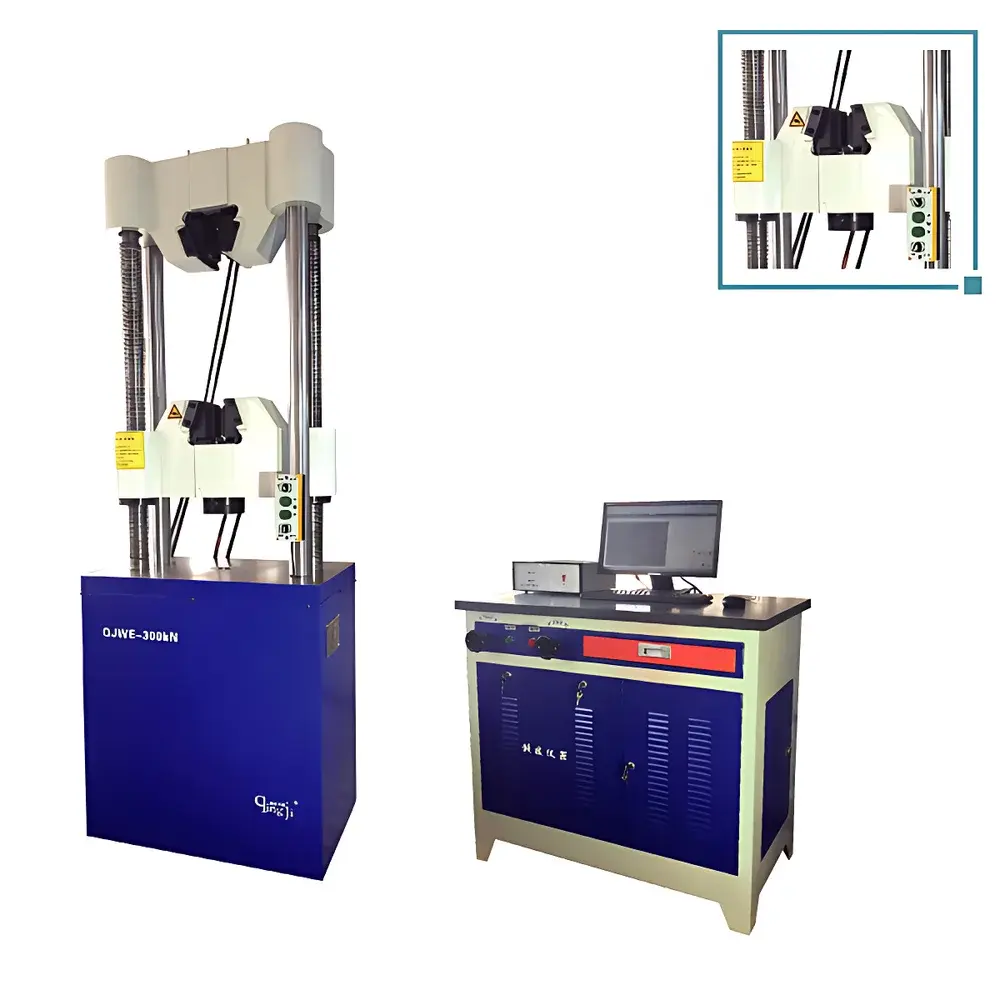
QJWE Series Electro-Hydraulic Servo Universal Testing Machine for Steel and Metallurgical Applications
| Origin | Shanghai, China |
|---|---|
| Manufacturer Type | Authorized Distributor |
| Origin Category | Domestic (China) |
| Model | QJWE Series |
| Quotation | USD 7,800 (FOB Shanghai) |
| Instrument Type | Electro-Hydraulic Servo Universal Testing Machine |
| Load Capacity Options | 50 kN, 100 kN, 300 kN, 600 kN, 1000 kN, 2000 kN |
| Accuracy | ±1% of full scale |
| Resolution | ≤0.5% of full scale |
| Compression Space | 550–700 mm |
| Tension Space | 550–700 mm |
| Round Specimen Grip Range | φ6–12 mm to φ20–70 mm |
| Flat Specimen Grip Thickness | 0–15 mm to 0–40 mm |
| Piston Stroke | 200–250 mm |
| Bend Support Span | 400–1000 mm |
| Shear Specimen Diameter | φ10–φ30 mm |
| Dimensions (W×D×H) | 640×550×1800 mm to 1255×866×4700 mm |
| Motor Power | 1.5 kW or 3.25 kW, 3-phase |
| Machine Weight | 1200 kg to 6600 kg |
Overview
The QJWE Series Electro-Hydraulic Servo Universal Testing Machine is engineered for high-precision mechanical property evaluation of ferrous metals, alloys, and structural materials in steel production, metallurgical R&D, and quality assurance laboratories. Based on the principles of closed-loop electro-hydraulic servo control, the system applies controlled axial force via a precision-engineered hydraulic actuator while simultaneously measuring load, displacement, and strain with traceable metrological integrity. Its oil-cylinder-underneath architecture ensures vertical stability and long-term alignment integrity—critical for ASTM E8/E8M (tensile testing of metallic materials), ISO 6892-1, and GB/T 228.1 compliant testing. Designed for integration into industrial QA/QC workflows, the machine supports standardized test sequences for yield strength (Rp0.2), ultimate tensile strength (Rm), Young’s modulus, elongation at break (A%), reduction of area (Z%), bending stiffness, and shear strength—fully aligned with DIN 50125 and EN 10002-1 requirements.
Key Features
- Electro-hydraulic servo architecture with imported high-pressure vane pump and high-response servo valve for stable force control across full load range
- Multi-channel closed-loop control capability: simultaneous force, displacement, and strain regulation with real-time PID parameter tuning
- PC-based servo controller with Windows-compatible software interface enabling automated test sequencing, real-time curve plotting (stress–strain, load–displacement), and digital signal filtering
- Modular gripping system: interchangeable wedge-action grips for round specimens (φ6–70 mm) and flat specimens (up to 40 mm thick), each configured for optimal stress distribution and minimal slippage
- Integrated bending and shear fixtures compliant with ASTM E290, ISO 7438, and GB/T 232 standards; adjustable support spans (400–1000 mm) and shear dies (φ10–30 mm)
- Rugged cast-iron base and reinforced column structure ensuring mechanical rigidity and vibration damping during high-load dynamic testing
- Compliance-ready design: audit trail logging, user access levels, and electronic signature support align with FDA 21 CFR Part 11 and GLP/GMP documentation requirements when paired with validated software modules
Sample Compatibility & Compliance
The QJWE platform accommodates standard and custom specimens per ISO 37, ASTM A370, and GB/T 228.1 geometries—including round bars, flat plates, welded joints, and rolled sections. Grip configurations are certified for static loading up to 2000 kN without plastic deformation of jaw faces. All mechanical components meet ISO 9001-certified manufacturing tolerances, and force transducers are calibrated per ISO/IEC 17025-accredited procedures. The system satisfies mandatory CE marking requirements for machinery safety (2006/42/EC) and electromagnetic compatibility (2014/30/EU). Optional extensometers (contact and non-contact) enable modulus measurement per ASTM E111 and ISO 527-1, extending compliance to research-grade material characterization protocols.
Software & Data Management
Bundled with proprietary TestMaster™ control and analysis software, the QJWE Series provides ISO/IEC 17025-aligned data acquisition at up to 1 kHz sampling rate. Software features include programmable test profiles (ramp-hold, cyclic, creep), automatic yield point detection (0.2% offset method), fracture energy calculation, and batch reporting with customizable PDF/Excel export. Raw data files are stored in encrypted binary format with embedded metadata (operator ID, timestamp, calibration certificate ID, environmental conditions). Audit logs record all user actions—including parameter changes, test aborts, and report generation—with time-stamped, non-erasable entries. Integration with LIMS environments is supported via ASTM E1482-compliant XML and ODBC drivers.
Applications
- Tensile property verification of hot-rolled coil, cold-drawn wire, and seamless pipe in steel mill QA labs
- Mechanical validation of alloy steels (e.g., 4140, 316L) for aerospace and energy sector procurement
- Yield-to-tensile ratio assessment of reinforcing bars (rebar) per ASTM A615/A615M
- Bending ductility testing of galvanized sheet metal per ISO 7438
- Shear strength evaluation of rivets, bolts, and spot welds in structural fabrication QA
- Creep and relaxation studies under sustained loading (with optional high-temperature furnace attachment)
- Educational use in university metallurgy and materials science programs for hands-on mechanical behavior labs
FAQ
What standards does the QJWE Series comply with for tensile testing?
It fully supports ASTM E8/E8M, ISO 6892-1, GB/T 228.1, and EN 10002-1 for metallic materials, including automatic determination of Rp0.2, Rm, A5, and Z values.
Is third-party calibration certification included?
Yes—each unit ships with an ISO/IEC 17025-accredited calibration certificate for load cell and displacement sensor, valid for 12 months from shipment.
Can the system be integrated into an existing factory MES or SAP QA module?
Yes—via optional OPC UA or REST API interface packages, supporting bidirectional data exchange of test results, equipment status, and maintenance alerts.
What is the recommended maintenance schedule?
Hydraulic oil replacement every 2,000 operating hours; servo valve inspection annually; grip jaw surface reconditioning every 5,000 tests or as wear indicators exceed 0.05 mm depth.
Are extensometers available as factory-installed options?
Yes—clip-on axial extensometers (10–50 mm gauge length, ±0.5 µm resolution) and video-based non-contact systems (DIC-ready) are available with NIST-traceable calibration.



