
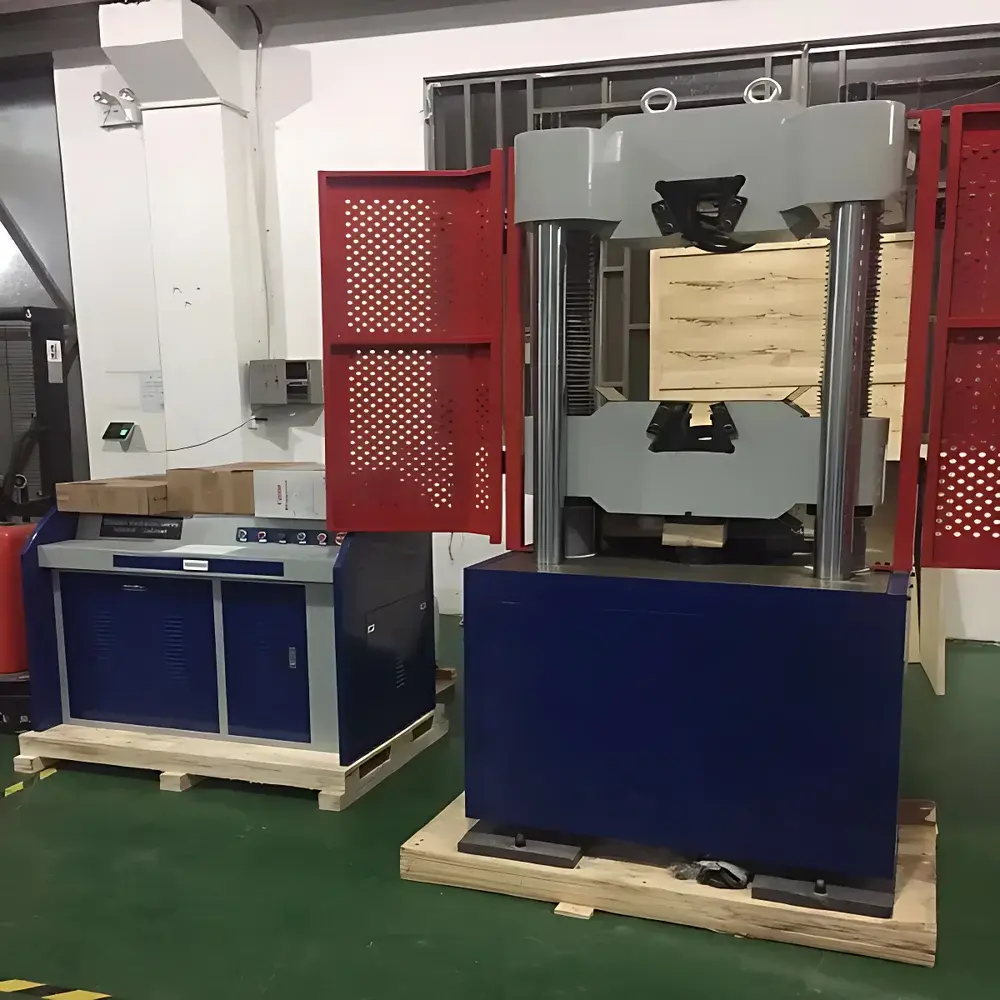
QJWE Series Electro-Hydraulic Servo Universal Testing Machine
| Origin | Shanghai, China |
|---|---|
| Manufacturer Type | Authorized Distributor |
| Origin Category | Domestic (China) |
| Model | QJWE Series |
| Instrument Type | Electro-Hydraulic Servo Testing Machine |
| Pricing | USD 6,300–12,500 (FOB Shanghai, model-dependent) |
| Key Specifications | Load Capacity Range: 50 kN to 2000 kN |
| Force Measurement Accuracy | ±1% of full scale |
| Force Resolution | ≤0.5% of full scale |
| Compression Space | 550–700 mm |
| Tension Space | 550–700 mm |
| Round Specimen Gripping Range | φ6–70 mm |
| Flat Specimen Gripping Thickness | 0–40 mm |
| Piston Stroke | 200–250 mm |
| Bend Support Span | 400–1000 mm |
| Shear Specimen Diameter | φ10–30 mm |
| Overall Dimensions (L×W×H) | 640×550×1800 mm to 1255×866×4700 mm |
| Motor Power | 1.5 kW or 3.25 kW, 3-phase |
| Machine Weight | 1200 kg to 6600 kg |
Overview
The QJWE Series Electro-Hydraulic Servo Universal Testing Machine is a high-stiffness, high-load-capacity mechanical testing system engineered for static mechanical property evaluation of metallic and non-metallic materials under controlled loading conditions. It operates on the principle of electro-hydraulic servo control—where a digitally regulated proportional valve modulates hydraulic oil flow to a precision actuator, enabling precise force, displacement, or strain control in closed-loop mode. This architecture ensures stable load application across tensile, compressive, flexural, and shear test modes, conforming to standardized mechanical testing protocols defined in ASTM E4, ASTM E8/E8M, ISO 6892-1, ISO 15630-1, and GB/T 228.1. The machine features a bottom-mounted hydraulic cylinder with adjustable test zones, allowing flexible specimen accommodation without mechanical reconfiguration. Integrated high-accuracy load cells (imported, temperature-compensated), extensometers (optional), and linear variable differential transformers (LVDTs) deliver synchronized acquisition of force, displacement, and deformation data at sampling rates up to 1 kHz.
Key Features
- Electro-hydraulic servo control system with full-digital closed-loop regulation, supporting force, displacement, and strain control modes
- Adjustable test space configuration: tension zone (550–700 mm), compression zone (550–700 mm), and customizable bending span (400–1000 mm)
- Multi-range hydraulic gripping system: round specimen clamping from φ6 mm to φ70 mm; flat specimen thickness up to 40 mm
- High-resolution measurement chain: ±1% force accuracy per ASTM E4, ≤0.5% relative resolution, traceable to national metrological standards
- Robust structural frame with reinforced cast-iron base and high-rigidity column assembly, minimizing deflection during high-load testing
- Dual-power motor options (1.5 kW / 3.25 kW, 3-phase) matched to load capacity tiers for optimal energy efficiency and thermal stability
- Integrated safety interlocks including over-travel limit switches, emergency stop circuitry, and hydraulic pressure relief valves compliant with ISO 13857
Sample Compatibility & Compliance
The QJWE series accommodates a broad spectrum of standardized and custom specimens—including round bars, flat plates, welded joints, concrete cylinders, cement mortars, polymer rods, and composite laminates. Its modular grip and fixture interface supports ASTM E8, ISO 6892-1 (tensile), ASTM C39/C109 (concrete/cement), ISO 178 (flexure), and ISO 37 (shear) geometries. All mechanical components meet GB/T 16825.1–2008 (equivalent to ISO 7500-1) for verification of static uniaxial testing machines. The system is designed for integration into GLP-compliant laboratories: audit trails, user access levels, and electronic signature support can be enabled via optional software modules aligned with FDA 21 CFR Part 11 requirements.
Software & Data Management
Bundled with Windows-based testing software, the system provides real-time graphical display of stress–strain, load–displacement, and time-based curves. Test parameters—including loading rate (0.001–100 mm/min), hold duration, cycle count, and control mode—are programmable prior to execution. Raw data is stored in ASCII-compatible .csv format with embedded metadata (operator ID, timestamp, calibration certificate ID, environmental conditions). Export functions support direct generation of ASTM/ISO-formatted reports, including modulus calculation, yield point determination (0.2% offset), ultimate tensile strength, elongation at break, and fracture toughness indices. Network connectivity enables centralized data archiving, remote diagnostics, and synchronization with LIMS platforms via TCP/IP or OPC UA protocols.
Applications
- Mechanical characterization of structural steels, aluminum alloys, titanium grades, and high-strength fasteners per ISO 898-1 and ASTM F568M
- Quality assurance testing of reinforcing bars (rebar), prestressed concrete tendons, and grouted duct systems
- Research-grade evaluation of polymer matrix composites under monotonic and cyclic loading
- Compressive strength validation of cementitious materials (mortars, concretes, geopolymers) per ASTM C39 and EN 12390-3
- Flexural performance assessment of ceramic tiles, fiber-cement boards, and wood-based panels per ISO 178 and ASTM D790
- Shear resistance quantification of riveted, bolted, or adhesive-bonded joints in aerospace and automotive assemblies
FAQ
What standards does the QJWE series comply with for force calibration and verification?
The system conforms to ISO 7500-1:2018 and GB/T 16825.1–2008 for static calibration of uniaxial testing machines. Load cell calibration certificates are provided with NIST-traceable documentation.
Is the machine suitable for fatigue testing applications?
No—the QJWE series is configured for static and quasi-static loading only. For dynamic or high-cycle fatigue testing, a dedicated electrodynamic or servo-hydraulic fatigue system is recommended.
Can third-party extensometers be integrated?
Yes—standardized analog (±10 V) and digital (RS422/SSI) interfaces support compatibility with clip-on, video, or laser extensometers meeting ASTM E83 Class B-2 specifications.
What maintenance intervals are recommended for hydraulic system integrity?
Hydraulic oil replacement every 2,000 operating hours or biannually (whichever occurs first); filter elements replaced quarterly; annual verification of valve response time and pressure transducer drift.
Does the system support multi-step test profiles with automatic mode switching?
Yes—programmable test sequences allow transitions between force-controlled ramping, displacement-controlled holding, and strain-controlled cycling within a single test routine.



