
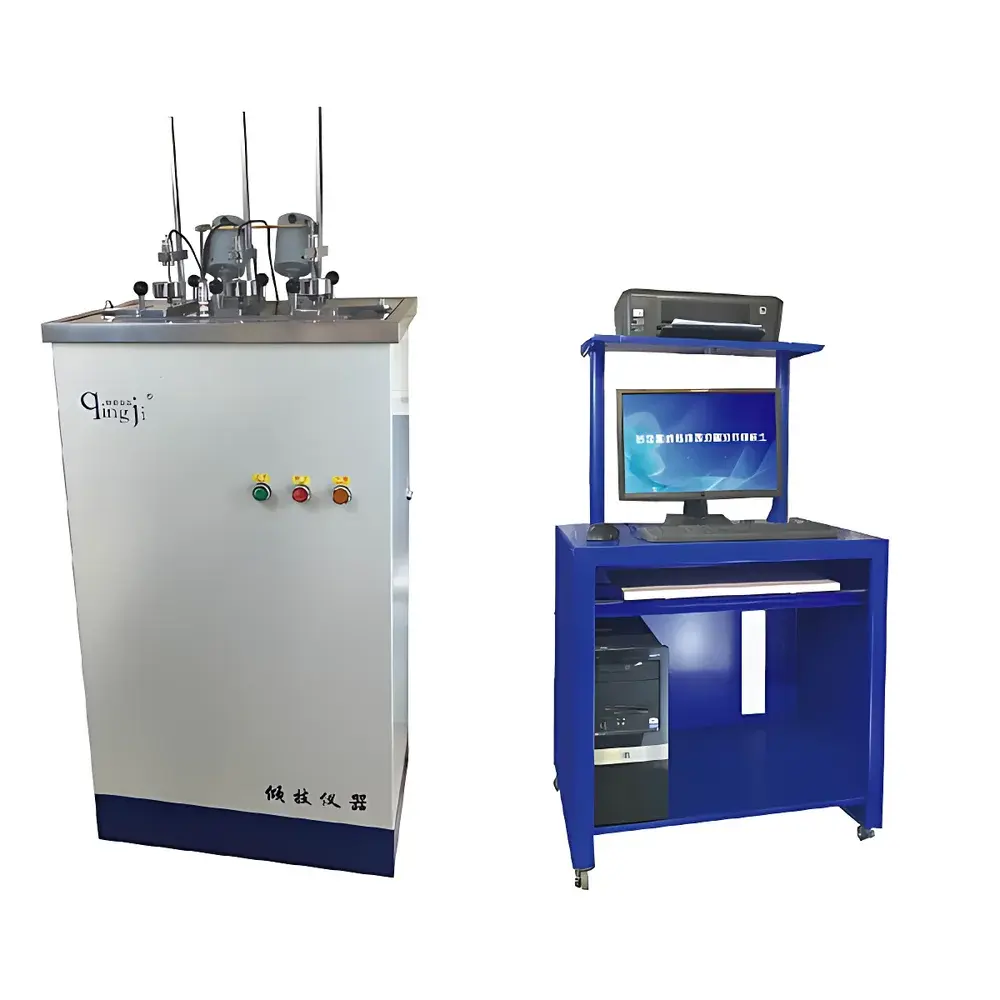
QJWK-507 Heat Deflection Temperature (HDT) and Vicat Softening Temperature (VST) Tester
| Brand | Qingji |
|---|---|
| Model | QJWK-507 |
| Temperature Range | Ambient to 300 °C |
| Heating Rate Options | (12 ± 1) °C/6 min or (5 ± 0.5) °C/6 min |
| Temperature Accuracy | ±1 °C |
| Deformation Measurement Range | 0–1 mm |
| Deformation Resolution | 0.01 mm |
| Heating Medium | Methyl Silicone Oil |
| Heating Power | 4 kW |
| Cooling Method | Natural cooling above 150 °C |
| Power Supply | AC 220 V, 20 A, 50 Hz |
| Dimensions (L×W×H) | 540 × 520 × 1360 mm |
| Compliance | GB/T 1633, GB/T 1634, GB 8802, ISO 75, ISO 306, ISO 2507 |
Overview
The QJWK-507 Heat Deflection Temperature (HDT) and Vicat Softening Temperature (VST) Tester is an engineered solution for standardized thermal performance evaluation of thermoplastic polymers, thermosets, and composite materials. It operates on two distinct ASTM- and ISO-aligned test principles: the Vicat Softening Test (ISO 306 / ASTM D1525), which measures the temperature at which a flat-ended needle penetrates 1 mm into a specimen under defined load and heating rate; and the Heat Deflection Test (ISO 75 / ASTM D648), which determines the temperature at which a standard rectangular beam deforms by 0.25 mm under a specified flexural stress while subjected to uniform heating. Both methods provide critical data for material selection in automotive, electrical insulation, piping, and construction applications where dimensional stability under thermal load is essential.
Key Features
- Programmable dual heating rate control: selectable (12 ± 1) °C/6 min (120 ± 10) °C/h for VST testing and (5 ± 0.5) °C/6 min (50 ± 5) °C/h for HDT testing—fully compliant with ISO 75-1:2013, ISO 306:2020, and GB/T 1634.1–2019 calibration requirements.
- High-stability silicone oil bath (methyl silicone oil, flash point >300 °C) ensures uniform thermal conduction and minimal temperature gradient across test specimens.
- Dual-mode deformation sensing: supports both high-contrast LED displacement indicators and precision mechanical dial gauges (0–1 mm range, 0.01 mm resolution), enabling traceable manual verification alongside digital readout.
- Robust thermal architecture: 4 kW resistive heating system coupled with hybrid cooling—natural convection above 150 °C and optional water-assisted cooling below 150 °C—enables rapid thermal cycling without oil degradation or thermal shock.
- Modular test fixture design accommodates standard specimen dimensions per ISO 75 (80 × 10 × 4 mm or 100 × 10 × 4 mm) and ISO 306 (10 × 10 × ∼50 mm), with interchangeable loading pins (1 mm² or 1.5 mm² cross-section) and bending supports conforming to ISO 75-2:2013 Annex A.
Sample Compatibility & Compliance
The QJWK-507 is validated for rigid and semi-crystalline polymer specimens including but not limited to polypropylene (PP), acrylonitrile-butadiene-styrene (ABS), polycarbonate (PC), polyethylene terephthalate (PET), unplasticized polyvinyl chloride (PVC-U), and fiber-reinforced composites. All test configurations adhere strictly to the geometric, loading, and environmental stipulations of GB/T 1633–2020 (VST), GB/T 1634.1–2019 (HDT), GB 8802–2001 (PVC-U pipe testing), ISO 75-1:2013, ISO 306:2020, and ISO 2507-2:2019. The instrument’s temperature uniformity profile (<±1 °C deviation across 100 mm immersion depth) and deformation measurement repeatability (<0.02 mm inter-test CV) satisfy internal QA protocols for GLP-compliant laboratories.
Software & Data Management
While the base configuration features standalone analog/digital instrumentation with front-panel setpoint control, optional PC-integrated software enables automated test sequencing, real-time temperature–deformation curve logging, and export to CSV or PDF formats. All digital outputs include embedded metadata: operator ID, sample ID, test standard selected, load condition, heating rate, ambient lab conditions (optional sensor input), and timestamped audit trail. When configured with secure login and electronic signature modules, the system meets documentation requirements aligned with FDA 21 CFR Part 11 for regulated environments—supporting retrospective review, version-controlled report generation, and user-access-level permissions.
Applications
- Quality control of incoming polymer resins and extruded profiles against supplier specifications.
- Thermal validation of flame-retardant compounds used in wire & cable sheathing (e.g., UL 94 V-0 rated materials).
- R&D screening of heat-resistant formulations for under-hood automotive components.
- Regulatory submission support for building materials (e.g., PVC-U pipes per GB 8802) and medical device housings requiring ISO 10993-1 biocompatibility thermal limits.
- Comparative analysis of annealing effects on crystallinity in injection-molded parts.
FAQ
What standards does the QJWK-507 fully support?
It meets the technical and procedural requirements of GB/T 1633, GB/T 1634, GB 8802, ISO 75-1/2/3, ISO 306, and ISO 2507-2—including specimen preparation, load application, heating ramp tolerances, and pass/fail criteria.
Can the instrument be calibrated to national metrology standards?
Yes—traceable calibration certificates are available for temperature sensors (Pt100 Class A) and displacement transducers (certified to ISO 9001-accredited labs), with documented uncertainty budgets per ISO/IEC 17025.
Is water cooling mandatory below 150 °C?
No—it is optional. Natural cooling is sufficient for routine QC; water cooling reduces cycle time by ~40% in high-throughput labs and extends oil service life when performing >10 daily tests.
What maintenance intervals are recommended for long-term accuracy?
Silicone oil replacement every 12 months or 500 test hours; annual verification of thermal uniformity and deformation sensor linearity; quarterly cleaning of heating chamber and load train components.
Related Products



