
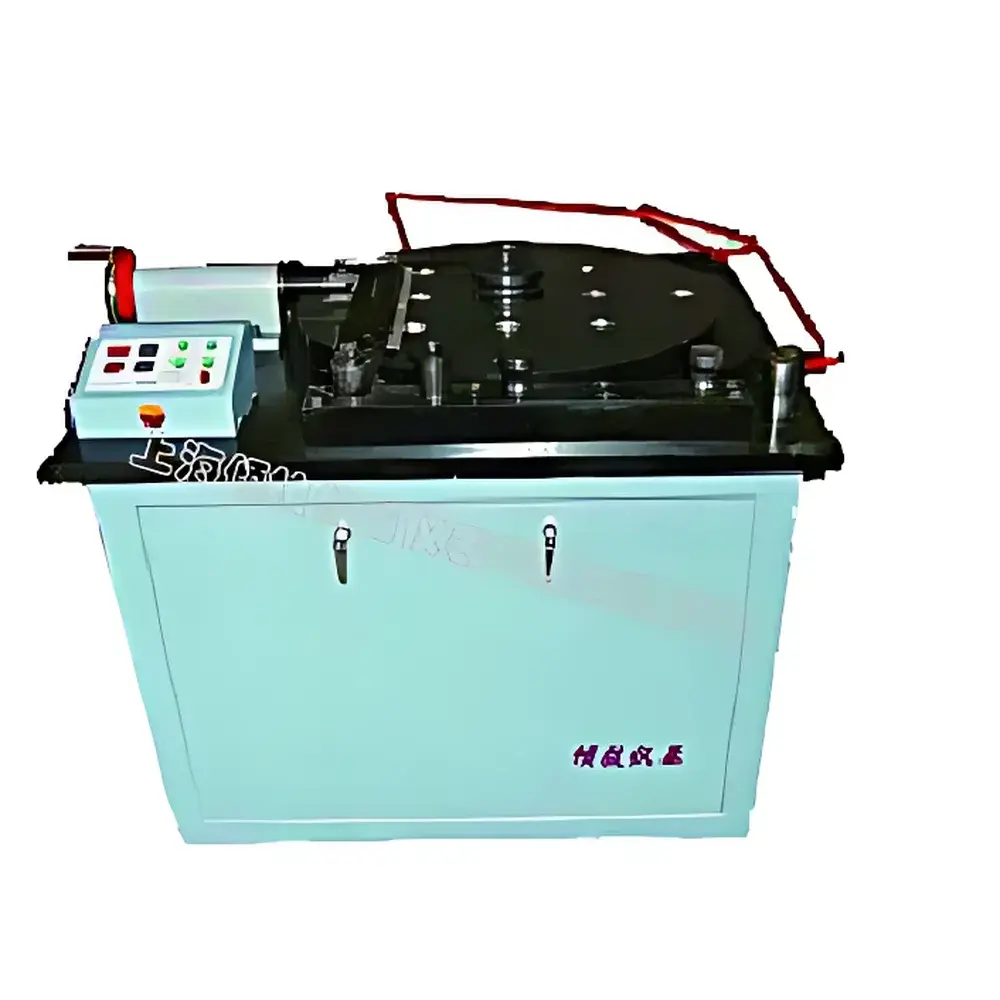
QJWQ41 Rebar Bending Testing Machine
| Brand | Qingji |
|---|---|
| Origin | Shanghai, China |
| Model | QJWQ41 |
| Max. Rebar Diameter | Φ40 mm |
| Forward Bending Angle Range | 0°–180° (adjustable) |
| Reverse Bending Angle Range | 0°–25° (adjustable) |
| Working Plate Rotational Speed | <2 rpm |
| Center-to-Center Distance Between Rollers | 205 mm |
| Working Plate Diameter | Φ580 mm |
| Motor Power | 1.5 kW |
| Standard Mandrel Sets Included | Φ6–Φ40 mm |
| Overall Dimensions (L×W×H) | 1250×950×1200 mm |
| Net Weight | 1450 kg |
| Power Supply | 3-phase 380 V AC |
| Compliance | YB/T 5126–1993, GB 1499–1998, ISO 6935-2 |
Overview
The QJWQ41 Rebar Bending Testing Machine is a dedicated mechanical testing system engineered for standardized forward and reverse bending evaluation of reinforcing steel bars (rebar) in accordance with internationally recognized metallurgical and construction material standards. It operates on the principle of controlled rotary bending—applying precise angular displacement to a fixed-length rebar specimen clamped between two support rollers and a centrally positioned mandrel. The machine replicates real-world plastic deformation conditions encountered during structural reinforcement installation and seismic design verification. Its rigid frame, low-speed high-torque drive architecture, and calibrated angular positioning system ensure repeatable, traceable, and mechanically stable bending cycles—critical for quality assurance in reinforced concrete applications.
Key Features
- Robust cast-iron base and reinforced steel frame designed to withstand high torsional loads during repeated bending cycles up to 180° forward and 25° reverse angles.
- Adjustable mandrel positioning mechanism enabling rapid setup for rebar diameters from Φ6 mm to Φ40 mm, with included standard mandrel sets covering common construction grades (e.g., HRB400, HRB500).
- Precision-controlled working plate rotation at <2 rpm—optimized to minimize inertial effects and ensure quasi-static loading conditions per ASTM E8/E8M and ISO 6892-1 requirements for ductility assessment.
- Fixed center-to-center roller distance of 205 mm—aligned with YB/T 5126–1993 and ISO 6935-2 geometric specifications for consistent bend radius-to-diameter ratios (ad/d).
- Integrated safety interlock system preventing operation unless all protective guards are correctly engaged and specimen is fully seated.
- Modular mandrel storage and quick-release tooling interface facilitating compliance-driven test sequence changes without recalibration.
Sample Compatibility & Compliance
The QJWQ41 accommodates deformed and plain round rebars conforming to GB/T 1499.2, ASTM A615/A615M, and ISO 6935-2 dimensional tolerances. Specimen lengths are determined by standard gauge length requirements (typically 5d or 10d, where d = nominal diameter). All bending tests are executed under ambient laboratory conditions (23 ± 5°C), adhering to pre-test conditioning protocols specified in GB/T 228.1 and ISO 6892-1. The machine’s mechanical repeatability supports GLP-compliant test record generation when paired with external documentation systems. While the unit itself does not embed digital audit trails, its physical operation aligns with ISO/IEC 17025 clause 6.4.1 (equipment suitability) and supports laboratories pursuing CNAS or A2LA accreditation.
Software & Data Management
The QJWQ41 is a manually operated, non-instrumented mechanical tester—no embedded microprocessor, touchscreen interface, or proprietary software is integrated. Angular positioning is achieved via calibrated mechanical stops and visual protractor scales; bending cycles are recorded externally using laboratory notebooks, LIMS entries, or spreadsheet-based QA templates. This analog architecture ensures long-term operational stability, eliminates firmware obsolescence risks, and simplifies validation under FDA 21 CFR Part 11 Annex 11 contexts where electronic records are not mandated. Users may integrate third-party digital calipers or angle encoders (e.g., Mitutoyo IP67-rated inclinometers) for enhanced data capture—provided such add-ons undergo independent verification per ISO/IEC 17025 section 6.5.
Applications
- Verification of cold bending ductility for hot-rolled ribbed rebar in precast and cast-in-place concrete manufacturing.
- Quality control testing at steel mills, fabrication yards, and third-party inspection agencies accredited to ISO/IEC 17020.
- Conformance assessment against national technical specifications (e.g., China’s JGJ 107 for mechanical splicing acceptance criteria).
- Reverse bending evaluation for seismic-resistant rebar—where post-forward-bend resilience under constrained reverse deformation is critical to structural performance.
- Calibration reference testing for bending fixtures used in universal testing machines equipped with four-point bending modules.
FAQ
Does the QJWQ41 comply with ASTM A615 or EN 10080 standards?
It satisfies the mechanical bending methodology described in ASTM A615 Section 9.3 and EN 10080 Annex A, provided mandrel diameters and support spacing are selected per the respective standard’s d/a ratio tables. Full conformance requires user-defined test setup adherence—not inherent machine certification.
Is electrical safety certification (e.g., CE, UL) provided?
The unit meets IEC 60204-1 general requirements for electrical equipment of machines. CE marking is not applied as it is supplied for industrial use within China’s regulatory framework; international users must perform local conformity assessment per their jurisdiction’s Machinery Directive obligations.
Can custom mandrels be fabricated for non-standard rebar profiles?
Yes—Qingji offers OEM mandrel machining services based on customer-provided engineering drawings and material specifications (e.g., hardened 42CrMo alloy steel, HRC 58–62 surface hardness).
What maintenance intervals are recommended for long-term accuracy?
Lubrication of roller bearings and gear train every 500 operating hours; annual torque verification of clamping mechanisms using calibrated beam-type torque wrenches; biannual inspection of mandrel surface finish for wear-induced dimensional deviation (>±0.1 mm).



