
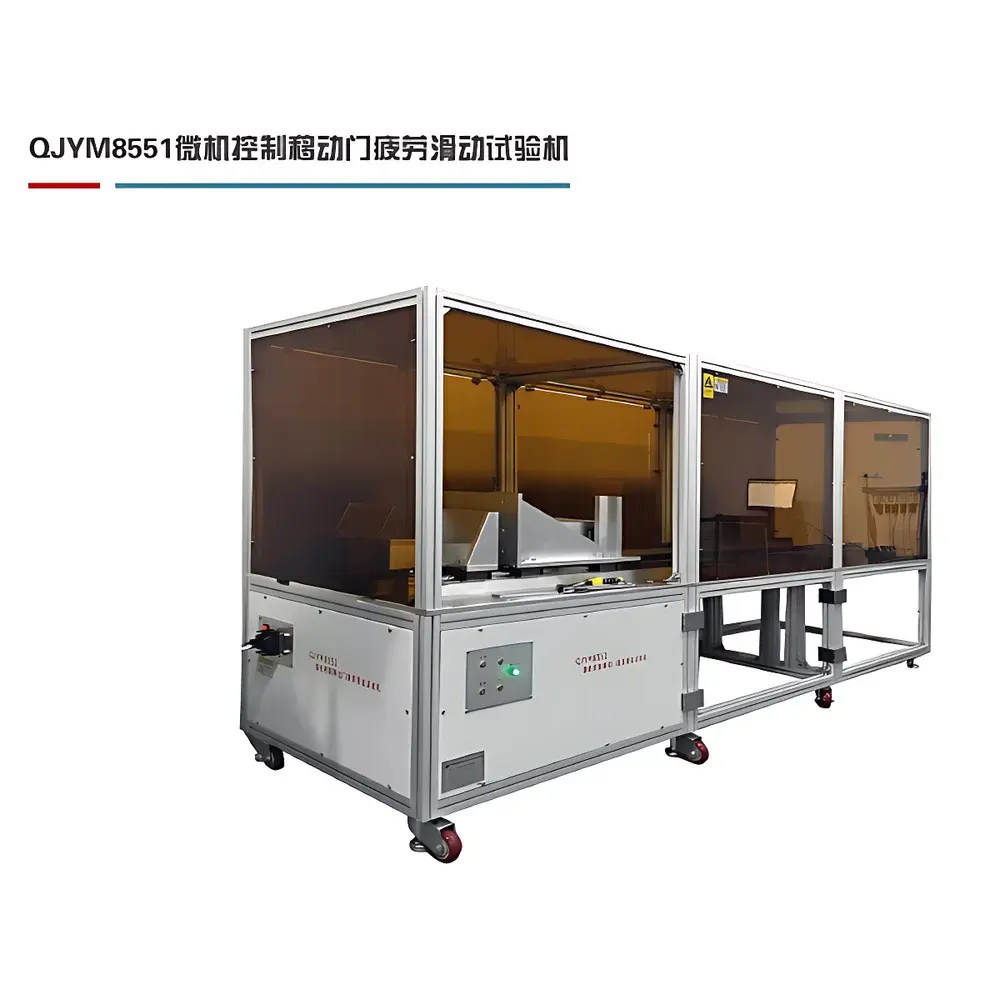
QJYM8551 Microcomputer-Controlled Fatigue Sliding Tester for Movable Doors and Windows
| Origin | Shanghai, China |
|---|---|
| Manufacturer Type | Authorized Distributor |
| Regional Classification | Domestic (PRC) |
| Model | QJYM8551 |
| Price | USD 7,000 (FOB Shanghai) |
Overview
The QJYM8551 Microcomputer-Controlled Fatigue Sliding Tester is an engineered mechanical endurance testing system designed to evaluate the long-term operational reliability of sliding components in architectural fenestration systems—specifically movable doors, windows, and parallel-sliding hardware assemblies. It replicates real-world service conditions by subjecting sliding mechanisms (e.g., roller carriers, track interfaces, and guiding systems) to controlled, repetitive translational motion under defined load, displacement, and acoustic constraints. The system operates on a servo-motor-driven linear actuation principle, with force feedback via high-stability load cells and acoustic monitoring via calibrated Class 2 sound level sensors. Its core function is to quantify fatigue-induced degradation—including increased frictional resistance, positional drift, abnormal noise generation, and mechanical binding—thereby supporting compliance verification against structural durability requirements in building product standards such as GB/T 8478–2020 (Aluminum Alloy Doors and Windows), EN 14351-1:2016+A2:2021 (Performance Characteristics), and ISO 10071:2017 (Acoustic Testing of Building Components).
Key Features
- Programmable displacement control: User-defined stroke length (0–1,200 mm range) with ±0.1 mm repeatability, adjustable in real time via Windows-based control interface.
- Dynamic force profiling: Bidirectional push-pull force setpoints (0–500 N range) with closed-loop PID regulation; real-time force waveform display and peak-hold capture.
- Cycle-based fatigue protocol: Configurable test duration from 1 to 999,999 cycles; automatic cycle counting with mid-test pause/resume capability.
- Integrated acoustic threshold monitoring: Sound pressure level (SPL) measurement per IEC 61672-1:2013 (Class 2), with user-definable alarm thresholds (35–85 dB(A)); auto-termination triggered when SPL exceeds preset limit for >3 consecutive cycles.
- System calibration & zeroing: Onboard hardware calibration routines for force transducers and position encoders; software-initiated tare function prior to each test sequence.
- Robust data acquisition architecture: 100 Hz sampling rate for force and position channels; synchronized 1 kHz SPL logging; timestamped raw data export in CSV and XML formats.
Sample Compatibility & Compliance
The QJYM8551 accommodates standard-sized sliding door/window sashes (max. 2.4 m width × 1.8 m height) with adjustable mounting fixtures for top-hung, bottom-rolling, and center-guided configurations. Specimens are secured using non-damaging clamping plates compatible with aluminum, PVC-U, and timber profiles. The tester supports compliance documentation workflows aligned with ISO/IEC 17025:2017 (General Requirements for Testing Laboratories) and facilitates audit-ready records for GLP-regulated quality assurance departments. All mechanical and electrical subsystems conform to GB 5226.1–2019 (Safety of Machinery – Electrical Equipment) and CE-marking directives (2014/30/EU EMC Directive, 2006/42/EC Machinery Directive).
Software & Data Management
The embedded WinTest v3.2 control software provides intuitive graphical configuration of multi-step test sequences—including ramp-up, steady-state cycling, and ramp-down phases—with conditional logic (e.g., “stop if force > 420 N for >5 s”). Data is stored in a local SQL Server Express database with full traceability: operator ID, environmental temperature/humidity tags (optional external sensor input), calibration certificate references, and digital signatures. Export modules generate PDF reports compliant with ISO 17025 Clause 7.8.2, including statistical summaries (mean cycle force, coefficient of variation, SPL trend slope), pass/fail annotations per user-specified criteria, and embedded charts (force vs. cycle count, SPL envelope over time). Audit trail functionality satisfies FDA 21 CFR Part 11 requirements for electronic records and signatures when deployed in regulated construction material certification labs.
Applications
- Pre-certification fatigue validation of sliding hardware per EN 1627–1630 (Burglar Resistance) and ASTM E283 (Air Leakage Rate).
- Root cause analysis of premature roller wear or track deformation in field-failed installations.
- Comparative evaluation of lubricant formulations under cyclic shear stress and ambient humidity exposure.
- Development-stage testing of low-friction polymer composites used in silent-sliding mechanisms.
- Quality conformance screening for OEM suppliers supplying to LEED- or BREEAM-certified building projects.
FAQ
Does the QJYM8551 support third-party calibration certificates traceable to NIM (National Institute of Metrology, China)?
Yes—calibration kits and accredited service contracts are available through our authorized metrology partners, with certificates issued per JJF 1094–2002 (Evaluation of Measurement Uncertainty).
Can the system be integrated into a factory’s MES or SAP QA module?
Yes—the software provides OPC UA server capability (IEC 62541) for bidirectional data exchange with enterprise manufacturing systems, including batch ID linking and automated non-conformance flagging.
What is the recommended maintenance interval for the linear guide rails and servo drive system?
Under continuous lab use (≤8 hrs/day), preventive maintenance—including rail lubrication, belt tension verification, and encoder alignment check—is scheduled every 6 months, documented in the included Maintenance Logbook (EN 13309-compliant format).



