
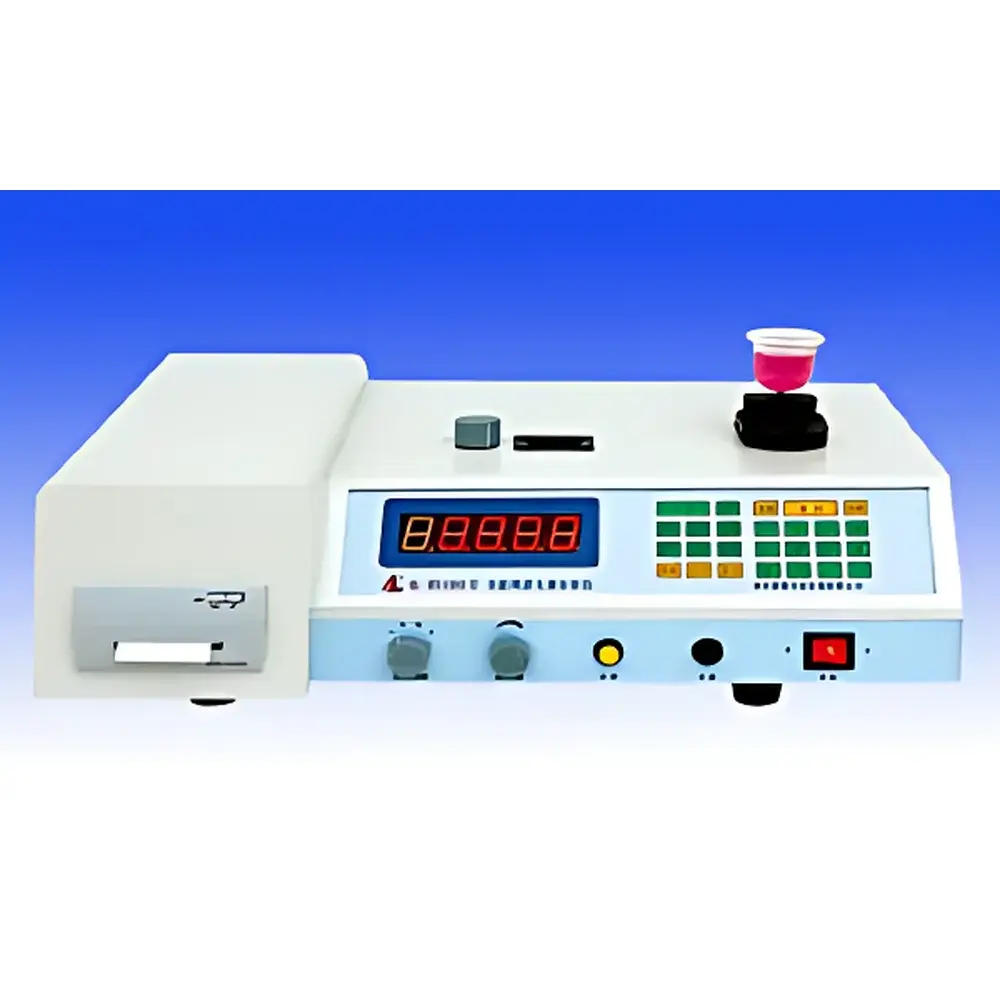
QL–BS1000 Precision Elemental Analyzer
| Brand | QL |
|---|---|
| Model | BS1000 |
| Origin | Jiangsu, China |
| Type | Photometric Elemental Analyzer (Visible Spectrophotometric, External Digestion) |
| Wavelength Range | 400–800 nm (continuously adjustable) |
| Wavelength Accuracy | ±3 nm |
| Analysis Time | ~2 min per sample |
| Measurement Range (typical) | Mn 0.10–15.00%, Si 0.10–5.00%, P 0.005–0.80%, Cr 0.01–25.0%, Ni 0.01–30.0%, Mo 0.101–6.00%, Mg 0.010–0.100%, Rare Earths 0.01–0.100% |
| Compliance | GB/T 223.5–1997 (Si), GB/T 223.59–1987 (P), GB/T 223.63–1988 (Mn) |
| Calibration | 9 stored calibration curves with linear/regression fitting |
| Detection Method | External sample digestion + photometric colorimetry (visible light absorption) |
| Optical System | Cold light source, imported photodetectors, auto-zero & auto-full-scale calibration |
| Control System | Embedded single-chip microcomputer with dedicated membrane keyboard and LED digital display |
| Output | Integrated thermal printer |
Overview
The QL–BS1000 Precision Elemental Analyzer is a benchtop photometric elemental analyzer engineered for rapid, reliable quantification of metallic and semi-metallic elements in ferrous and non-ferrous alloys. It operates on the principle of visible-region spectrophotometric colorimetry: after external acid digestion or chemical development, analyte-specific chromophores are formed in solution; their absorbance at precisely selected wavelengths (400–800 nm, continuously tunable) is measured to determine concentration via Beer–Lambert law correlation. Unlike fixed-wavelength filter photometers, the BS1000’s continuously adjustable optical path enables method flexibility across diverse matrices—eliminating the need for multiple dedicated instruments when analyzing Si, Mn, P, Cr, Ni, Mo, Mg, and rare earth elements in steel, cast iron, aluminum, copper, and brass. Designed for routine QC/QA environments—including foundry floor, incoming material inspection, and finished product verification—the system prioritizes operational robustness, method traceability, and compliance with Chinese national standards (GB/T series), while maintaining compatibility with internationally recognized wet-chemical preparation protocols.
Key Features
- Continuously adjustable wavelength selection (400–800 nm) with ±3 nm accuracy—enabling precise alignment to peak absorption maxima for each element-specific reaction, significantly improving selectivity and reducing interferences.
- Dedicated cold-light illumination system paired with high-stability imported photodetectors ensures minimal thermal drift and long-term photometric repeatability.
- Embedded single-chip microcomputer architecture supports automated data acquisition, real-time calculation of mass fractions, and direct digital display—no external PC required for basic operation.
- Nine user-definable calibration curves stored in non-volatile memory; curve fitting performed via linear or polynomial regression during setup, supporting both single-point and multi-point standardization.
- External digestion workflow eliminates internal fluidic pathways—removing valves, tubing, and pump wear mechanisms that commonly degrade over time in integrated wet-chemistry analyzers.
- Thermal printer output provides auditable hard-copy records with timestamp, sample ID, element, result, and method identifier—supporting GLP-aligned documentation practices.
Sample Compatibility & Compliance
The BS1000 is validated for solid metallic samples requiring classical wet-chemical dissolution (e.g., HCl/HNO₃ for steels; HCl/HF for silicates; aqua regia for Ni-based superalloys). It accommodates standard 10–50 mm pathlength cuvettes and supports variable sample volume inputs (typically 1–5 mL post-digestion). All reported measurement ranges comply with relevant GB/T standards: silicon per GB/T 223.5–1997, phosphorus per GB/T 223.59–1987, and manganese per GB/T 223.63–1988. While not certified to ISO/IEC 17025 or ASTM E3061, its methodology aligns with foundational principles of ISO 6497 (animal feeding stuffs), ISO 11885 (water), and ASTM E1019 (steel analysis), making it suitable for internal quality control where regulatory submission is not mandated. The instrument’s external digestion design inherently avoids cross-contamination risks associated with automated fluid handling—critical for high-mix, low-volume lab environments.
Software & Data Management
Operation is fully self-contained within the embedded firmware: no host PC, drivers, or proprietary software installation is required. All calibration, measurement, and reporting functions are accessed via tactile membrane keypad navigation. Each analysis session stores metadata—including date/time stamp, operator ID (manually entered), curve ID used, and raw absorbance values—in non-volatile memory (retained for ≥10,000 cycles). Thermal printouts include full traceability fields: sample identification, element symbol, measured mass fraction (%), detection limit indicator (if applicable), and pass/fail status relative to pre-set specification limits. For labs requiring electronic data archiving, ASCII-formatted output can be captured via optional RS-232 interface (standard on all units) and parsed into LIMS or Excel using generic terminal emulation—fully compatible with FDA 21 CFR Part 11 audit trail requirements when paired with appropriate laboratory SOPs.
Applications
- Rapid furnace-side composition verification in iron and steel foundries—monitoring Mn, Si, and P for charge correction prior to tapping.
- Incoming raw material inspection for scrap metal recyclers assessing alloy grade conformity (e.g., 304 vs. 316 stainless via Cr/Ni ratio).
- Quality assurance of machined components in automotive and aerospace supply chains—validating residual Mg in Al-Si castings or Mo content in tool steels.
- Research and development labs performing method development for novel alloy systems where spectral interference necessitates fine wavelength tuning.
- Educational institutions teaching classical quantitative analysis—demonstrating Beer–Lambert relationships, calibration curve statistics, and matrix effect mitigation strategies.
FAQ
What sample preparation methods are required before analysis?
Solid metal samples must undergo external acid digestion (e.g., HCl–HNO₃ mixture for carbon steels; HF-containing reagents for high-silicon alloys) followed by colorimetric development using standardized reagents (e.g., ammonium molybdate for phosphorus, ammonium persulfate for manganese). Detailed procedures are provided in the operator manual and aligned with GB/T methodologies.
Can the BS1000 analyze non-metallic elements such as carbon or sulfur?
No. The BS1000 is optimized for metallic and semi-metallic elements detectable via visible-region colorimetric reactions. Carbon, sulfur, nitrogen, and oxygen require combustion-infrared or carrier-gas hot extraction techniques—outside the scope of this photometric platform.
Is the instrument compliant with ISO/IEC 17025 or FDA 21 CFR Part 11?
The hardware and firmware support key technical prerequisites—audit-trail-capable data logging, calibration history retention, and electronic signature-ready output—but formal accreditation requires site-specific validation, documented SOPs, and third-party assessment per ILAC-G8 or FDA guidance. QL provides full technical documentation to facilitate such audits.
How often does the optical system require recalibration?
Auto-zero and auto-full-scale calibration are executed automatically at power-on and before each analysis sequence. Physical wavelength verification using NIST-traceable holmium oxide or didymium filters is recommended quarterly—or after any mechanical shock or ambient temperature shift exceeding ±5°C.
What maintenance is required beyond routine cleaning?
No consumable optics or lamps require periodic replacement. The cold-light source has a rated lifetime exceeding 10,000 hours. Primary maintenance consists of periodic verification of cuvette alignment, cleaning of optical windows with spectroscopic-grade methanol, and annual verification of printed output accuracy against reference standards.






