
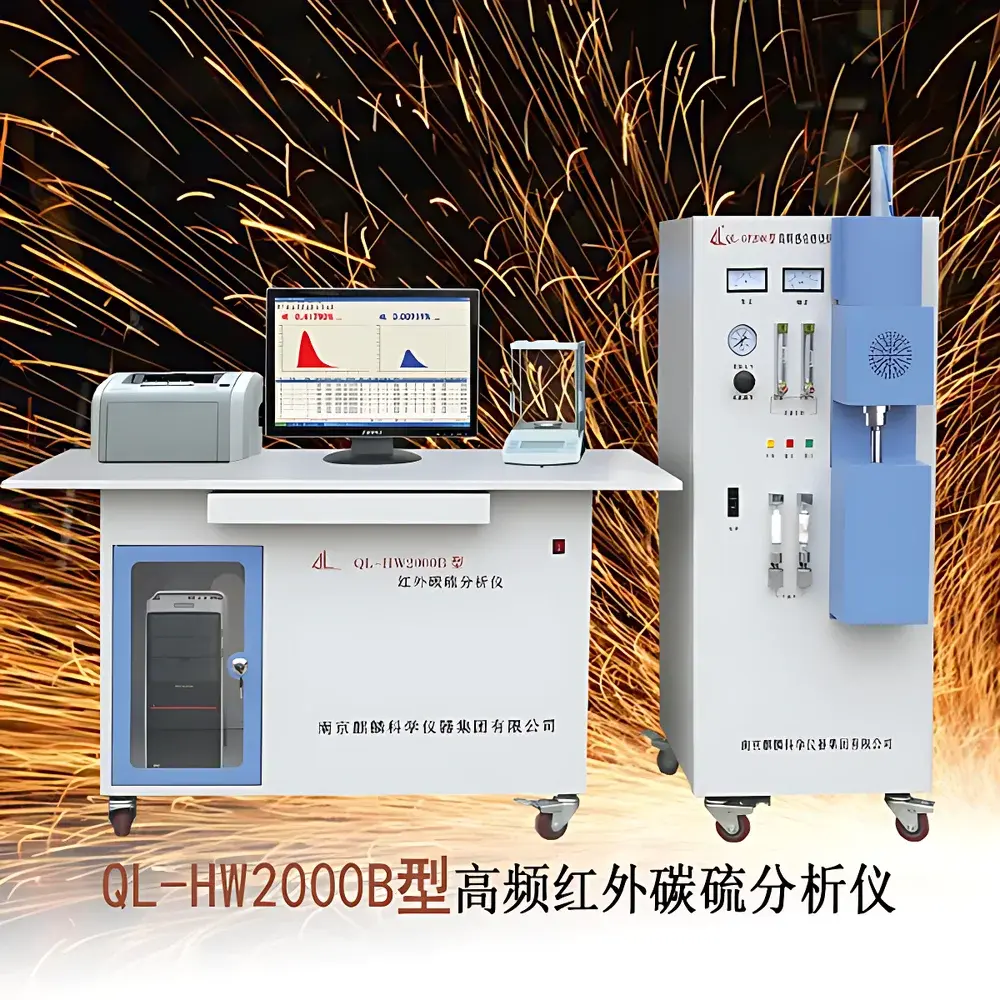
QL HW2000B High-Frequency Infrared Carbon-Sulfur Analyzer
| Brand | QL |
|---|---|
| Origin | Jiangsu, China |
| Manufacturer Type | Authorized Distributor |
| Country of Origin | China |
| Model | Nanjing HW2000B |
| Price Range | USD 7,000–14,000 (FOB) |
| Measurement Principle | Non-Dispersive Infrared (NDIR) Absorption |
| Heating System | High-Frequency Induction Furnace (2.5 kVA, 18–20 MHz) |
| Carbon Range | 0.00001–10.0000 wt% (extendable to 99.999 wt%) |
| Sulfur Range | 0.00001–0.5000 wt% (extendable to 99.999 wt%) |
| Sensitivity | 0.1 ppm (minimum display resolution) |
| Precision | Carbon RSD ≤ 0.5% |
| Analysis Time | 25–60 s (user-adjustable) |
| Compliance | GB/T 20123–2006, ISO 15350:2000 |
| Weighing Accuracy | 0.0001 g (external analytical balance required) |
| Optical Detection | High-stability pyroelectric IR detectors with narrow-band interference filters |
| Gas Handling | Precision mass flow control |
| Mechanical Drive | Aerospace-grade synchronous motor in IR absorption cell (rated >100,000 h MTBF) |
| Compensation | Real-time temperature, pressure, and flow compensation algorithms |
| Architecture | Modular PCB design with isolated signal conditioning and digital filtering |
Overview
The QL HW2000B High-Frequency Infrared Carbon-Sulfur Analyzer is a laboratory-grade elemental combustion analyzer engineered for precise, routine quantification of total carbon (C) and total sulfur (S) in solid inorganic and organic matrices. It operates on the principle of non-dispersive infrared (NDIR) spectroscopy: sample combustion in a high-frequency induction furnace generates CO₂ and SO₂ gases, which are swept through dedicated optical cells where their characteristic absorption bands at 4.26 µm (CO₂) and 7.35 µm (SO₂) are measured via calibrated pyroelectric detectors. The system integrates real-time environmental compensation—temperature, pressure, and carrier gas flow—to maintain measurement integrity across variable lab conditions. Designed for metallurgical QA/QC, geological survey labs, and materials R&D facilities, the HW2000B delivers trace-level sensitivity (0.1 ppm detection limit) and robust reproducibility (RSD ≤0.5% for C, ≤1.0% for S) without requiring cryogenic cooling or vacuum optics.
Key Features
- High-frequency induction furnace (2.5 kVA, 18–20 MHz) with RF-controlled thermal ramping ensures uniform, repeatable combustion across heterogeneous samples—including refractory alloys and high-carbon steels—minimizing incomplete oxidation artifacts.
- Dual-channel NDIR detection architecture with thermally stabilized, narrow-band interference filters eliminates spectral cross-talk between CO₂ and SO₂ bands, critical for accurate sulfur measurement in high-carbon matrices (e.g., cast irons, ferroalloys).
- Pyroelectric infrared detectors optimized for low-noise, wide-dynamic-range response enable simultaneous high-precision analysis of ultra-trace (ppm-level) and high-concentration (up to 99.999 wt%) carbon and sulfur.
- Modular electronic architecture with galvanically isolated analog front-ends and FPGA-based digital signal processing reduces electromagnetic interference from furnace switching transients.
- Aerospace-grade synchronous motor drives the optical chopper in the IR absorption cell, delivering >100,000 hours of maintenance-free operation—critical for unattended overnight batch analysis.
- Integrated mass flow controllers and Airtac solenoid valves (rated for ≥100,000 actuation cycles) ensure stable, pulse-free carrier gas delivery, eliminating baseline drift during extended calibration sequences.
Sample Compatibility & Compliance
The HW2000B accommodates a broad spectrum of solid samples requiring minimal preparation: ferrous and non-ferrous metals (carbon steel, stainless steel, aluminum alloys), mineral ores (iron ore, manganese nodules), ceramics, catalysts, coal and coke, cement clinker, slag, and organic polymers. Sample mass ranges from 0.1 g to 1.0 g (dependent on expected C/S content), weighed externally using an analytical balance with ≥0.1 mg readability. All measurements comply with ISO 15350:2000 (Steel and iron — Determination of total carbon and sulfur content — Infrared absorption method after combustion in an induction furnace) and GB/T 20123–2006, supporting audit-ready reporting for GLP and ISO/IEC 17025-accredited laboratories. Optional data archiving modules support 21 CFR Part 11-compliant electronic signatures and audit trails when integrated with validated LIMS environments.
Software & Data Management
The embedded Windows-based control software provides full instrument configuration, method development, real-time spectral visualization, and automated calibration curve generation (linear, quadratic, or multi-point weighted). Raw detector voltage traces, combustion profiles, and gas flow logs are stored in open CSV format for third-party statistical analysis. Calibration management includes bracketing standards, drift correction, and memory of up to 50 user-defined methods with parameter locking. Data export supports ASTM E1382-compliant report templates, including uncertainty estimation per GUM (Guide to the Expression of Uncertainty in Measurement). Firmware updates are delivered via secure HTTPS with SHA-256 signature verification.
Applications
- Metallurgical process control: Rapid verification of carbon equivalence in stainless steel melts and sulfur segregation in continuous-cast billets.
- Mineral resource evaluation: Quantification of organic carbon in coal seams and pyritic sulfur in sulfide-rich ores for acid mine drainage modeling.
- Cement and refractory manufacturing: Monitoring free carbon in kiln feed and sulfate impurities in clinker to optimize burnability and strength development.
- Environmental testing labs: Total sulfur determination in fly ash and scrubber sludge per EPA Method 5050B-equivalent protocols.
- Research applications: Coupling with isotopic ratio monitoring (via optional CO₂/SO₂ pre-concentration) for δ¹³C and δ³⁴S studies in geochemical samples.
FAQ
What sample types require flux addition prior to analysis?
Fluxes (e.g., tungsten oxide, tin oxide) are recommended for low-conductivity samples such as ceramics, quartz, and certain polymers to ensure complete combustion and prevent crucible carryover.
Is external calibration gas required for daily operation?
No—calibration is performed using certified solid reference materials (e.g., NIST SRM 1251, 1253, 1260); zero gas (high-purity O₂) and span gases are only needed for initial factory verification or detector linearity validation.
Can the system be integrated into an automated sample introduction workflow?
Yes—the RS-232 and Ethernet interfaces support SCPI command set integration with robotic autosamplers and MES systems; hardware trigger I/O enables synchronization with balance tare signals and furnace ignition.
What maintenance intervals are specified for the IR optical path?
The sealed absorption cells require no routine cleaning; annual verification of detector responsivity and filter transmission is recommended using built-in diagnostic routines and NIST-traceable reference cells.
Does the analyzer meet requirements for ISO/IEC 17025 accreditation?
Yes—full traceability documentation, uncertainty budgets, and IQ/OQ/PQ protocol templates are provided; the system supports GLP-compliant electronic record retention with role-based access control and immutable audit logs.






