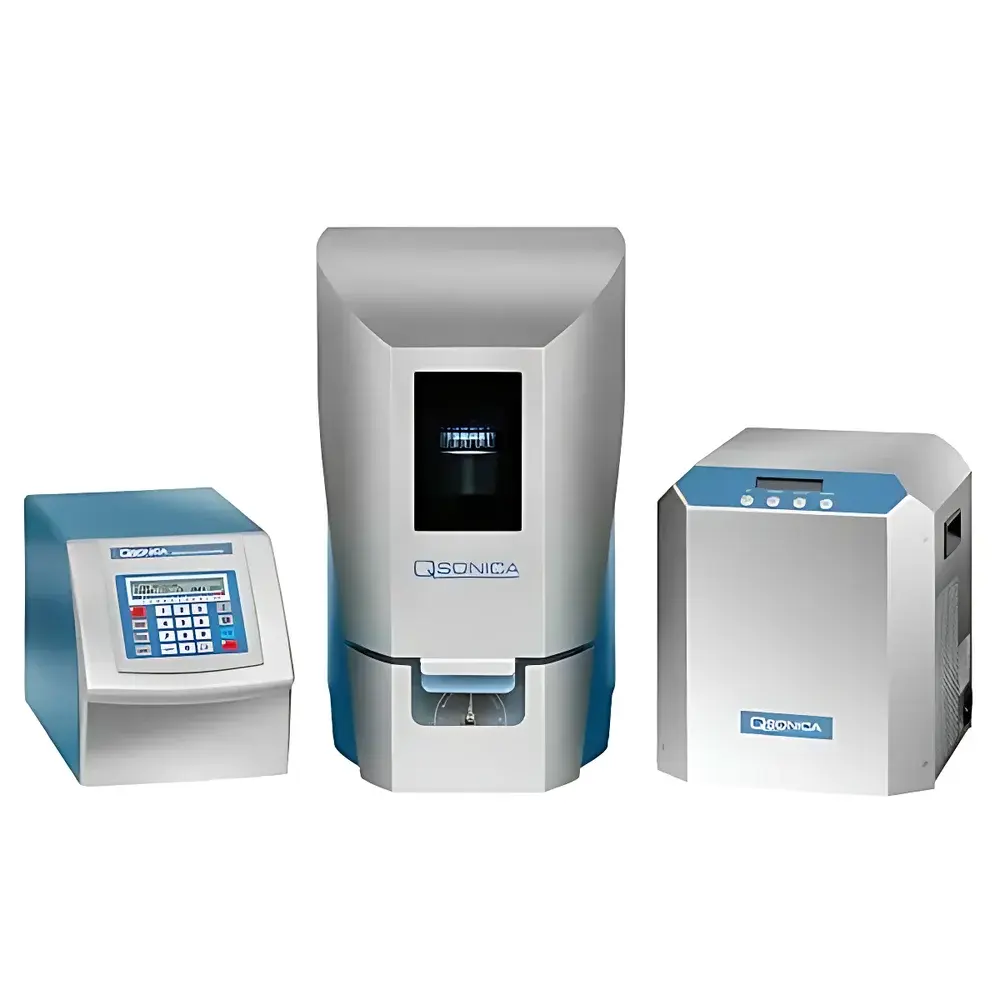
Qsonica Q800R3 DNA Shearing Ultrasonic Disruptor
| Brand | Qsonica LLC |
|---|---|
| Origin | USA |
| Model | Q800R3 |
| Instrument Type | Ultrasonic Cell Disruptor |
| Ultrasonic Power | 750 W |
| Operating Frequency | 20 kHz |
| Temperature Range | 2–45 °C |
| Sample Volume per Tube | < 50 µL |
| Maximum Sample Capacity | 36 tubes |
| Compatible Adapters | 8 × 1.5 mL, 12 × 0.5 mL, 18 × 0.2 mL |
Overview
The Qsonica Q800R3 DNA Shearing Ultrasonic Disruptor is a precision-engineered, benchtop sonication system designed specifically for controlled chromatin and genomic DNA fragmentation in next-generation sequencing (NGS) library preparation workflows. It operates on the principle of high-intensity focused ultrasound delivered via a cup-horn transducer—enabling non-contact, bath-based sonication that eliminates probe-to-sample contamination and ensures consistent energy transfer across all samples. Unlike conventional probe-based sonicators, the Q800R3 subjects samples to uniform acoustic cavitation within a temperature-controlled water bath while rotating at low, programmable speeds. This rotational motion ensures isotropic exposure of nucleic acid complexes to ultrasonic shear forces, resulting in reproducible fragment size distributions essential for ChIP-seq, ATAC-seq, RNA-seq, and whole-genome sequencing applications. The system integrates seamlessly into GLP- and GMP-aligned molecular biology laboratories where traceability, process consistency, and compliance with ISO/IEC 17025 and FDA 21 CFR Part 11 requirements are critical.
Key Features
- Non-contact cup-horn transducer architecture minimizes cross-contamination and eliminates probe wear or sample heating from direct contact
- Motor-driven, low-speed sample rotation (programmable RPM) ensures uniform shearing across all positions in the adapter rack
- Digital control interface with real-time display of amplitude (%), pulse-on/pulse-off timing, total elapsed time, and water bath temperature
- Integrated thermoelectric cooling circulator maintains bath temperature stability within ±0.5 °C over extended runs (2–45 °C range)
- Hermetically sealed, transparent acoustic chamber with internal LED illumination and gas-spring-assisted hinged lid for safe, ergonomic access
- Magnetic sample tube holder design enables rapid, tool-free loading and unloading of adapters
- Modular adapter system supports up to 36 tubes simultaneously—including configurations for 0.2 mL, 0.5 mL, and 1.5 mL microcentrifuge tubes
- Advanced software features include degassing mode (to remove dissolved gases prior to sonication) and pause/resume functionality for protocol optimization
- Compliant with Illumina-validated NGS fragmentation protocols and referenced in MilliporeSigma’s Magna ChIRP™ kit documentation for chromatin shearing
Sample Compatibility & Compliance
The Q800R3 accommodates a broad range of biological sample types—including crosslinked chromatin, native nucleosomes, purified genomic DNA, and RNA-protein complexes—without requiring optimization of probe geometry or insertion depth. Its non-contact configuration inherently supports low-volume processing (down to 5 µL per tube) and avoids foaming or aerosol generation associated with probe sonication. All wetted components are constructed from chemically resistant, autoclavable materials compliant with USP Class VI standards. The system meets CE marking requirements for laboratory equipment and conforms to IEC 61000-6-3 (EMC) and IEC 61000-6-2 (immunity). For regulated environments, audit trails, user access controls, and electronic signature support can be implemented via optional Qsonica Control Software v3.x, aligning with 21 CFR Part 11 and ALCOA+ data integrity principles.
Software & Data Management
The embedded digital controller stores up to 99 user-defined protocols with full parameter logging—including amplitude setpoint, duty cycle, total sonication duration, and thermal history. Optional PC-connected software provides export of timestamped CSV logs, graphical visualization of real-time temperature and power delivery, and batch report generation suitable for SOP documentation and regulatory submissions. Data files include metadata such as operator ID, instrument serial number, and calibration status—facilitating traceability in clinical research and diagnostic development settings.
Applications
- Chromatin immunoprecipitation followed by sequencing (ChIP-seq) and CUT&RUN/CUT&Tag
- ATAC-seq library preparation requiring sub-100 bp fragments
- RNA fragmentation for stranded RNA-seq and ribosome profiling
- Preparation of sheared DNA for Illumina, PacBio, and Oxford Nanopore library construction
- Cell lysis and nuclear extraction under native or denaturing conditions
- Protein complex dissociation and epitope retrieval in chromatin biochemistry
FAQ
Is the Q800R3 validated for use with Illumina sequencing platforms?
Yes—the Q800R3 is explicitly cited in Illumina’s published NGS workflow documentation as an approved instrument for DNA shearing prior to library construction.
Can the system process samples at sub-zero temperatures?
No—the operational temperature range is strictly 2–45 °C; sub-ambient cooling is achieved via thermoelectric circulation, not cryogenic refrigeration.
Does the Q800R3 support 96-well plate formats?
Not natively; however, third-party custom adapters compatible with deep-well plates may be evaluated for feasibility under Qsonica’s application support program.
What maintenance is required for long-term reliability?
Annual verification of transducer resonance frequency, calibration of temperature sensors, and inspection of circulator pump performance are recommended per Qsonica’s Preventive Maintenance Guide.
How does rotational speed affect fragment size distribution?
Empirical studies show that consistent low-RPM rotation (e.g., 10–20 rpm) reduces positional bias and narrows fragment size standard deviation by ≥35% compared to static bath sonication.
Related Products