
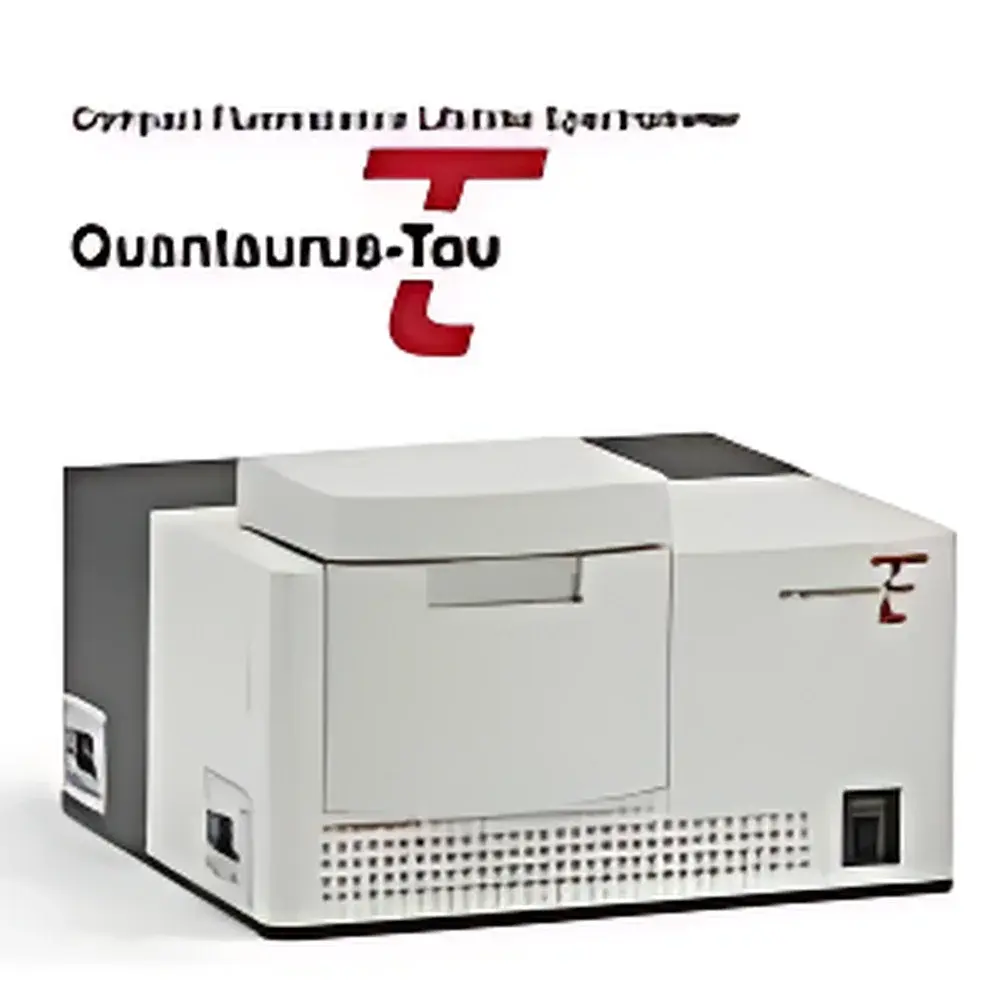
Quantaurus-Tau Fluorescence Lifetime Spectrometer
| Origin | Japan |
|---|---|
| Manufacturer Type | Authorized Distributor |
| Origin Category | Imported |
| Model | Quantaurus-Tau |
| Pricing | Upon Request |
Overview
The Quantaurus-Tau Fluorescence Lifetime Spectrometer is a turnkey time-resolved photoluminescence measurement system engineered for high-precision fluorescence lifetime analysis across the picosecond to millisecond temporal range. It operates on the principle of time-correlated single-photon counting (TCSPC), a gold-standard technique in ultrafast optical spectroscopy that delivers exceptional timing resolution and photon detection efficiency. By exciting samples with pulsed laser sources (typically diode or solid-state lasers with pulse widths <100 ps) and recording the arrival times of individual emitted photons relative to the excitation trigger, the system reconstructs decay kinetics with statistical fidelity. This enables quantitative deconvolution of multi-exponential decay profiles—critical for distinguishing coexisting emissive species, probing energy transfer pathways, and characterizing excited-state dynamics in heterogeneous or complex molecular systems. Designed for routine laboratory use, the Quantaurus-Tau integrates excitation optics, wavelength selection, time-gated detection, and data acquisition into a thermally stabilized, vibration-damped platform suitable for both ambient and cryogenic environments.
Key Features
- Time resolution <50 ps (instrument response function full width at half maximum), enabling resolution of ultrafast non-radiative relaxation processes
- TCSPC architecture with high quantum-efficiency hybrid photomultiplier tubes (HPMTs) or superconducting nanowire single-photon detectors (SNSPDs) for sub-nanosecond gating and low dark count rates
- Integrated liquid nitrogen cryostat support for temperature-controlled measurements from 77 K (–196 °C) to 300 K, preserving sample integrity during low-temperature phosphorescence studies
- Simultaneous acquisition of time-resolved fluorescence spectra and anisotropy decays, supporting rotational diffusion analysis and molecular conformational dynamics
- Modular optical path with selectable excitation wavelengths (266 nm–640 nm) and emission grating spectrometers (1200 grooves/mm, 200–1100 nm range)
- Automated sample chamber with motorized XYZ stage, quartz cuvette holders, and optional solid-sample mounting fixtures
Sample Compatibility & Compliance
The Quantaurus-Tau accommodates a broad spectrum of optically active materials—including small-molecule fluorophores, organometallic complexes, conjugated polymers, quantum dots, fluorescent proteins, perovskite thin films, and semiconductor nanocrystals—in solution, thin-film, powder, or frozen matrix formats. Its design conforms to ISO/IEC 17025 requirements for analytical instrument validation and supports GLP-compliant workflows through audit-trail-enabled software logging. Data acquisition and processing comply with FDA 21 CFR Part 11 guidelines when configured with electronic signature modules and role-based access control. All optical components meet RoHS and CE safety directives; laser subsystems are Class 1 enclosed per IEC 60825-1.
Software & Data Management
Control and analysis are executed via the proprietary Tau Analysis Suite—a Windows-based application featuring intuitive workflow wizards, real-time decay preview, global fitting algorithms (Levenberg–Marquardt, singular value decomposition), and batch-processing capabilities. The software exports decay traces, lifetime distributions (e.g., intensity- vs. amplitude-weighted lifetimes), spectral deconvolution results, and anisotropy parameters in ASCII, CSV, and HDF5 formats. Integrated metadata tagging ensures traceability of instrument settings, calibration history, environmental conditions, and user annotations. Raw TCSPC histograms are stored in industry-standard .ptu format (PicoQuant Time-Tagged Time-Resolved), enabling cross-platform compatibility with third-party analysis tools such as SymPhoTime, FluoFit, or custom Python/Matlab scripts.
Applications
- Charge transfer kinetics and intramolecular energy migration in transition metal complexes (e.g., Ir(III), Ru(II), Pt(II) emitters)
- Förster resonance energy transfer (FRET) efficiency quantification in biomolecular constructs and biosensors
- Triplet-state characterization and delayed fluorescence mechanisms in thermally activated delayed fluorescence (TADF) emitters for OLED development
- Defect-state mapping and carrier recombination dynamics in perovskite and organic photovoltaic absorbers
- Conformational heterogeneity analysis of fluorescently labeled proteins via time-resolved anisotropy
- Photostability assessment and degradation pathway identification under controlled irradiation protocols
FAQ
What is the minimum detectable lifetime using the Quantaurus-Tau?
The system reliably resolves lifetimes down to ~30 ps, limited primarily by the instrument response function and excitation pulse width—not by detector electronics.
Can the system measure phosphorescence lifetimes in air-sensitive samples?
Yes—when coupled with a glovebox-integrated sample chamber or sealed cryostat insert, it supports inert-atmosphere phosphorescence measurements up to several seconds.
Is spectral deconvolution supported for overlapping emission bands?
Yes—the software includes multi-wavelength global analysis, allowing simultaneous fitting of decay profiles across the entire emission spectrum to extract component-specific lifetimes and spectra.
Does the system support time-resolved emission spectra (TRES) acquisition?
Yes—TRES mode captures full emission spectra at user-defined delay windows post-excitation, enabling visualization of spectral evolution during decay.
How is calibration performed for lifetime accuracy?
System calibration uses reference standards with certified lifetimes (e.g., Rhodamine B in ethanol: τ ≈ 4.1 ns; Coumarin 153: τ ≈ 4.8 ns) and IRF measurement via scattered laser light or reflective scatterers.






